Malaysian trumpet snail
Melanoides tuberculata
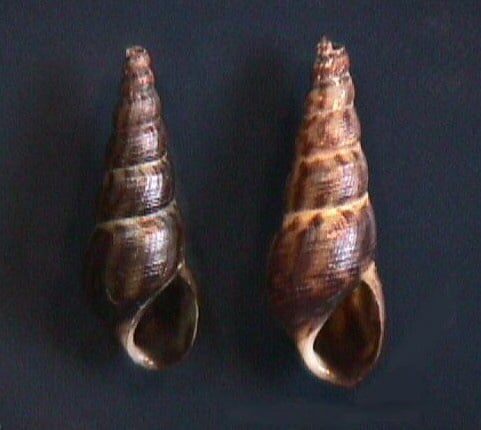
The Malaysian trumpet snail lives partly in the substrate and is consequently easy to underestimate. Melanoides tuberculata searches for edible organic material and often becomes more visible when the tank is quiet or dark. Numbers can expand rapidly with abundant food. It is neither a maintenance tool to add without thought nor automatic evidence that an aquarium has failed. Suitable substrate, controlled feeding and population observation belong to its care. This guide addresses the biological species; other elongated aquarium snails are not given the same identity merely because their shells look similar.
Plan your aquarium →At a glance
- Temperature
- 20–28 °C
- pH
- 7.0–8.5
- KH
- At least 3 °dKH
- Difficulty
- Easy
- Diet
- Herbivore
- Plant safety
- With caution
- Adult size
- Approximately 2–3 cm
- Swimming zone
- Bottom
- Temperament
- Peaceful, Forages on and in the substrate
- Cover
- Suitable plants, Wood
Figures are cautious husbandry guidance, not a full stocking calculation. Missing values are insufficiently supported. Read layout, water and pairing conditions together.
About this species
The narrow coiled shell has several whorls and often brownish markings. Adults usually reach a few centimetres, depending partly on population and conditions. Melanoides tuberculata is the usual scientific name; tuberculatus appears in older image labels. Shell characters aid identification, but damaged specimens may be difficult to distinguish from relatives. The species has an operculum. Do not confuse it with large Tylomelania, which can have different habits and requirements.
Natural habitat
This snail is widespread in warm regions and has spread beyond its original distribution. It uses varied waters and spends much time in or on sediment. Accessible fine substrate is therefore more useful than a tank consisting entirely of large sharp stones. Its presence does not automatically keep the substrate healthy or demonstrably prevent every waste problem. Maintenance and sensible loading remain necessary. Never release animals, occupied substrate or aquarium water containing snails outdoors.
Aquarium and layout
Provide a mature aquarium with accessible sand or fine gravel. Avoid repeatedly disturbing the entire substrate and plant roots. Feed carefully in small aquaria because available food can quickly support population growth. No precise social minimum is required; numbers must fit the system. Check equipment and filter parts for small snails when moving them. A single introduced animal may be sufficient to establish a population.
Water conditions
Stable tropical conditions around 20–28 °C provide a practical maintenance range. Broad tolerance does not establish optimal care at extremes. Neutral to slightly alkaline water with minerals supports suitable shell conditions. Check GH and KH if erosion or sudden abnormal behaviour occurs. An unexpected mass movement upwards warrants investigation of oxygen and water quality, but snails are not calibrated measuring instruments. Do not adjust chemistry based solely on one visible animal.
Behaviour and group size
These snails burrow and search among substrate particles, so only part of a population may be visible by day. More animals on glass after feeding differs from a sudden mass exodus from the substrate. Assess time, maintenance and measurements together. They do not actively hunt healthy fish or establish crayfish-like territories. Burrowing may disturb delicate newly planted stems; check loose roots and recent planting.
Feeding
They consume growth and edible organic material, including leftovers. Unlimited feeding is still inappropriate. Feed other inhabitants properly without creating sustained excess. If targeted supplementation is needed, check consumption and remove remains. Rising numbers may prompt a review of overall feeding, but do not prove one particular error. Snails turn food into biomass and waste; they do not make nutrients disappear from the aquarium.
Breeding
Many populations reproduce without mating and release live young. One animal can therefore start a lasting population. Ordinary freshwater may support reproduction without a saltwater larval stage. Numbers and speed depend on conditions, so no fixed production figure is provided. Control unwanted expansion primarily through sensible food management and selective removal, not by starving the entire aquarium or treating it indiscriminately.
Keeping with fish
Peaceful fish that ignore snails may fit. Snail-eating fish can take smaller animals or repeatedly injure larger ones. Do not add such fish solely as control measures: they have their own space, group and feeding needs. Inability to crack a shell does not prevent picking at the foot. Compatibility cards therefore assess disturbance and shared substrate use as well as predation. Sheltered ground does not turn an unsuitable hunter into a safe partner.
Keeping with other invertebrates
Peaceful grazing shrimp may coexist when their water needs match. More substrate life does not automatically require unlimited extra food. Competition with Clithon and other snails remains possible even if their favoured surfaces differ. Crayfish may catch snails and are not generally safe partners. Shell condition needs attention in very soft acidic Caridina water. A combination overlapping only at one boundary is not a robust long-term choice.
Exoskeleton, shell and minerals
The shell grows continuously and is not shed. Examine new growth separately from existing damage. Minerals matter, but calcium products are not recommended without investigating conditions. Check chemistry, food and possible attacks. Old damaged whorls do not become new after an additive. Avoid rapid correction and do not treat shell damage automatically as though it were a shrimp moulting problem.
Possible problems
Sudden mass activity above the substrate calls for checks of oxygen, filtration and water quality. Rapid population expansion warrants a feeding and maintenance review rather than immediate chemical intervention. Snail treatments may harm other invertebrates, while dying animals increase loading. No control dose is prescribed here. Inspect plants and equipment before transfer to other tanks. Recurrent losses or unusual behaviour need assessment of the aquarium as a whole.
Keeping with other species

Neon tetra
Suitable with conditionsA shell does not protect the extended foot and tentacles. End the combination after persistent withdrawal or injuries. Neon tetras are not specialised snail predators. Check uninterrupted grazing and especially the cooler, softer fish profile; meeting at one boundary provides little margin.
View species profile →
Pygmy cory
SuitableA shell does not protect the extended foot and tentacles. End the combination after persistent withdrawal or injuries. Pygmy corys are not specialised shell-crushers, but share bottom space and food. Retain the fish group and ensure the snail can graze quietly.
View species profile →
Siamese fighting fish
Suitable with conditionsRisk of injury to snailsA shell does not protect the extended foot and tentacles. End the combination after persistent withdrawal or injuries. A betta may deliberately hunt or pick at exposed parts. Individuals differ; dense plants and shells do not guarantee protection. Separation must be possible.
View species profile →
Freshwater angelfish
Not recommendedRisk of injury to snailsA shell does not protect the extended foot and tentacles. End the combination after persistent withdrawal or injuries. Adult angelfish are large and territorial and can seize smaller animals. Predation, picking and moulting vulnerability matter despite water overlap; their own large aquarium is still required.
View species profile →
Guppy
SuitableA shell does not protect the extended foot and tentacles. End the combination after persistent withdrawal or injuries. Guppies are not specialised snail predators and their water often suits snails better than very acidic breeding water. Still watch for picking at foot or tentacles and competition for growth.
View species profile →
Tiger shrimp
Suitable with conditionsQuiet behaviour helps, but choose stable water supporting the shell and the shrimp line. Monitor population and food.
View species profile →Suitable plants

Dwarf Anubias
Sturdy Anubias leaves and roots provide grazing surfaces and shelter. Attach the rhizome rather than burying it. Anchor new plants; burrowing or movement may dislodge loose roots.
- Light
- Low, Moderate
- CO₂
- CO₂ injection not needed

Java fern
Java fern on wood offers lasting leaves and cover. Keep the rhizome exposed and leave access for maintenance and feeding. Anchor new plants; burrowing or movement may dislodge loose roots.
- Light
- Low, Moderate
- CO₂
- CO₂ injection not needed

Green wendtii crypt
The Cryptocoryne wendtii rosette shelters the substrate. Let roots establish and retain an open feeding route alongside it. Anchor new plants; burrowing or movement may dislodge loose roots.
- Light
- Low, Moderate
- CO₂
- CO₂ injection not essential
Sources & review
This care guide draws on several specialist sources and was last checked on .