Ocellaris clownfish
Amphiprion ocellaris

The ocellaris clownfish is a small reef fish with a strong attachment to its home. Its orange body and three white bars are familiar, but a fixed refuge and social hierarchy matter more for its care. An established pair often stays near one corner or shelter and may firmly repel intruders. Away from that territory, many calm, differently shaped reef fish can be considered. Prefer traceable captive-bred fish that are already feeding well. An anemone is not essential: suitable shelter in a stable aquarium can provide a good home without one. Availability does not make this a fish for a newly filled tank. Start with a biologically mature system and reserve space for adults. Two randomly selected fish are not necessarily a compatible pair. Observe their individual feeding and behaviour, and be prepared to separate a bullied animal.
Plan your aquarium →At a glance
- Adult size
- Approximately 11 cm
- Aquarium length
- At least 80 cm
- Minimum aquarium volume
- At least 80 L
- Temperature
- 24–26 °C
- Specific gravity (SG at 25 °C)
- 1.024–1.026 SG
- Salinity
- 32–35 ppt
- pH
- 8.1–8.3
- Difficulty
- Easy
- Temperament
- Territorial
- Diet
- Omnivore
- Swimming zone
- Middle
- Reef safety
- Generally reef safe
- Suitable for beginners
- Conditional
- Social needs
- Pair
- Keeping conspecifics
- Only a confirmed compatible pair, Territorial toward conspecifics
Cautious husbandry guidance for adults, not a complete stocking calculation. Assess tank length, layout and the entire community together.
About this species
Amphiprion ocellaris belongs to the damselfish family. Plan for an adult around eleven centimetres long; dominant females in particular can become substantial. The similar Amphiprion percula is a different species, and captive colour variants are not reliable identification keys. Buy by confirmed species and provenance rather than colour alone. In a social unit, the largest dominant individual is female. Sex development is linked to hierarchy, so putting two large dominant fish together is an unnecessary risk.
Natural habitat
This species occurs in the tropical eastern Indian Ocean and western Pacific. In nature, a suitable host anemone provides a secure home among reef structures. This helps explain the fish's attachment to a familiar location. Provide a sheltered area with gentle water movement and adjacent room to intercept food. A completely bare aquarium offers fewer opportunities for this behaviour. The natural association does not make every anemone an appropriate host; anemones have their own demanding requirements.
Aquarium and layout
Treat eighty litres and eighty centimetres of length as a cautious starting threshold for a simple setup, not permission to stock a crowded community. A pair with other fish benefits from more width and volume. Secure the rocks, provide several escape routes and prevent the home territory from blocking every passage. Protect pump openings and retain calmer areas outside direct jets. Fit a lid. Confirm biological maturity before adding the fish; equipment and water alone do not establish a working biological filter.
Water conditions
Stable tropical seawater matters more than chasing an exact number every day. Use the checked ranges in the overview when assessing the whole community. Measure temperature, pH and salinity with suitable calibrated equipment. Replace evaporation with suitable fresh water because salt remains behind. Check ammonia/ammonium and nitrite, especially after stocking changes or filter problems, and follow nitrate over time. Do not use fish to cycle an immature aquarium. Calcium and magnesium dosing is not a separate dietary recommendation for this clownfish.
Behaviour and group size
Defending a home is not automatically abnormal. A pair may become more defensive around eggs. It becomes a welfare problem when neighbours cannot pass a refuge, are constantly chased or lose access to food. Break sightlines so they can move out of view. A small aquarium with one central rock offers few alternatives. Intervene when harassment persists instead of waiting for injuries.
Feeding
This omnivore needs both animal and plant-derived nutrients. A complete marine food that fits the mouth can form the staple diet. Offer small portions that can be captured while sinking slowly, and vary the diet with suitable frozen foods such as appropriately sized mysis or enriched Artemia. Initially retain food familiar to captive-bred fish. Watch both animals eat: a dominant partner may consume an apparently generous portion alone. Leftovers become waste rather than a useful food reserve.
Reef safety
Ocellaris clownfish are generally reef safe because coral tissue is not their usual food. However, repeated rubbing or occupation can irritate a chosen coral, particularly a small or newly introduced colony. Buying an anemone to lure the fish away is not a guaranteed solution. The category assessments distinguish a generally low risk from insufficient specific evidence. Reef safety does not guarantee individual behaviour or adequate space for the complete community.
Keeping with other fish
Calm cardinalfish or a bottom-dwelling goby may fit if they can stay clear of the territory and obtain food. Timid firefish need their own secure refuge. Avoid another clownfish species in a restricted aquarium and be cautious with dominant wrasses or large predators. The assessed pairings are individual relationships. Four suitable cards are not permission to add all four species together: total space, territories and introduction order still matter.
Keeping with invertebrates
Large adult cleaner shrimp and common reef snails are often kept with this fish. Tiny ornamental shrimp and newly hatched young require separate consideration around an opportunistic feeder. Shelter can reduce risk without proving safety. Assess the reverse direction too: a large crab may threaten a sleeping fish. A fish-to-crab risk assessment is therefore not a complete declaration of mutual compatibility. Poorly documented groups remain explicitly uncertain.
Breeding
Captive breeding is well established. A compatible pair can lay eggs on a clean hard surface near its home, with the male tending the clutch. Newly hatched larvae have very different requirements from adults, including suitably small live starter foods and separately managed rearing conditions. Eggs in a community aquarium do not mean that young will survive without preparation. Leave the pair undisturbed and do not use spawning as a reason to add more fish to an already defended territory.
Possible problems
Watch for rapid breathing, skin changes, prolonged hiding and sudden refusal of familiar food. Check water quality, temperature, equipment and possible bullying first. Staying near a familiar corner can be normal; a marked behavioural change deserves investigation. New fish may carry pathogens without obvious signs, so discuss suitable quarantine with a specialist. Do not medicate a reef aquarium indiscriminately, especially with copper products that can harm invertebrates. Retain a practical way to house an injured or bullied fish separately.
Keeping with other species

Royal gramma
Suitable with conditionsSeparate permanent refuges and provide several escape routes. Outside defended caves or breeding territories, these different ways of life can coexist.
View species profile →
Firefish
Suitable with conditionsThe timid fish must feed near its refuge without being chased. An established territorial neighbour can make the pairing unsuitable; introduction and observation are decisive.
View species profile →
Banggai cardinalfish
SuitableSeparate permanent refuges and provide several escape routes. Outside defended caves or breeding territories, these different ways of life can coexist.
View species profile →
Pajama cardinalfish
SuitableSeparate permanent refuges and provide several escape routes. Outside defended caves or breeding territories, these different ways of life can coexist.
View species profile →
Blue-green chromis
Suitable with conditionsThe chromis group needs open water and its own minimum group size. Distribute small portions so the calmer neighbour is not consistently outcompeted.
View species profile →
Yellow tang
Suitable with conditionsThe tang sets a much greater minimum length and needs clear swimming lanes. Give the smaller neighbour cover and a feeding area outside the busy route.
View species profile →
Regal tang
Suitable with conditionsThe tang sets a much greater minimum length and needs clear swimming lanes. Give the smaller neighbour cover and a feeding area outside the busy route.
View species profile →
Coral beauty angelfish
Suitable with conditionsThe dwarf angelfish actively searches rockwork and may claim its neighbour’s refuge. Several separate rock routes and checks on food intake are needed.
View species profile →
Flame angelfish
Suitable with conditionsThe dwarf angelfish actively searches rockwork and may claim its neighbour’s refuge. Several separate rock routes and checks on food intake are needed.
View species profile →
Yellow watchman goby
Suitable with conditionsThe bottom-dweller needs its own safe sandy area and targeted feeding. Keep rock foundations stable and prevent a territorial neighbour from blocking the refuge.
View species profile →
Diamond watchman goby
Suitable with conditionsThe bottom-dweller needs its own safe sandy area and targeted feeding. Keep rock foundations stable and prevent a territorial neighbour from blocking the refuge.
View species profile →
Yellow clown goby
Suitable with conditionsThe small coral goby must not be excluded from perches or fine food. Provide separate refuges; its separate SPS warning still applies.
View species profile →
Tailspot blenny
Suitable with conditionsThe blenny must retain grazing surfaces and resting holes. Shared use of rockwork can cause conflict; monitor its condition and actual food intake.
View species profile →
Six-line wrasse
Not recommendedThe six-line wrasse may intimidate this calmer or site-attached neighbour and intercept food. Not a default pairing; space alone does not guarantee freedom from persistent aggression.
View species profile →
Picasso triggerfish
UnsuitableThe adult triggerfish may bite or prey on this much smaller fish. Calm juvenile behaviour is not a reliable basis for long-term cohabitation.
View species profile →Suitable products
Recommended staple foods
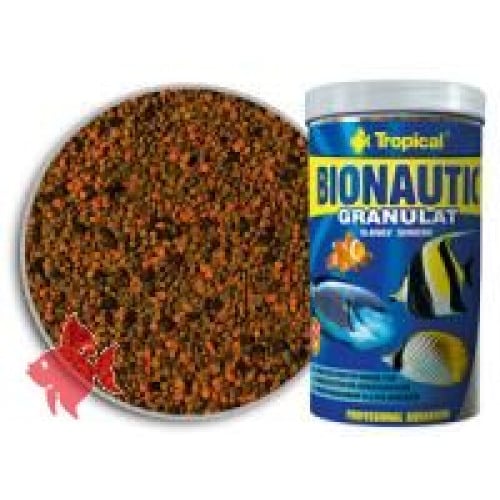
Tropical Bionautic Granulaat 100ml
Marine granulate for daily feeding; the manufacturer explicitly lists this species. Offer small portions and observe feeding. An exact grain diameter is not documented; this is not larval food.
Check retailer for price0 retailers
Compare prices
Tropical Bionautic Granulaat 500ml
Marine granulate for daily feeding; the manufacturer explicitly lists this species. Offer small portions and observe feeding. An exact grain diameter is not documented; this is not larval food.
Check retailer for price0 retailers
Compare pricesSupplementary foods
No sufficiently verified product advice is available for this feeding category yet. Follow the feeding guide; an absent product card does not mean this food is unnecessary.
Grazing food
No sufficiently verified product advice is available for this feeding category yet. Follow the feeding guide; an absent product card does not mean this food is unnecessary.
Prices from the latest retailer update, excluding shipping. Check stock and delivery with the retailer.
Sources & review
This care guide draws on several specialist sources and was last checked on .