Blue-green chromis
Chromis viridis

Blue-green chromis bring movement to open water and can hover attractively above a reef in a suitable group. Chromis viridis is a small blue-green damselfish, but the idea of a trouble-free school in every aquarium is too simple. Individuals need room to swim, eat and take shelter. Hierarchy and feeding competition can change even when a new group initially seems calm. OATA recommends group keeping with considerably more space than for one small damselfish. This guide therefore uses a spacious group profile rather than a tiny tank for one inexpensive fish. Choose a mature stable system with open water and distributed cover. Do not repeatedly replace losses or aggression casualties with more fish. First investigate why the group is unstable and observe every individual at each feeding.
Plan your aquarium →At a glance
- Adult size
- Approximately 10 cm
- Aquarium length
- At least 120 cm
- Minimum aquarium volume
- At least 250 L
- Temperature
- 24–26 °C
- Specific gravity (SG at 25 °C)
- 1.024–1.026 SG
- Salinity
- 32–35 ppt
- pH
- 8.1–8.3
- Difficulty
- Moderate
- Temperament
- May compete for food
- Diet
- Omnivore
- Swimming zone
- Middle
- Reef safety
- Generally reef safe
- Suitable for beginners
- Conditional
- Social needs
- School
- Keeping conspecifics
- Group possible with conditions
Cautious husbandry guidance for adults, not a complete stocking calculation. Assess tank length, layout and the entire community together.
About this species
Adults can reach approximately 10 cm. Lighting strongly affects the blue-green appearance. Other Chromis species resemble it, and generic blue or green trade names are insufficient for confident identification. Check Chromis viridis and ask about origin. Although it belongs to the broad family containing many territorial damselfish, their individual care profiles are not interchangeable. Inspect condition and fins before purchase and avoid groups already containing conspicuously thin or isolated fish.
Natural habitat
Groups inhabit tropical Indo-Pacific reefs, taking food from open water above shelter and retreating quickly into structure when threatened. An aquarium therefore needs both swimming space and numerous separate refuges. A compact solid rock wall leaves too little open water, while a bare tank provides too little security. Live branching corals are not compulsory for reproducing the functional arrangement of open water beside cover.
Aquarium and layout
For an initial group use approximately 250 L and 120 cm of length as a cautious lower threshold. OATA already assigns groups substantially more space than a single small damselfish; additional residents may require a larger tank. Create long clear routes above and beside several rock groups. Provide gas exchange and moderate flow carrying fine particles through the water, together with quieter areas and separate resting sites. Final group capacity cannot be calculated from gross litres alone.
Water conditions
Use stable seawater within the central planning ranges. Repeated small meals for a group require attention to waste loading. Check ammonia/ammonium and nitrite after additions or technical problems and monitor nitrate alongside regular maintenance. Match replacement water to temperature and salinity, and replace evaporation with suitable fresh water. A powerful pump does not compensate for inadequate biological maturity. Check oxygen supply and breathing especially when several fish unusually congregate high in the tank.
Behaviour and group size
Fish hovering together do not prove that every group member receives equal rest and food. Watch stragglers, damaged fins and individuals driven repeatedly into a corner. Distribute food at several places so dominant fish cannot control everything. One large portion often fails to improve distribution while burdening the water. Persistent exclusion calls for reassessment of space, group composition and tankmates rather than assuming the schooling appearance demonstrates success.
Feeding
Small water-column food particles form the basis of a varied omnivorous marine ration. An appropriate complete marine food can be the staple, with suitable fine animal foods such as enriched brine shrimp or finely divided mysis for variety. Offer small portions each fish can intercept before they sink out of reach. The manufacturer explicitly names Chromis viridis for Bionautic Granulat, but actual uptake still needs checking in juveniles and small individuals. Nutritional advice is not permission to feed without limit.
Reef safety
Blue-green chromis are generally kept as reef safe. Deliberate coral-tissue feeding is not part of their described normal diet. Group activity and food demand still affect the whole aquarium; a reef can be too small or overstocked despite low coral risk. Tiny plankton-like organisms may be eaten. Evidence gaps for particular invertebrates remain visible so the general label cannot be read as universal safety for every animal.
Keeping with other fish
Quiet cardinalfish may lose out if chromis intercept every portion. An ocellaris or royal gramma needs its own territory away from the group’s route. Large tangs increase the required scale and must retain open swimming room too. Timid firefish can suffer from continual activity. A large triggerfish is not an automatically suitable neighbour. Each pairing requires assessment of the whole community, not just a temperament label on paper.
Keeping with invertebrates
Larger adult reef invertebrates differ from free-swimming offspring or tiny crustacean food particles; assess these stages separately. A breeding setup intended to preserve planktonic larvae does not fit a group of actively feeding chromis. Specific evidence may be insufficient for snails, worms and other categories, which then remain unknown. Consider reverse predation from large crabs and secure resting sites for the fish as well.
Breeding
Reproductive behaviour can include selecting and defending a spawning site. Developing small larvae need specialist rearing and appropriate live food. Eggs therefore do not automatically produce surviving young in the reef. No unsupported home recipe with guaranteed timing or yield is supplied. Increased territorial defence around a clutch may put pressure on other group members and belongs in continuing social monitoring.
Possible problems
Count and inspect individuals daily rather than assessing only the group. Poor condition, isolation, skin injuries or rapid breathing require investigation. Test water, assess food distribution and watch whether a dominant fish displaces others. New arrivals can also introduce disease; do not blindly replace losses with another group. Seek advice about quarantine and diagnosis for recurring problems. Stable grouping depends on adequate space and care, not a fixed number on a sales card.
Keeping with other species

Ocellaris clownfish
Suitable with conditionsThe chromis group needs open water and its own minimum group size. Distribute small portions so the calmer neighbour is not consistently outcompeted.
View species profile →
Royal gramma
Suitable with conditionsThe chromis group needs open water and its own minimum group size. Distribute small portions so the calmer neighbour is not consistently outcompeted.
View species profile →
Banggai cardinalfish
Suitable with conditionsThe chromis group needs open water and its own minimum group size. Distribute small portions so the calmer neighbour is not consistently outcompeted.
View species profile →
Pajama cardinalfish
Suitable with conditionsThe chromis group needs open water and its own minimum group size. Distribute small portions so the calmer neighbour is not consistently outcompeted.
View species profile →Suitable products
Recommended staple foods
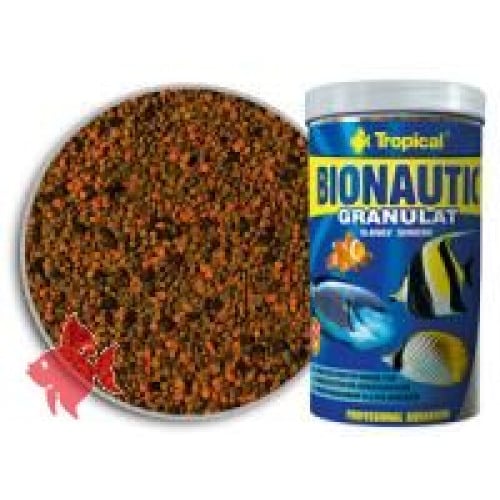
Tropical Bionautic Granulaat 100ml
Marine granulate for daily feeding; the manufacturer explicitly lists this species. Offer small portions and observe feeding. An exact grain diameter is not documented; this is not larval food.
Check retailer for price0 retailers
Compare prices
Tropical Bionautic Granulaat 500ml
Marine granulate for daily feeding; the manufacturer explicitly lists this species. Offer small portions and observe feeding. An exact grain diameter is not documented; this is not larval food.
Check retailer for price0 retailers
Compare pricesSupplementary foods
No sufficiently verified product advice is available for this feeding category yet. Follow the feeding guide; an absent product card does not mean this food is unnecessary.
Grazing food
No sufficiently verified product advice is available for this feeding category yet. Follow the feeding guide; an absent product card does not mean this food is unnecessary.
Prices from the latest retailer update, excluding shipping. Check stock and delivery with the retailer.
Sources & review
This care guide draws on several specialist sources and was last checked on .