Roundleaf rotala
Rotala rotundifolia

Round-leaved rotala (Rotala rotundifolia) is a delicate stem plant for a soft-looking background. The name can be confusing: the round leaves are mainly associated with growth above water, while underwater leaves are narrower. The common species can turn green to pink or reddish, depending on conditions. This guide therefore does not promise a red plant with every lamp and does not discuss a specific color cultivar. A loose grouping provides an attractive contrast to broadleaf rosette plants and wood. For a neat, compact shape, sufficient light, nutrition and regular pruning are more important than an exact color effect. The species can grow in simpler conditions, but a dense, low-kept red forest requires more attention than a green background group. Take these different expectations into account when purchasing.
Plan your aquarium →At a glance
- Difficulty
- Moderate
- Plant height
- 15–50 cm
- Growth rate
- Fast
- Placement
- Background
- Temperature
- 18–28 °C
- pH
- 5.0–8.0
- Light
- Moderate, High
- CO₂
- Optional
- Nutrient uptake
- Through the water column
- Substrate
- Sand, Gravel, Aquasoil
- Propagation
- Cuttings
About this plant
The stems branch after pruning and bear narrow underwater leaves. For the design we use 15–50 cm, depending on maintenance and growth form. The name Rotala indica was often used incorrectly for this species in the trade. That does not mean that both are botanically the same species. Therefore, check the label and the origin of a plant before taking care of another Rotala. Color alone is not a reliable species identification.
Natural habitat
The species has an Asian distribution area with wet locations where the water level can fluctuate. Growth above and below water explains why a nursery plant can produce a different leaf shape after planting. An aquarium is not a copy of one natural growing place. The practical translation is space for light and new shoots, a stable water environment and maintenance that prevents the plant from being overshadowed by its own top layer.
Placement in the aquarium
Place small groups of individual stems in the back or to the side, with open space between the bases. Use 18–28 °C and pH 5–8 as the central care band. A healthy, stable combination with the fish is more important than pursuing an extreme value. Do not leave the shoot tips permanently against the water surface. Place a lower plant in front of it when the lower stem parts remain visible, without completely removing the light there.
Light
Medium to high light suits a compact presentation. The species can also grow under less light, but a looser shape and greener leaves are no surprise. Red coloring is not an independent proof of health. The light on the plant depends on water depth, shade and the width of the lamp. There is no substantiated universal PAR limit for this guide; an unknown lamp is therefore not given a made-up light class.
CO₂
CO₂ addition is optional for the species, but can support a more intensively lit, densely planted layout. Without gas, a calmer growth target remains more realistic. Do not increase light greatly while nutrition and carbon availability lag behind. Anyone who uses an installation carefully adjusts it to the entire aquarium and checks the animals. A commercial photo of a red plant forest is not a prescription to copy the same dosage or light intensity without further context.
Nutrition and fertilisation
Nutrition through the water column must be able to keep up with the formation of new leaves. Check which components the fertiliser used actually contains. A trace element product does not replace missing nitrogen or phosphate. Don't try to force red color by deliberately starving plants; an attractive color is less important than sustainable growth. Assess changes to the new shoot tips and do not adjust multiple individual nutritional products at the same time.
Substrate and root feeding
The stems root in sand, fine gravel or aquasoil. The soil provides anchorage and can contribute nutrition, but the species does not automatically require a completely new nutrient substrate. Remove leaves that would otherwise become buried. When planting, keep the stems apart so that water and light remain available at the bottom. In an existing aquarium, local replanting is often less disruptive than replanting the entire bottom zone.
Growth and pruning
Prune above a healthy node when the clump becomes too tall. Side branches may develop underneath. A dense forest also needs to be thinned out: always cutting off only the tops ultimately results in many shaded old stems. If necessary, replant the best shoot tips and remove some of the old bases. Work in sections and keep an eye on the back wall and filter inlet. An open structure remains healthy more easily than an impenetrable mass.
Propagation
Healthy top cuttings can be replanted after lower leaves are removed. Choose sturdy parts with multiple nodes and avoid rotting or heavily soiled parts. Give the new stems room to root themselves. Growth may be temporarily less regular after transplanting; extra fertilizer is not automatically the solution. Keep clippings out of natural water and store trade forms separately if the exact name must be known.
Suitable fish and animals
Small peaceful schooling fish can use the stems as cover. With neon tetras, ember tetras or harlequin rasboras, provide a well-lit area for Rotala and adjacent shaded shelter for the fish. Keep the swimming area open and respect each fish’s group size and aquarium length. Shared temperature and pH alone do not establish suitability. Fish that dig or pull at stems may uproot new cuttings; reassess the combination if this occurs.

Neon tetra
Suitable with conditionsThis pairing needs separate light zones: illuminate the Rotala while retaining shaded shelter and open swimming space for the fish. Trim before the stems form a closed canopy. Red colour is not required for healthy growth. Retain the neon tetra school and calm, shaded swimming space.
View species profile →
Ember tetra
Suitable with conditionsThis pairing needs separate light zones: illuminate the Rotala while retaining shaded shelter and open swimming space for the fish. Trim before the stems form a closed canopy. Red colour is not required for healthy growth. Ember tetras need a school and calm sheltered zones; do not brightly illuminate the entire aquarium.
View species profile →
Harlequin rasbora
Suitable with conditionsThis pairing needs separate light zones: illuminate the Rotala while retaining shaded shelter and open swimming space for the fish. Trim before the stems form a closed canopy. Red colour is not required for healthy growth. Preserve uninterrupted swimming length for the harlequin rasbora school.
View species profile →Possible problems
Bare lower stems require checking for shade and density. Loose, pale shoot tips can also occur when transitioning from nursery growth to underwater growth or due to an imbalance in nutrition and light. First check the pattern: old leaves and new leaves tell different stories. Brown, soft stem parts are removed. Judge recovery on new shoots and do not expect damaged old leaves to become fully beautiful again. Keep the growth target realistic for the available technology.
Care for this plant
Plant fertiliser
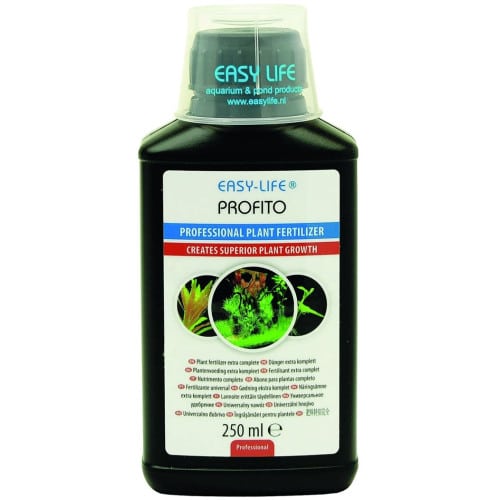
Easy Life ProFito 250ml
OptionalLiquid potassium and trace nutrients available through the water. Contains no nitrate or phosphate. Adapt supplementation to existing nutrients and plant growth; no automatic extra dosing.
Check retailer for price0 retailers
Compare prices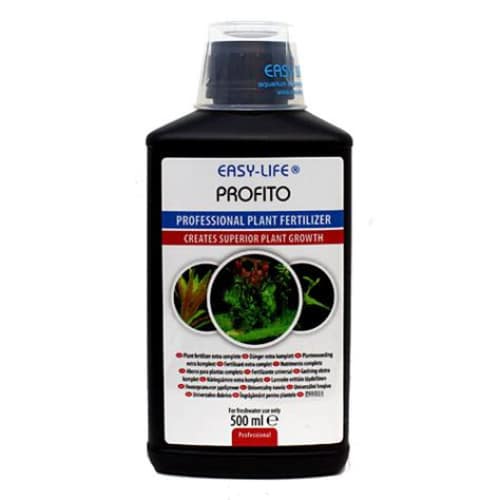
Easy Life ProFito 500ml
OptionalAn optional suitable product type; use according to manufacturer instructions and measured need.
Check retailer for price0 retailers
Compare pricesTools
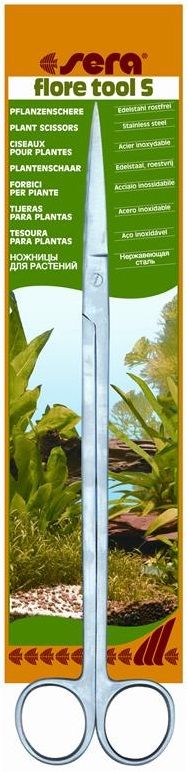
Sera Flore Tool S plantenschaar
OptionalOptional plant scissors for selective pruning or removing damaged parts. Protect growing points; gentle hand thinning is usually sufficient for floating plants.
Check retailer for price0 retailers
Compare pricesPrices from the latest retailer update, excluding shipping. Check stock and delivery with the retailer.
Lighting has been investigated but is not yet linked: available specifications do not adequately establish light class and coverage at plant depth.
Sources & review
This care guide draws on several specialist sources and was last checked on .