Carolina bacopa
Bacopa caroliniana

Carolina bacopa (Bacopa caroliniana) has sturdy, opposite leaves that provide a calm contrast to delicate stemmed plants. The plant grows upright and in a group can make a clear vertical line in the center or background. It is less hasty than some other stem plants, making a neat clump easier to maintain. The thick leaves can turn slightly warmer, but healthy green leaves are just as useful. This guide covers the common species, not a special color form. Bacopa is suitable for a simply planted aquarium, provided that the lower leaves continue to receive sufficient light. Give each stem some space and prune before the group closes at the top. A modest, open group is often more beautiful than a large forest with bare undersides.
Plan your aquarium →At a glance
- Difficulty
- Easy
- Plant height
- 10–40 cm
- Growth rate
- Moderate
- Placement
- Midground, Background
- Temperature
- 18–26 °C
- pH
- 6.0–7.0
- Light
- Moderate, High
- CO₂
- Optional
- Nutrient uptake
- Through the water column
- Substrate
- Sand, Gravel, Aquasoil
- Propagation
- Cuttings
About this plant
The fleshy leaves grow in pairs along fairly sturdy stems. They are clearly different from the narrow leaves of Rotala and the fine leaves of Limnophila. The usual installation height here is 10–40 cm, depending on pruning and conditions. New leaves may look different when transitioning from above-water culture to the aquarium. Recognition should not be based on color alone; the species name from a reliable grower remains important when comparable Bacopa varieties are offered.
Natural habitat
Bacopa caroliniana is native to North America and grows in wet places. The species can grow above and below water. A nursery photo with an above-water leaf therefore does not show exactly what the plant will look like later in the aquarium. Translate the natural growth habit to a stable place with light for the entire stem. There is no need to simulate a swamp bottom or a highly variable water level in a regular community aquarium.
Placement in the aquarium
Place individual stems in small groups in the center or background. Don't plant them so densely that the lower pairs of leaves are immediately shaded. We use 18–26 °C and pH 6–7 as a gentle care band. Specialized sources give varying pH ranges; the guide chooses their shared range and does not present that as an absolute tolerance limit. Adjust the final values to the fish and avoid quick corrections.
Light
Medium to high light helps maintain a compact, well-leaved group. Growth in lower light is possible, but the stems may loosen. The color does not have to be coppery to comply. Check that taller neighbors do not overshadow the Bacopa. A lamp with only a known wattage cannot be reliably linked to this plant: container height, coverage and light output at the location count.
CO₂
CO₂ is optional. The common species can be kept without a gas installation if light and growth expectations remain modest. Addition can support growth, but does not automatically make a shady spot or missing nutrition suitable. If gas is used, monitoring of the animals and careful adjustment are part of maintenance. Change settings step by step and assess new leaves, not just the color of old leaves.
Nutrition and fertilisation
The leaves absorb nutrients from the surrounding water. Use fertilizer based on the total planting and available nutrients, not on the basis of a fixed amount per Bacopa stem. Check whether a liquid product contains nitrogen and phosphate or mainly supplies potassium and trace elements. Adding loose iron is not an automatic solution for every discoloration. First map out light, growth rate and the composition of the existing fertilization.
Substrate and root feeding
Sand, fine gravel or a suitable aquasoil can anchor the stems. A specific nutrient medium is not required if the water column contains sufficient nutrients. Remove lower leaves before planting the lower stem part. This leaves fewer buried parts that can die. When replanting, a healthy top is often preferable to an old bare lower stem. Only loosen the bottom locally and avoid unnecessary disruption of the entire facility.
Growth and pruning
Cut back stems that are too tall above a healthy node. Branching may occur below the cut. Because Bacopa usually grows more slowly than fast background plants, daily intervention is not necessary; Regular observation remains important. Thin out a highly branched group before the bottom of the leaf disappears. Remove damaged leaves without bruising healthy stems. Leave enough open space between groups to siphon off debris and observe the fish.
Propagation
Healthy top cuttings with several pairs of leaves are suitable for replanting. Remove leaves from the buried area and give each cutting its own space. Older, healthy bases can resprout, but severely damaged areas do not need to be retained. Please allow for a recovery period after moving. Propagation does not mean that every pruning has to go back into the container; a smaller open group can remain healthier in the long term.
Suitable fish and animals
Small schooling fish can take shelter along the sturdy stems and use the open space in front of them. When combined with neon tetras or ember tetras, the joint temperature and pH band remains leading. The plant is not a food source that is purposefully resistant to large herbivores. Diggers can loosen young stems. Keep the bottom accessible for small catfish and ensure that food does not disappear deep into a dense bunch of leaves.

Neon tetra
Suitable with conditionsFirm stems provide cover along the edges. Plant loose groups with light reaching the base; keep the centre and bottom feeding area open. Use the shared temperature range rather than the warmest extremes. Retain the neon tetra school and calm, shaded swimming space.
View species profile →
Pygmy cory
Suitable with conditionsFirm stems provide cover along the edges. Plant loose groups with light reaching the base; keep the centre and bottom feeding area open. Use the shared temperature range rather than the warmest extremes. Pygmy corydoras also use the bottom: retain soft, open substrate for foraging and an accessible feeding area.
View species profile →
Zebra danio
Suitable with conditionsFirm stems provide cover along the edges. Plant loose groups with light reaching the base; keep the centre and bottom feeding area open. Use the shared temperature range rather than the warmest extremes. Zebra danios remain active schooling fish: retain the existing minimum swimming length of 90 cm and do not let planting block it.
View species profile →Possible problems
Loss of lower leaves calls for a check of shading, planting density and the transition to submerged growth. Remove soft, rotting stem sections; healthy shoot tips can often be replanted. Brown or pale patches have several possible causes and do not prove a particular nutrient deficiency. Also check mechanical damage and deposits on the leaves. Temperatures above the chosen shared care range and repeated transplanting may hamper recovery. Give the plant a stable location.
Care for this plant
Plant fertiliser
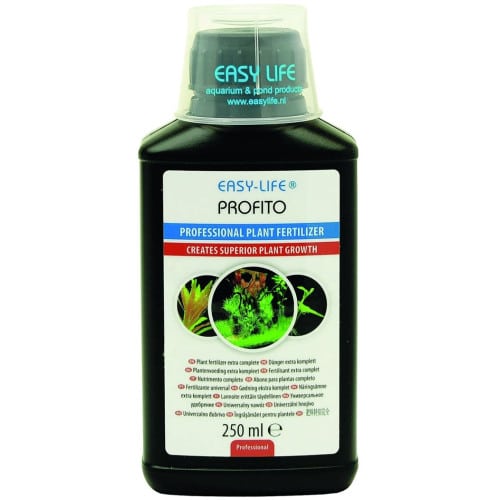
Easy Life ProFito 250ml
OptionalLiquid potassium and trace nutrients available through the water. Contains no nitrate or phosphate. Adapt supplementation to existing nutrients and plant growth; no automatic extra dosing.
Check retailer for price0 retailers
Compare prices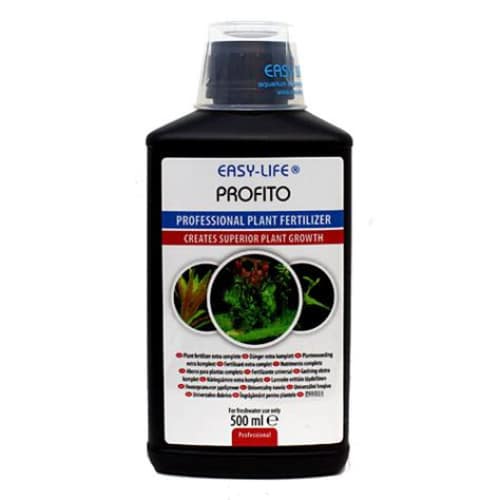
Easy Life ProFito 500ml
OptionalAn optional suitable product type; use according to manufacturer instructions and measured need.
Check retailer for price0 retailers
Compare pricesTools
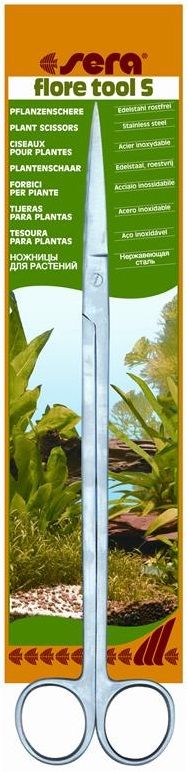
Sera Flore Tool S plantenschaar
OptionalOptional plant scissors for selective pruning or removing damaged parts. Protect growing points; gentle hand thinning is usually sufficient for floating plants.
Check retailer for price0 retailers
Compare pricesPrices from the latest retailer update, excluding shipping. Check stock and delivery with the retailer.
Lighting has been investigated but is not yet linked: available specifications do not adequately establish light class and coverage at plant depth.
Sources & review
This care guide draws on several specialist sources and was last checked on .