Head-and-tail light tetra
Holopristis ocellifera

The head-and-tail light tetra (Holopristis ocellifera) is an active, peaceful shoaling fish from northern South America. Its coppery reflective spot above the eye and bright mark near the tail base show when light catches the fish. It was long called Hemigrammus ocellifer; a taxonomic revision places it back in Holopristis. Keep at least six, preferably ten or more, in a mature aquarium with open swimming room and sheltered margins. A footprint around 60 × 38 cm and about 68 litres is a documented guideline, not a universal stocking guarantee.
Plan your aquarium →At a glance
- Temperature
- 24–28 °C
- pH
- 5.5–7.5
- GH
- 5–19 °dGH
- Aquarium length
- At least 60 cm
- Minimum aquarium volume
- At least 68 L
- Adult size
- Up to 4.5 cm
- Group size
- At least 6 individuals
- Temperament
- Peaceful
About this species
Holopristis ocellifera is a small characin in the order Characiformes and family Acestrorhamphidae. Its silvery to translucent flank carries dark and copper accents. Reflective spots near the eye and tail base explain its common name. Colour and brightness vary with lighting, mood and condition, and are not by themselves a health measure.
Seriously Fish reports about 45 mm standard length, excluding the tail. FishBase lists a maximum total length of 4.9 cm but flags the estimate as uncertain. These measurements use different methods. The species occurs in Guyana, Suriname, French Guiana and parts of the Amazon basin in Brazil and Peru; many trade fish are captive-bred. Older books use Hemigrammus ocellifer. A 2024 phylogenetic revision reinstated Holopristis; sources and databases are being updated at different rates. The former combination is retained as a search name.
Natural habitat
The species occurs in varied lowland waters of northern South America. Aquarium references describe slow rivers, tributaries and floodplain lakes. FishBase notes adults along coastal zones and a preference for little current. Because the range covers several drainages, no single fixed chemistry or exact biotope represents every population.
A natural layout can combine sand or fine rounded gravel, wood and plants along the margins while leaving open swimming room. Subdued light and sheltered places provide cover, but dense planting should not take all the space. Leaf litter or peat is optional; use it only when the material is safe and the aquarium remains stable. Artificially dark water is unnecessary. Prioritise stable water quality and a calm transition between open and sheltered areas.
Aquarium and layout
Seriously Fish gives a footprint around 60 × 38 cm and about 68 litres at 30 cm water depth. This is a guideline for a small group, not a guarantee for every stocking combination. A longer tank gives an active shoal more room. Keep at least six fish; ten or more supports natural shoaling when space allows.
Leave open water and place plants, wood or floating plants along parts of the margins. Provide a mature filter and good gas exchange. The specialist source suggests four to five turnovers per hour for about 68 litres; this is a starting point, while actual flow in the aquarium remains the practical guide. Avoid a strong jet across the whole tank. Acclimate new fish gradually and check after introduction that all feed and swim calmly. Volume alone does not determine whether tank-mates are suitable.
Water conditions
This guide uses the aquarium recommendation from Seriously Fish: 24–28 °C, pH 5.5–7.5 and GH 5–20 dGH. FishBase describes broader observations of about 22–26 °C, pH 6–8 and hardness 5–19. Differences may reflect populations and the distinction between field data and husbandry advice. Keep values stable and do not abruptly change a functioning aquarium to reach an endpoint.
The GH ranges largely overlap, but do not prove every point is optimal. A species-specific KH range or exact conductivity is not sufficiently supported and is not supplied. Measure with reliable equipment and also watch breathing, feeding and normal swimming. For breeding, Seriously Fish describes softer, more acidic water outside parts of the routine care range; these are breeding conditions, not daily requirements. Change chemistry gradually and only with a clear purpose.
Behaviour and group size
The head-and-tail light tetra is lively but generally peaceful. Keep it with conspecifics and choose tank-mates by adult size, temperament, swimming zone, social needs and water conditions. Sharing a temperature alone does not establish compatibility. Large fish that may view small tetras as prey are unsuitable. Small calm fish and peaceful bottom-dwellers may work when space is sufficient and every species can behave normally.
The species uses several water levels; open midwater supports shoaling. A lone fish or a very small group may become timid. After introduction, watch for persistent chasing, damaged fins, hiding or fish unable to feed. Adult females are often fuller and slightly larger, while males are slimmer; these are tendencies, not reliable juvenile sexing. Do not assume shrimp fry or fish eggs are safe.
Feeding
FishBase describes small worms, insects, crustaceans and plant material in the diet. In aquaria the species usually accepts small dry foods and suitable frozen or live foods. Offer small portions and check that all fish actually eat. Small daphnia or brine shrimp can add variety; source or culture foods safely to reduce disease transmission.
Choose flakes or granules whose particles fit the fish’s mouth. A slowly sinking granule may remain available to midwater feeders, but observe the actual feeding zone. A product name does not prove every particle size is appropriate. Safely crush food or choose a finer type if fish spit it out. TetraMin Mini Granules is linked in the existing product database as a suitable small staple; verify intake. Remove leftovers and avoid overfeeding.
Breeding
The species scatters eggs and provides no parental care. Adults may eat the eggs. A separate mature breeding tank with fine-leaved plants or an egg mesh is therefore useful for deliberate breeding. Keep lighting subdued, filtration gentle and water quality stable. Remove adults after spawning if you want to retain the eggs.
Seriously Fish describes breeding in softer, more acidic water, hatching after about 24–36 hours and free swimming a few days later. These are source-based observations, not a guarantee for every spawn. Once larvae swim freely, provide clean water and very fine, suitable fry food. A breeding tank is not required for routine care. Do not confuse breeding conditions with everyday care ranges, and stop if water quality becomes unstable.
Keeping with other species

Lemon tetra
Suitable with conditionsBoth are peaceful, active South American shoaling characins with overlapping guideline ranges. They may share a spacious, mature aquarium if each keeps its own school and has enough open swimming room and access to food. This pairing is not experimentally tested; observe behaviour and feeding, and avoid large predators or tiny shrimp fry.
View species profile →
Golden tetra
Suitable with conditionsBoth are peaceful, active South American shoaling characins with overlapping temperature, pH and hardness ranges. They may be kept together with sufficient space if each retains its own shoal and all fish can feed calmly. The golden tetra grows larger; watch food competition and individual responses. This is a source-based assessment, not a controlled cohabitation trial.
View species profile →
Serpae tetra
Not recommendedSerpae tetras are known to nip fins, especially in undersized groups or restricted space. The smaller, peaceful head-and-tail light tetra is therefore at increased risk despite some water overlap. Not recommended as a standard combination; reconsider only in a spacious aquarium with a full serpae shoal and close observation.
View species profile →Suitable products
Recommended staple foods
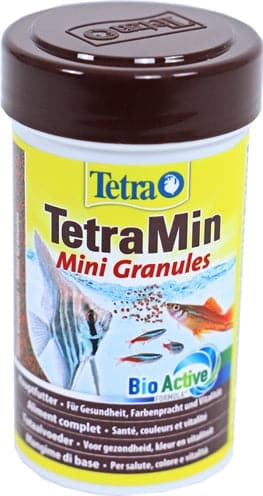
Tetra Min Minigranules Fish food 100 ml
The manufacturer describes Mini Granules as fine, slowly sinking complete food for small ornamental fish. It may suit the head-and-tail light tetra’s small mouth and midwater zone. Check that the granules are swallowed and offer small portions.
Check retailer for price0 retailers
View retailersPrices from the latest retailer update, excluding shipping. Check stock and delivery with the retailer.
Sources & review
This care guide draws on several specialist sources and was last checked on .
View the sources
- Tetra — TetraMin Mini Granules — manufacturer product information
- Seriously Fish — Holopristis ocellifera — aquarium profile, revised 2026
- FishBase Consortium — Holopristis ocellifera (Steindachner, 1882) — FishBase
- Zoological Journal of the Linnean Society — Melo et al. 2024, Phylogenomics of Characidae and phylogenetic classification
- Tropische Vissengids — Lantaarndragertje — Holopristis ocellifera
- Wikimedia Commons / Deadlyballistics — Head-&-Tail-Light-Tetra.jpg — Wikimedia Commons
- Creative Commons — Creative Commons CC0 1.0 Universal