Golden tetra
Hemigrammus rodwayi

The golden tetra (Hemigrammus rodwayi) is a peaceful, active shoaling fish from northern South America. Most captive-bred fish are silvery grey; the golden trade form is not simply a separate colour strain, but in some wild populations it is linked to a reaction to a trematode parasite. Do not deliberately expose aquarium fish to parasites to obtain the colour. Keep at least six, preferably ten or more, in a well-maintained aquarium with open swimming room and sheltered margins. The guideline of about 60 × 38 cm footprint and 68 litres comes from a specialist aquarium source.
Plan your aquarium →At a glance
- Temperature
- 24–28 °C
- pH
- 5.5–7.0
- GH
- 1–12 °dGH
- Aquarium length
- At least 60 cm
- Minimum aquarium volume
- At least 68 L
- Adult size
- Up to 5.5 cm
- Group size
- At least 6 individuals
- Temperament
- Peaceful
About this species
Hemigrammus rodwayi is a small South American characin. Its natural colour is often silvery grey with some colour in the fins. Seriously Fish reports that some wild populations may develop golden guanine deposits in the skin after exposure to a trematode parasite. This is a parasitic reaction, not a health goal or a reason to expose aquarium fish to parasites. Many captive-bred fish lack the striking gold and remain silvery.
Seriously Fish gives about 55 mm standard length, measured without the tail. FishBase lists 5.3 cm total length but marks the maximum estimate as questionable. The numbers use different measurement methods and should not be presented as one exact adult maximum. The range includes Guyana, Suriname, French Guiana, Peru and the Amazon basin. The accepted species name is Hemigrammus rodwayi; modern phylogenetic classifications place this group within Acestrorhamphidae, while older sources use Characidae.
Natural habitat
The golden tetra occurs in rivers and coastal lowlands of northern South America, including Guyana, Suriname and French Guiana, plus parts of the Amazon basin. Seriously Fish describes slow-moving rivers, tributaries and floodplain lakes. FishBase notes abundance in coastal creeks and floodplains; some sites may be mildly brackish. That is a local field observation, not aquarium advice to add salt.
A biotope-style layout can use sand, driftwood and sheltered margins, but plants are not essential for the species’ health. A well-maintained planted community tank can also work. Leave open water for the shoal and avoid sharp décor or current that constantly pushes fish back. Leaf litter is optional and should be used only if aquarium-safe and compatible with stable maintenance. The species spans several drainages, so one exact blackwater recipe cannot represent every population.
Aquarium and layout
Seriously Fish gives a footprint around 60 × 38 cm and about 68 litres at 30 cm water depth for a small group. Treat this as a supported lower planning guideline, not guaranteed capacity. A longer aquarium gives an active shoal more horizontal swimming room. Keep at least six fish; ten or more is preferable when space and filtration permit.
Combine open water with wood, plants or other safe cover along the margins. Provide a mature filter and adequate gas exchange. The specialist profile calculates four to five turnovers per hour for about 68 litres. This is a source-based starting point; actual flow and fish behaviour matter more than the filter label alone. Gentle to moderate circulation is suitable if fish can swim and feed without effort.
Add fish gradually and acclimate them calmly to temperature and chemistry. After changes, check that the whole shoal feeds normally. Adjust stocking if fish are persistently chased, hide or cannot reach food. The stated volume does not replace assessment of tank-mates, length and maintenance.
Water conditions
For aquarium care, Seriously Fish gives 24–28 °C, pH 5.5–7.0 and GH 1–12 dGH. FishBase describes 24–28 °C and gives a pH from about 6.3, but its data are incomplete. This guide therefore uses the specialist care profile for its practical pH range. Field records are not automatically optimal aquarium targets.
Keep values stable and do not abruptly change a functioning aquarium to chase a number. The sources do not provide a sufficiently supported species-specific KH range or target conductivity. Do not add salt because some wild populations occur locally in mildly brackish water. Measure with reliable equipment, watch feeding and breathing, and make water changes gradually.
Seriously Fish describes softer, more acidic and warmer water for breeding than for routine care. These are specific breeding conditions, not standard husbandry advice. Do not confuse the two ranges.
Behaviour and group size
The golden tetra is peaceful and benefits from company of its own kind. Choose tank-mates by adult size, temperament, swimming zone, water needs and social behaviour. Matching temperature alone does not prove compatibility. Very large fish may treat small tetras as prey; boisterous or aggressive fish can also displace them from food and swimming space.
Keep at least six together and preferably a larger shoal if the aquarium allows it. Provide open water and retain calm resting areas. Watch whether all fish feed, the shoal spreads normally and fins remain intact. Persistent chasing, hiding or missed meals mean the combination or layout needs adjustment. The species is not restricted to one fixed water layer, so sharing a midwater feeding zone with other fish can increase food competition.
The golden colour in some wild fish is associated with a parasitic reaction. Do not try to stimulate or reproduce it by introducing parasites. A silvery captive-bred fish can be a normal, healthy golden tetra.
Feeding
Seriously Fish describes the species as easy to feed and accepting a range of small dried, frozen and live foods. Small insect larvae, daphnia or brine shrimp can add variety. Offer small portions and, if needed, spread food across more than one place so less dominant fish can feed.
Flakes and granules work as a practical daily base when particle size suits the mouth. A fine, slowly sinking granule may reach fish feeding in midwater. Let actual intake guide you: if fish spit out granules, crush them safely or select finer food. Combine dry food with appropriate animal-based supplements; one product need not provide the whole diet.
The existing product database links TetraMin Mini Granules as a suitable small staple for this tetra. Check that the shoal actually swallows the granules and remove leftovers. Avoid overfeeding, which can degrade water quality.
Breeding
Deliberate breeding can use a separate, mature tank with subdued light, fine plants or a mesh that keeps eggs beyond adult reach. The species scatters eggs and provides no parental care; adults may eat them. Remove parents after spawning if you want to retain the eggs. Use gentle filtration so small fry are not drawn in.
Seriously Fish describes an approach similar to other Hemigrammus: softer, acidic water, about 26.5–29 °C, with hatching after roughly 24–36 hours and free swimming a few days later. Treat those numbers as reported breeding conditions, not a guaranteed outcome. Larvae are initially tiny and need appropriately fine first foods. Prepare the tank and food before attempting to breed them.
A separate breeding tank is not needed for routine care. Record temperature and chemistry during breeding and do not make abrupt corrections. Stop the attempt if water quality deteriorates.
Keeping with other species

Head-and-tail light tetra
Suitable with conditionsBoth are peaceful, active South American shoaling characins with overlapping temperature, pH and hardness ranges. They may be kept together with sufficient space if each retains its own shoal and all fish can feed calmly. The golden tetra grows larger; watch food competition and individual responses. This is a source-based assessment, not a controlled cohabitation trial.
View species profile →Suitable products
Recommended staple foods
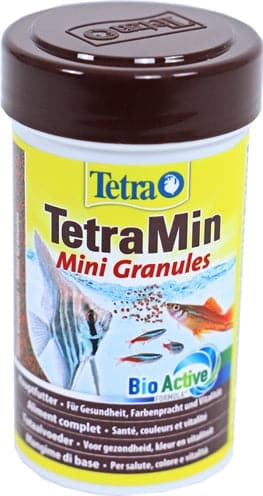
Tetra Min Minigranules Fish food 100 ml
Fine, slowly sinking complete food for small ornamental fish according to the manufacturer. It may suit the golden tetra if the particles are eaten; check intake and use small portions alongside varied animal-based supplements.
Check retailer for price0 retailers
View retailersPrices from the latest retailer update, excluding shipping. Check stock and delivery with the retailer.
Sources & review
This care guide draws on several specialist sources and was last checked on .
View the sources
- Creative Commons — Creative Commons Attribution-ShareAlike 4.0 International
- Tetra — TetraMin Mini Granules — manufacturer product information
- Zoological Journal of the Linnean Society — Melo et al. 2024, Phylogenomics of Characidae and phylogenetic classification
- Seriously Fish — Hemigrammus rodwayi — specialist aquarium profile
- FishBase Consortium — Hemigrammus rodwayi Durbin, 1909 — FishBase
- Wikimedia Commons / Daiju Azuma — Hemigrammus rodwayi by DaijuAzuma.JPG — Wikimedia Commons