Rainbow Shark
Epalzeorhynchos frenatum

The rainbow shark (Epalzeorhynchos frenatum), also called the rainbow sharkminnow, is an active Southeast Asian cyprinid with conspicuous red fins. Despite its trade name it is not a shark. It is often sold as a small juvenile, although an adult can reach about 15 cm standard length and claims a territory. This makes it unsuitable for many small community aquaria. Plan a long, mature aquarium with shelters, visual breaks and open swimming room, and normally keep one specimen alone. Matching water parameters do not by themselves prove that two species can live together. Assess the adult fish's eventual space and behaviour rather than judging suitability by the small size of a shop juvenile.
Plan your aquarium →At a glance
- Temperature
- 20–26 °C
- pH
- 6.5–8.0
- GH
- 2–15 °dGH
- Aquarium length
- At least 120 cm
- Minimum aquarium volume
- At least 243 L
- Adult size
- Up to 15 cm
- Group size
- At least 1 individuals
- Temperament
- Territorial
About this species
Eschmeyer's Catalog of Fishes accepts Epalzeorhynchos frenatum (Fowler, 1934), in the family Cyprinidae and subfamily Labeoninae. Older or alternative names include Labeo frenatus and Labeo erythrura; the spelling Epalzeorhynchos frenatus is also encountered. Do not confuse it with the red-tailed black shark, E. bicolor. The typical form has predominantly red fins and a dark band across the head, but captive colour forms and juveniles can complicate identification.Natural habitat
This species comes from freshwater habitats in mainland Southeast Asia. The Catalog lists Mekong and Chao Phraya basins, while the Seriously Fish profile discusses records in Thailand, Laos and Cambodia and notes uncertainty around some localities. It grazes over sand or rock in streams and rivers and moves into seasonally flooded areas during the wet season. FishBase displays Least Concern from an assessment dated 2011. That is a dated assessment, not a current population census.Aquarium and layout
Seriously Fish gives a 120 × 45 cm footprint and about 243 litres as the smallest setup to consider for one specimen. Treat this as a cautious lower planning baseline; more space allows better swimming and territorial separation. Use sand or rounded gravel with rocks, wood and secure retreats. Visual barriers may reduce encounters but do not automatically make two adult territorial fish compatible. Provide mature, effective filtration, oxygen-rich water, moderate flow and low organic-waste accumulation. A secure lid is sensible.Water conditions
The species-specific Seriously Fish guidance is 20–26 °C, pH 6.5–8.0 and GH 2–15 dGH. FishBase lists differently scoped environmental values of 24–27 °C, pH 6–8 and hardness 5–12. We therefore show the specialist aquarium range and emphasize a stable, mature system rather than chasing endpoints. No sufficiently supported species-specific KH range is available here. Ammonia and nitrite should be undetectable; avoid rapid temperature changes.Behaviour and group size
Rainbow sharks become territorial, especially as adults, and are usually kept singly. Seriously Fish warns against congeners and similar bottom-dwelling fish; many catfish and other bottom occupants can also be harassed. This page therefore shows explicit warnings for the red-tailed black shark and Crossocheilus oblongus, not trial-pairing suggestions. In mixed aquaria, robust, active fish using higher levels may be easier to assess, but no species is presented here as guaranteed safe. Watch for persistent chasing, fin damage, hiding and exclusion from food.Feeding
This omnivorous grazer eats algae and biofilm as well as small crustaceans and insect larvae. Offer a varied diet of suitable dried foods, small live or frozen prey and plant material. The linked Hikari Algae Wafers are only supplementary plant-based grazing food, not a complete diet. Feed in a way that ensures this bottom-oriented fish actually gets food, and remove leftovers. Do not buy it solely as an algae-control fish: grazing is not a dependable fix for an algae problem.Breeding
The species is commercially bred; Seriously Fish reports that farms may use hormone stimulation and knows of no reliable breeding accounts from ordinary home aquaria. This does not support a simple home-breeding recipe. Juveniles are difficult to sex reliably. Mature females may be fuller-bodied and males may show a dark anal-fin edge, but these traits are not a certain test for an individual. Keep any breeding stock only in a spacious system with a safe way to separate territorial fish.Keeping with other species

Red-tailed black shark
UnsuitableDo not house together. Seriously Fish warns that Epalzeorhynchos congenerics are commonly attacked and recommends keeping this fish alone in most aquaria. The minimum footprint does not establish enough room for two territories.
View species profile →
Siamese algae eater care guide
UnsuitableNot recommended. Seriously Fish specifically lists Crossocheilus among fish that Epalzeorhynchos tends to attack. Their overlapping grazing and bottom niches raise conflict risk; matching water values do not make this a safe pairing.
View species profile →Suitable products
Supplementary foods
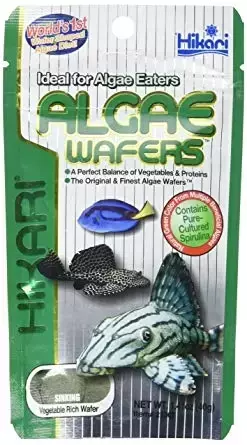
Hikari Algae wafers 40gr - Vissenvoer
Supplementary plant-based grazing food for this omnivore; combine with suitable animal foods and a varied diet. Not a complete staple.
Check retailer for price0 retailers
View retailersPrices from the latest retailer update, excluding shipping. Check stock and delivery with the retailer.
Sources & review
This care guide draws on several specialist sources and was last checked on .
View the sources
- Hikari — Hikari Tropical Algae Wafers — manufacturer feeding information
- California Academy of Sciences — Eschmeyer's Catalog of Fishes — Epalzeorhynchos frenatum
- Seriously Fish — Epalzeorhynchos frenatum — species and aquarium profile
- FishBase — Epalzeorhynchos frenatum — FishBase species summary
- Drachenschwertträger36 / Wikimedia Commons — Zügelfransenlipper.jpg — Wikimedia Commons