Red-tailed black shark
Epalzeorhynchos bicolor

The red-tailed black shark (Epalzeorhynchos bicolor) is a striking, territorial cyprinid from Thailand. Its nearly black body contrasts with a red tail. Despite its trade name, it is not a true shark and is not an easy general community fish. Adults defend space, especially against similarly shaped bottom-dwellers. Plan a long aquarium, usually keep this species singly and assess every proposed pairing carefully. Plan around the adult fish, not the juvenile seen in a shop; its territorial needs remain as it grows. Decide in advance where a territorial fish can be moved if a combination proves unsafe.
Plan your aquarium →At a glance
- Temperature
- 20–26 °C
- pH
- 6.0–8.0
- GH
- 2–15 °dGH
- Aquarium length
- At least 120 cm
- Minimum aquarium volume
- At least 243 L
- Adult size
- Up to 12.5 cm
- Group size
- At least 1 individuals
- Temperament
- Territorial
About this species
Eschmeyer’s Catalog of Fishes accepts Epalzeorhynchos bicolor (Smith, 1931), in Cyprinidae. It is also sold as the redtail labeo. In trade it is often confused with the rainbow shark, E. frenatum. Adult E. bicolor typically has a dark body and red caudal fin; colour alone does not prove identity. Seriously Fish reports a maximum standard length of 12.5 cm. Standard length excludes the tail fin; OATA gives an approximate 15 cm size without specifying the same measurement basis.Natural habitat
The species is known from Thailand, with historical records in the Mae Klong, Chao Phraya and Bang Pakong drainages. Sources describe freshwater wetlands, rivers and floodplains. The 2011 IUCN assessment lists the red-tailed black shark as Critically Endangered and reported one known remaining wild location at that time; the assessment is marked as needing an update. FishBase reports that aquarium-trade exports are captive-bred. These are dated source statements, not a recent population survey or a guarantee about an individual fish’s origin.Aquarium and layout
Seriously Fish recommends a minimum footprint of 120 × 45 cm, about 243 litres. This is a lower planning limit for one adult territorial fish; multiple individuals need substantially more space and are generally discouraged. Provide both cover and visual barriers as well as open swimming room. A mature, effective filter, oxygen-rich water and regular removal of organic waste help maintain stable conditions. Use a secure lid. Adults may reach about 12.5 cm standard length.Water conditions
The species-specific range from Seriously Fish is 20–26°C, pH 6.0–8.0 and GH 2–15 dGH. OATA gives different general guidance for the freshwater-shark group: 22–27°C and GH 4–12 dH. Because the recommendations differ, this guide presents the specialist species range and emphasises stability rather than chasing both sets of endpoints. No sufficiently supported species-specific KH range is included here. Ammonia and nitrite should be undetectable; avoid abrupt changes.Behaviour and group size
This fish is generally solitary and becomes more territorial with age. OATA advises keeping red-tailed black sharks singly rather than as pairs or groups. Seriously Fish warns that they attack similar-looking fish and that many other bottom-dwellers are risky. Choose tankmates by more than water values: adult size, use of the bottom, speed, cover and access to food also matter. No named species pairing is presented here as individually verified. In any existing combination, watch for persistent chasing, injuries or fish that no longer dare to feed.Feeding
Epalzeorhynchos bicolor is an omnivorous grazer. Aufwuchs and algae are only part of its diet; it also takes small crustaceans and insect larvae. Seriously Fish recommends variety including suitable dry foods, small live or frozen foods and plant matter. The linked Hikari Algae Wafers are supplementary plant-based grazing food only, not a complete diet. Feed small amounts, confirm the fish actually eats them and remove leftovers. Do not rely on aquarium algae as its sole food or treat the fish as guaranteed algae control.Breeding
The public sources consulted do not provide a simple, reliable home-breeding recipe. FishBase reports commercial aquaculture and captive-bred exports; that does not prove that home breeding is straightforward. Commercial or hormone-induced spawning reports are not routine home-aquarium advice. Keep water stable and do not attempt breeding unless there is enough space to separate adult territorial fish safely.Keeping with other species

Rainbow Shark
UnsuitableDo not house together. Seriously Fish warns that Epalzeorhynchos congenerics are commonly attacked and recommends keeping this fish alone in most aquaria. The minimum footprint does not establish enough room for two territories.
View species profile →Suitable products
Supplementary foods
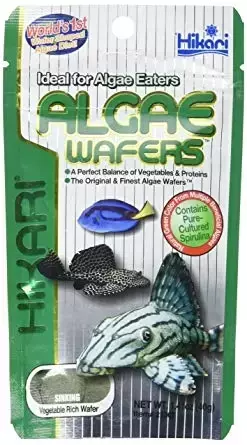
Hikari Algae wafers 40gr - Vissenvoer
Supplementary plant-based grazing food for an omnivore; combine it with varied animal and other suitable foods. Do not use it as a complete diet.
Check retailer for price0 retailers
View retailersPrices from the latest retailer update, excluding shipping. Check stock and delivery with the retailer.
Sources & review
This care guide draws on several specialist sources and was last checked on .
View the sources
- California Academy of Sciences — Eschmeyer’s Catalog of Fishes — Epalzeorhynchos bicolor
- Seriously Fish — Epalzeorhynchos bicolor — species and aquarium profile
- Ornamental Aquatic Trade Association — How to look after freshwater sharks — group guidance
- FishBase — Epalzeorhynchos bicolor — FishBase species summary
- IUCN — IUCN Red List assessment — Epalzeorhynchos bicolor (2011)
- Hikari — Hikari Tropical Algae Wafers — manufacturer feeding information
- Astellar87 / Wikimedia Commons — Epalzeorhynchos bicolor2.jpg — Wikimedia Commons