Green neon tetra
Paracheirodon simulans

The green neon tetra (Paracheirodon simulans), also sold as the blue neon tetra, is a small South American schooling fish. Its blue-green stripe reaches the base of the tail, while its red markings are much less extensive than those of the cardinal tetra. A quiet setting with darker backgrounds makes that stripe particularly noticeable. Staying small does not make this fish suitable for every small aquarium, however. It needs soft, acidic water, a mature system and companions of its own species. A busy community of larger, competitive feeders is not an obvious choice. Start with at least ten fish and design their home around the school. This guide distinguishes temperatures measured in nature from sensible everyday husbandry. Stable conditions and every fish getting enough food matter more than reproducing an extreme field measurement.
Plan your aquarium →At a glance
- Temperature
- 24–27 °C
- pH
- 5.5–6.0
- GH
- 1–4 °dGH
- Aquarium length
- At least 60 cm
- Adult size
- Approximately 2–2.5 cm
- Group size
- At least 10 individuals
- Temperament
- Peaceful
About this species
Identification starts with the scientific name. Paracheirodon simulans is distinct from the neon tetra (P. innesi) and cardinal tetra (P. axelrodi), rather than a small cultivated form of either. Expect roughly 2–2.5 cm in body length. Sources use different length conventions, so a measurement without its method can imply unjustified precision. The continuous blue-green band and limited red markings are more useful identifying features than the size of a juvenile alone.
The name green neon is also sometimes applied to Hemigrammus hyanuary. Check the label and identifying features before adding to a school. Ask whether the fish are wild-caught or captive-bred and how long they have been settled in the supplier's water. This information helps plan their transition to your aquarium; a trade name cannot tell you their history.
Natural habitat
This fish occurs in the Negro and Orinoco river systems of northern South America. Field research in the middle Rio Negro describes shallow palm-swamp habitats between larger rivers. These places are not bare tanks with a heater: water level, shade and temperature vary seasonally and over the course of a day.
Green neons are associated with soft, acidic blackwater. For aquarium planning, the useful combination is cover, subdued lighting and suitable water chemistry. There is no need to reconstruct an exact river cross-section. Wood and plants around the edges can meet practical needs even when those plants do not originate in the same drainage. Such a setting should not be described as an exact biotope.
The field study recorded temperatures at some P. simulans sites well above usual aquarium recommendations. That does not establish a safe permanent heater setting. Likewise, cardinal tetras occurring in the same broader region does not mean the two species occupy identical microhabitats.
Aquarium and layout
A specialist care source recommends a minimum footprint of 45 × 30 cm. For planning a school we prefer a tank at least 60 cm long, with an unobstructed swimming lane and cover around the edges. This is an editorial space allowance, not an experimentally established biological minimum. Allow more room for companions and assess the whole stock. A tall tank with a short footprint is not automatically equivalent to a longer one holding the same litres. No separate minimum volume is therefore specified here.
Avoid filling the entire length with a solid wall of plants and wood. Fish should be able both to retreat out of sight and to swim through the aquarium freely. Position the outlet to circulate water without making the school constantly fight a strong jet. Guard a powerful intake against small fish. After arranging the tank, check that you can feed and maintain it without dismantling every refuge.
A newly filled aquarium is not biologically mature. Establish the filter and check water quality before introducing the school. Do not add many other animals at the same time simply to fill apparently empty swimming space.
Water conditions
We use 24–27 °C for routine care. This species needs soft, acidic water; the guide adopts pH 5.5–6.0 and GH 1–4 °dH as a cautious practical profile within the checked sources. These are not absolute physiological boundaries or instructions to alter an established aquarium abruptly. Specialist sources also give broader ranges. Changing pH in water with very little buffering requires particular understanding and monitoring.
Test the available water first and ask which conditions the supplier uses. Conditioner alone does not turn hard tap water into soft water. If using reverse-osmosis water, establish a repeatable mixing and testing routine instead of guessing a different ratio at each change. Aim for predictable replacement water and observe the fish after maintenance.
Research into heat tolerance compares survival and physiological responses. It does not justify routinely increasing the heater setting. Salt is not a standard addition for this freshwater setup. If behaviour changes, first check water quality, temperature, circulation and food intake.
Behaviour and group size
Keep at least ten green neons together. A different tetra species does not replace their own school. They need not swim in a perfectly synchronised formation continuously; also watch whether all fish explore, use cover and get food. Persistent hiding is a reason to reassess lighting, disturbance, flow and tankmates.
Their small size restricts the choice of companions. A fish need not look aggressive to regard a green neon as prey. Large mouths, repeated chasing and strong competition at feeding are reasons to reject a combination. A species-focused aquarium is a sensible starting point. Any proposed combination requires consideration of adult size, swimming space, each species' social needs and access to food, as well as water chemistry.
A peaceful fish is not automatically harmless to newly hatched shrimp either. Do not promise survival of all juvenile invertebrates merely because the school appears quiet. Only separately assessed combinations should be presented as recommended pairings.
Feeding
Offer small portions that the fish can actually swallow. A complete food for small tropical fish can provide the daily staple when its form and size are appropriate. A tetra pictured on the package does not prove that every pellet suits this species. Watch whether fish swallow the food or repeatedly spit it out. Break flakes down when needed rather than offering large pieces eaten only by other inhabitants.
Small live or frozen foods provide variety. Supplementary foods do not automatically replace a nutritionally complete staple. Feed where the school can eat calmly and check the fish at the back too. Adding more food is not a good remedy when dominant companions intercept everything. Remove excess and adjust the next portion.
A specific product recommendation requires adequate evidence in the existing product record. Without confirmed suitability of the pellet or flake size, no recommendation is forced and no precise mouth measurement is inferred from body length.
Breeding
A reliable, detailed home-breeding protocol for this species is not well supported by the sources checked here. A biological summary describes spawning in groups as more useful than restricting fish to pairs. That does not provide a complete recipe for temperature, conductivity, lighting and hatching time. Figures from a related neon tetra are therefore not presented as established for P. simulans.
Anyone planning breeding should begin with clearly species-specific breeder experience and a separate plan for water quality and first foods. Record which fish and conditions were actually involved. One successful spawning does not show that a method is reproducible under different circumstances. Treat breeding as a separate specialist project; stable husbandry and good condition come first for an ordinary display school.
Keeping with other species

Freshwater angelfish
UnsuitableDo not combine with angelfish. An adult angelfish may prey on this very small tetra; shared water parameters, growing up together or extra plants do not reliably remove that risk.
View species profile →Suitable plants

Java fern
Java fern can provide cover on wood along the sides at 24–27 °C and pH 5.5–6. Keep the rhizome exposed and preserve an open swimming lane. Subdued lighting for the fish must not leave leaves in complete darkness; this is not a shared natural-biotope claim.
- Light
- Low, Moderate
- CO₂
- CO₂ injection not needed
Suitable products
Recommended staple foods

Tropical Supervit Basic 100ml
Complete flake food for omnivorous and carnivorous fish. Crumble flakes into suitably small pieces and let them descend into the swimming layer. Check that quieter fish also feed.
Check retailer for price0 retailers
View retailers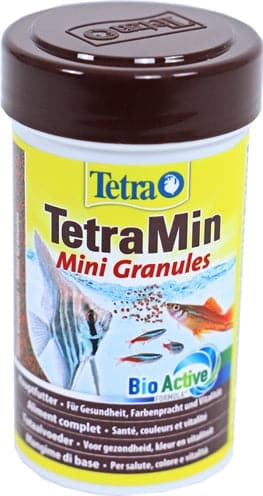
Tetra Min Minigranules Fish food 100 ml
Fine, slowly sinking mini granules as a staple for small freshwater fish. Let them soften and check that every fish swallows them easily; crush further if necessary.
Check retailer for price0 retailers
View retailersSupplementary foods

Tropical Dafnia 100ml
Dried daphnia as an occasional animal-food supplement. Crumble larger pieces and briefly moisten them before feeding. This does not replace a complete staple food.
Check retailer for price0 retailers
View retailersPrices from the latest retailer update, excluding shipping. Check stock and delivery with the retailer.
Sources & review
This care guide draws on several specialist sources and was last checked on .
View the sources
- Seriously Fish — Paracheirodon simulans — specialist care profile
- FishBase — Paracheirodon simulans — biological summary
- Aquarium Glaser / Frank Schäfer — Paracheirodon simulans — direct trade observations, 2021
- Marshall, Forsberg, Hess & Freitas — Water temperature differences in interfluvial palm swamp habitats (2011)
- Genetics and Molecular Biology / PubMed — Differential survivorship of congeneric ornamental fishes under forecasted climate changes (2018)
- OATA — Tetras and pencilfish — general care