Axelrod Rasbora
Sundadanio axelrodi
The Axelrod Rasbora (Sundadanio axelrodi) is a tiny, shy shoaling fish from the blackwater streams and pools of Borneo. It grows to about 2.2 cm and occurs in locality-associated red, green and blue colour forms. A calm setting alone is not enough: the fish needs soft, acidic and stable water, a biologically mature aquarium and a substantial shoal of roughly 20–30. Newly imported fish can be difficult to settle and may refuse dry food. Start with small live foods and check carefully that every fish is eating. Do not mix colour forms, as the specialist source cautions against unnecessary hybridisation.
Plan your aquarium →At a glance
- Temperature
- 23–26 °C
- pH
- 4.0–6.5
- GH
- 0–5 °dGH
- Aquarium length
- At least 45 cm
- Minimum aquarium volume
- At least 30 L
- Adult size
- Up to 2.3 cm
- Group size
- At least 20–30 individuals
- Temperament
- Peaceful
About this species
Sundadanio axelrodi was originally described as Rasbora axelrodi. The accepted current combination is Sundadanio axelrodi; FishBase and Eschmeyer’s Catalog place it in Sundadanionidae, order Cypriniformes. Seriously Fish lists 22 mm standard length and FishBase 2.25 cm standard length; these are close but not identical measures. Use about 2.2 cm standard length, not total length. Red, green and blue colour forms are associated with locality. Mature males are slimmer and more colourful; females are fuller and have a colourless anal fin.Natural habitat
The best documented collection localities are on Borneo. Although distribution summaries also list Sumatra, Riau and Bangka, Seriously Fish notes that the specific collection data the authors found refer to Bornean populations. The fish inhabits brown blackwater streams and pools in old peat-swamp forests. Leaves, twigs and other organic matter release tannins. Water is very soft and acidic, locally as low as pH 4, and the forest canopy dims the light. These peat-swamp habitats are threatened by plantations, development and other human activity.Aquarium and layout
Seriously Fish gives a length of about 45 cm and approximately 29.5 litres or more as preferable for long-term care. Its metric and imperial dimension strings do not agree geometrically, so this guide uses only the explicit length and rounds the stated volume up to 30 litres. This is a lower limit for the species, not a recommendation for a community tank. A larger, mature and stable aquarium gives a shoal of 20–30 more room. Use sand, wood, leaf litter, floating plants and shade. Keep flow gentle and use regular small water changes; do not add the fish to an immature aquarium.Water conditions
The stated temperature is 23–26 °C, hardness GH 0–5 dGH and the detailed pH recommendation 4.0–6.5. The source quick facts omit pH, while its full water section provides a range; we use that detailed range with this caveat. The fish comes from very soft, acidic water. Match conditions to stock origin and previous holding water. Avoid pronounced swings: this tiny fish is sensitive to unstable water chemistry. Regular small water changes are preferable to large corrections.Behaviour and group size
The species is peaceful, but its tiny size and shy nature make it an unsuitable default community fish. Keep roughly 20–30 of the same colour form. The Green Neon (Paracheirodon simulans) may suit under conditions: the specialist profile lists it as a potential similarly sized companion, and the verified temperature, pH and GH ranges overlap. Give each species a full shoal, adequate space and soft, acidic, stable conditions. Watch feeding, as faster fish may outcompete Sundadanio. Do not mix colour forms with one another.Feeding
In nature it presumably eats small crustaceans, worms, insect larvae and other zooplankton. It can be a picky feeder and may refuse dried food. Start newly imported or weakened fish on fine live foods such as Artemia nauplii, Daphnia, grindal worms or microworms. Also offer regular small portions of frozen foods, including finely chopped bloodworm. Try complete mini granules only after the fish settle. Feed very small amounts and check that shy individuals eat; remove leftovers.Breeding
The species scatters eggs and provides no parental care. It is not often bred under ordinary aquarium conditions. A mature, densely planted species-only aquarium with stable soft acidic water is a better starting point, but does not guarantee spawning. Adults may eat eggs and larvae; deliberate breeding requires keeping them out of reach of the parents. First foods must be extremely fine. Males may make a soft croaking or chirping sound during dominance behaviour. Do not remove a fish from water to hear it; the source specifically discourages this.Keeping with other species

Green neon tetra
Suitable with conditionsSeriously Fish lists Paracheirodon simulans as a potential companion of similar size. Both species are peaceful and their verified water ranges overlap narrowly. Keep both full shoals in a spacious, mature aquarium with soft, acidic, stable water; check that the shy Sundadanio gets enough food. The pairing depends on the individual fish and setup.
View species profile →Suitable plants

Java fern
Seriously Fish specifically lists Java fern (Microsorum pteropus) as a plant that can grow in this subdued setup. The recorded temperature ranges overlap. Attach its rhizome to wood or rock, use modest lighting and leave the midwater open. This is a practical aquarium combination, not a shared natural locality.
- Light
- Low, Moderate
- CO₂
- CO₂ injection not needed
Suitable products
Recommended staple foods
No staple product can yet be linked with sufficient confidence. This picky fish may refuse dried food. Start with small live foods and offer suitable frozen foods, checking that the fish eat. No product is labelled a staple based on its name alone.
Supplementary foods

Tropical Dafnia 100ml
Dried Daphnia as a small animal-food supplement, only if the fish accept it after acclimation. Crumble if needed and rotate with fine live or frozen foods.
Check retailer for price0 retailers
View retailers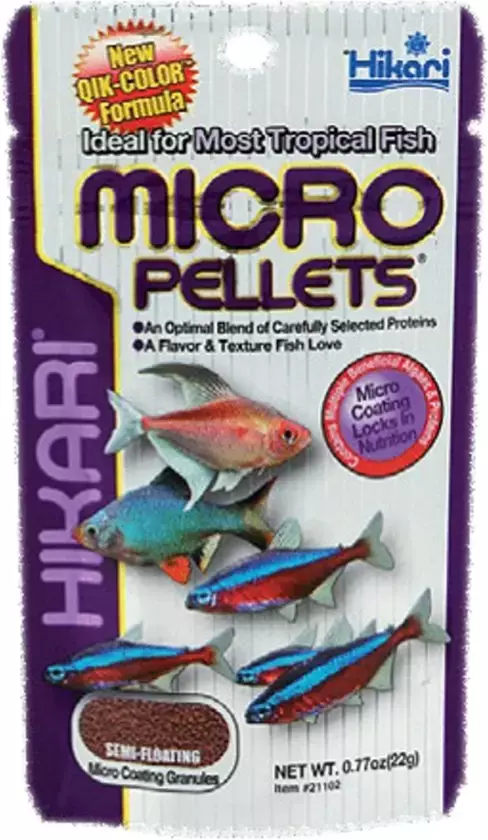
Hikari Micro pellets 22gr - Vissenvoer
The manufacturer describes this as a daily micro-pellet diet for small-mouthed fish. Sundadanio may refuse dry food: offer only after acclimation, in tiny portions, and check ingestion.
Check retailer for price0 retailers
View retailersPrices from the latest retailer update, excluding shipping. Check stock and delivery with the retailer.
Sources & review
This care guide draws on several specialist sources and was last checked on .