Silvertip tetra
Hasemania nana

The silvertip tetra (Hasemania nana) is an active, golden-toned shoaling fish from Brazil’s Rio São Francisco basin. The silvery tips on its fins catch the light as it swims. It is also sold as the copper tetra. Keep this lively species in a group of at least six, with open swimming space and plants around the margins. Species profiles suggest a base of about 60 × 38 cm and roughly 68 litres for a small shoal; this is a guideline, not a guarantee for every stocking combination. The fish is generally peaceful, but too few companions may encourage fin nipping. A stable tropical freshwater aquarium, varied food and careful observation at feeding time help support the group.
Plan your aquarium →At a glance
- Temperature
- 23–28 °C
- pH
- 6.0–8.0
- GH
- 5–19 °dGH
- Aquarium length
- At least 60 cm
- Minimum aquarium volume
- At least 68 L
- Adult size
- Up to 5 cm
- Group size
- At least 6 individuals
- Temperament
- Peaceful
About this species
Hasemania nana was described by Lütken in 1875. It belongs to the order Characiformes and recent taxonomic sources place it in Acestrorhamphidae, subfamily Stichonodontinae. Older aquarium profiles still use Characidae. Unlike many other characins, the silvertip tetra lacks an adipose fin. Its slender body is usually copper to gold, with pale tips on the fins as a characteristic feature. Colour intensity changes with lighting, condition and mood.
The common names silvertip tetra and copper tetra are both used in the trade. Check the scientific name when buying because trade names are not always consistent. Seriously Fish gives about 5 cm standard length; FishBase reports 3.8 cm standard length, so published maximum sizes differ. Standard length ends at the base of the tail and is not total length. Use 5 cm as a generous care-planning figure, not a guaranteed size for every fish.
Natural habitat
The species is known from the Rio São Francisco basin in Minas Gerais, Brazil. The aquarium profile describes it mainly in smaller streams and tributaries away from the main channel. Both clearer, more mineral-rich water and darker water have been reported, so its habitat is not a single uniform “blackwater” type.
For a natural-style layout, use sand, wood and roots, with optional dried aquarium-safe leaves. The silvertip tetra also does well in a planted community aquarium, although aquatic plants are not a feature of its described natural habitats. Plant densely around the edges for cover and leave the middle open for swimming. Dimmed lighting may bring out the colour but is not essential.
Aquarium and layout
Seriously Fish suggests a tank of at least about 60 × 38 × 30 cm, roughly 68 litres, for a small shoal. FishBase lists a minimum length of 60 cm and keeping groups of five or more. As the fish is active and does best in a larger group, 60 cm is a practical lower-length guideline; provide more room if the aquarium also houses other active fish. Volume alone does not determine whether a stocking plan is suitable.
Combine open swimming lanes with wood, roots and sheltered margins. Sand suits a biotope layout but is not essential for care. Use a mature filter and perform regular water changes. The species suits a stable tropical freshwater aquarium. Avoid abrupt changes in temperature or acidity and acclimate new fish gradually.
Water conditions
Seriously Fish recommends 23–28 °C, pH 6.0–8.0 and 5–20 °dGH. FishBase gives 22–28 °C, pH 6.0–8.0 and hardness of 5–19 dH. The pH ranges agree; for the daily care range, this guide uses the overlap for temperature and hardness: 23–28 °C and 5–19 °dGH. Stability matters more than chasing a particular number. FishBase’s “dH” is retained as a general hardness report; match test methods and units to your kit.
A broad tolerance does not make rapid swings safe. Measure consistently and avoid sudden adjustments. Suitable filtration, restrained feeding and periodic water changes help maintain dependable water quality.
Behaviour and group size
The silvertip tetra is lively, generally peaceful and social. Keep at least six; a larger shoal of ten or more may distribute group behaviour better when space allows. Some individuals can nip fins if kept in too small a group. The aquarium profile says this risk is much lower when the fish are maintained in an appropriate shoal.
Calm fish of similar size are usually better companions than large predators or very slow species that may be outcompeted at feeding time. Species profiles list small tetras, danios, rasboras, livebearers and peaceful bottom dwellers as possible community types. This is not an automatic compatibility guarantee: consider adult size, swimming room and individual behaviour too. Do not combine the tetra with fish likely to treat it as prey.
Feeding
Seriously Fish reports that the species accepts a wide range of prepared foods. Use a complete tropical omnivore food as a staple, and regularly offer small frozen or live foods such as Daphnia, brine shrimp or mosquito larvae. Rotate foods rather than relying on one item. The silvertip tetra feeds actively; spread food so less assertive fish can eat too.
No controlled, species-specific pellet size has been established. Choose food the fish can demonstrably take and watch them feed. Give small portions that are eaten promptly and remove leftovers to avoid unnecessary water pollution.
Breeding
Hasemania nana is bred in the aquarium hobby. For planned breeding, a separate dimly lit tank with fine-leaved plants or spawning mops is useful. A mesh can keep eggs out of reach of the adults. Condition the fish with small live or frozen foods. The species scatters adhesive eggs; adults may eat them, so remove the parents after spawning if you intend to raise fry.
Seriously Fish reports hatching after around 24–36 hours and free swimming a few days later. These are source-based approximate timings, not a fixed guarantee. Start the fry on very fine food and move to larger foods only as they grow. Keep the spawning tank clean, stable and dimly lit; feed carefully to protect water quality.
Suitable plants

Java fern
Suitable: Java fern fits within the reviewed temperature and pH ranges. Attach its rhizome to wood along the margin and keep midwater open for this active shoal. This is a practical aquarium pairing, not a claim of natural co-occurrence.
- Light
- Low, Moderate
- CO₂
- CO₂ injection not needed
Suitable products
Recommended staple foods
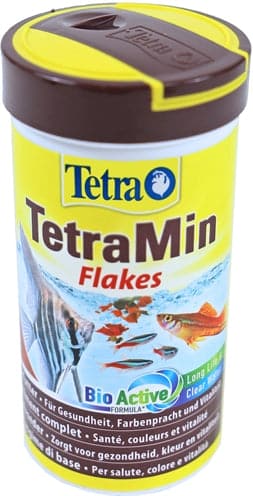
Tetramin Bio Active Vlokken Fish food 100 ml
Complete omnivorous flakes as a staple. Offer small portions and vary with suitable small frozen or live foods.
Check retailer for price0 retailers
View retailersPrices from the latest retailer update, excluding shipping. Check stock and delivery with the retailer.
Sources & review
This care guide draws on several specialist sources and was last checked on .