Red phantom tetra
Megalamphodus sweglesi

The red phantom tetra (Megalamphodus sweglesi) is an active yet peaceful shoaling fish from the Orinoco region. Males spread their extended dorsal and anal fins during displays; the photograph shows an adult male of the bright red form. Keep eight to ten or more together, with swimming length and planted margins for cover. The older trade name Hyphessobrycon sweglesi remains common, but the currently accepted combination is Megalamphodus sweglesi. This gives each fish room to behave naturally as a group while retaining shelter without losing the open swimming area.
Plan your aquarium →At a glance
- Temperature
- 22–23 °C
- pH
- 6.5–7.5
- GH
- 8–12 °dGH
- Aquarium length
- At least 80 cm
- Minimum aquarium volume
- At least 72 L
- Adult size
- Up to 3.5 cm
- Group size
- At least 8 individuals
- Temperament
- Peaceful
About this species
The red phantom tetra is a small characin from the upper and middle Orinoco watershed in Colombia and Venezuela. The accepted combination is Megalamphodus sweglesi (Géry, 1961); Hyphessobrycon sweglesi is the familiar older combination. The species is commercially bred and traded in several colour forms. Taxonomic work treats the particularly bright red form, sometimes sold as “rubra”, as the same species rather than a separate taxon.
Seriously Fish reports about 35 mm standard length, measured without the caudal fin. This guide’s photograph shows an adult male of the bright red form, with the characteristic dark shoulder spot and extended fins. Males develop longer dorsal and anal fins; females are generally deeper-bodied. Colour and fin development vary with individual condition.
Natural habitat
In the wild, the species occurs in smaller tributaries, oxbows and flooded forest habitats rather than only in main river channels. In Venezuela it is also found in morichals: clear water with sandy bottoms and dense aquatic or marginal vegetation. Both flowing blackwater sites and still floodplain lakes are reported elsewhere in its range, so one specific water type is not mandatory.
In an aquarium, provide sheltered areas and calm retreats alongside open swimming room. Sand, branching wood and plants along the margins suit this behaviour. Leaf litter can optionally add cover and micro-organisms but requires sensible maintenance. A clear planted aquarium can work too; do not create extreme acidity or unstable conditions simply to imitate a biotope.
Aquarium and layout
Seriously Fish gives an 80 × 30 cm base footprint, with about 72 litres as the smallest tank to consider. Preserve length and floor area: the same volume in a tall, narrow tank does not provide the same swimming space. This is a practical source-based guideline, not a universal stocking guarantee. Keep a mixed group of at least eight to ten; displays and social behaviour are more evident in a suitably sized shoal.
Use a mature aquarium with stable filtration, sand or another safe fine substrate, wood and planted margins. Leave open water through the centre. The species is active and uses mainly the middle and upper levels. Include sheltered areas without filling every part of the tank with plants. A cover is sensible because jumping risk is not sufficiently documented to recommend an open aquarium as safe.
Water conditions
Seriously Fish gives 20–28°C, pH 4.5–7.5 and GH 1–12 dGH. FishBase lists a narrower temperature range of 20–23°C and pH 5.5–7.5, based on older literature for the aquarium values. Tetra’s general aquarium recommendation is 22–24°C, pH about 6.5–8.5 and GH 8–15 dH. Because recommendations differ, for an ordinary community tank we use a cautious overlap of about 22–23°C, pH 6.5–7.5 and GH 8–12 dGH; this is not a proven biological boundary or a substitute for information about a fish’s source.
Stability and gradual acclimation matter more than chasing a particular number. Avoid sudden pH adjustments. No reliable species-specific KH target was established, so do not infer one from pH. Check the supplier’s conditions and acclimate fish gradually.
Behaviour and group size
The red phantom tetra is peaceful but active. Within a group, males display to one another and spread their fins to attract females and establish temporary dominance. Keep eight to ten or more so that attention is not repeatedly focused on one fish. Brief displays are normal; persistent chasing, damaged fins or an isolated fish suggest problems with space, group composition or tankmates.
Calm, similarly sized fish may suit it, including small South American characins, pencilfish and appropriate small catfish. Small to medium non-predatory dwarf cichlids are conditional on the overall layout and territories. Avoid large predators and established fin-nippers. Serpae tetras are therefore a risky match: behavioural risk matters more than overlapping water ranges. Give each species its own appropriate group and enough swimming room.
Feeding
In nature the species probably takes small invertebrates, crustaceans, filamentous algae and fallen fruit. In aquaria it generally accepts fine prepared foods, but variety with suitable live or frozen prey such as Daphnia, small mosquito larvae or Moina better reflects the documented diet.
Fine flakes or mini granules can form a daily staple if all fish can readily take the particles. Tetra names fine-grained foods such as TetraMin or Micro Pellets for this species; offer small portions and observe feeding. Alternate prepared food with small animal foods and avoid overfeeding. Distribute food so less dominant fish can feed too. A linked suitable product is a practical option, not an exclusive or mandatory diet.
Breeding
This species scatters eggs freely and provides no parental care. Fry may appear in a mature, densely planted aquarium, but adults and other fish can eat eggs and larvae. For controlled breeding, use a separate mature tank with subdued light. Provide fine-leaved plants, a spawning mop, marbles or mesh that lets eggs fall beyond adult reach. A sponge filter or air stone supplies gentle movement and oxygen.
The specialist source recommends slightly acidic to neutral water and a temperature toward the warm end of the usual range, without prescribing one universal breeding setpoint. Condition adults beforehand with varied small foods. A pair or small group can be introduced; check for eggs and remove the adults afterwards. Initial larvae need very fine food such as Paramecium or dust food around 5–50 microns. Introduce Artemia nauplii or microworms later, once the fry can eat them.
Keeping with other species

Serpae tetra
Not recommendedDiscouraged: Serpae tetras are active and may nip fins, while red phantom tetras display their extended fins and are calmer. Small tanks, undersized groups or food competition increase risk. Overlapping water values do not remove this behavioural concern.
View species profile →Suitable products
Recommended staple foods
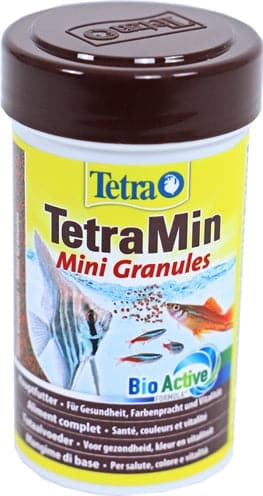
Tetra Min Minigranules Fish food 100 ml
Fine mini granules as a practical staple option for small freshwater fish. Offer small portions and check that all red phantom tetras can take the particles.
Check retailer for price0 retailers
View retailersPrices from the latest retailer update, excluding shipping. Check stock and delivery with the retailer.
Sources & review
This care guide draws on several specialist sources and was last checked on .
View the sources
- Zoological Journal of the Linnean Society — Melo et al. 2024, Phylogenomics of Characidae and phylogenetic classification
- Vertebrate Zoology — D. Bork, A. Zarske and H.J. Richter — source of the female photograph
- Creative Commons — Creative Commons Attribution 4.0 International
- Seriously Fish — Megalamphodus sweglesi species profile, revised 2026
- FishBase — Megalamphodus sweglesi — FishBase
- California Academy of Sciences — Eschmeyer’s Catalog of Fishes — Megalamphodus sweglesi
- Tetra — Red phantom tetras — Tetra Fishkeeper Blog
- D. Bork, A. Zarske and H.J. Richter / Wikimedia Commons — Hyphessobrycon sweglesi (31473-A).png — Wikimedia Commons