Red-eye tetra
Bario sanctaefilomenae

The red-eye tetra is an active, medium-sized shoaling fish still widely sold as Moenkhausia sanctaefilomenae. Its current name is Bario sanctaefilomenae. Look for the bright red eye, silver body and dark band at the base of the tail. Adults may reach about 7 cm standard length, so they need more horizontal room than many small tetras. Seriously Fish recommends a base around 90 × 38 cm and about 103 litres for this active species. Keep a group, plant the margins while leaving open swimming space, and consider fin condition and feeding access when choosing tankmates.
Plan your aquarium →At a glance
- Temperature
- 22–26 °C
- pH
- 6.0–8.0
- GH
- 3–20 °dGH
- Aquarium length
- At least 90 cm
- Minimum aquarium volume
- At least 103 L
- Adult size
- Up to 7 cm
- Group size
- At least 6 individuals
- Temperament
- Peaceful, May nip fins
About this species
The current Catalog of Fishes accepts Bario sanctaefilomenae (Steindachner, 1907). It was first described as Tetragonopterus sanctaefilomenae and later widely used as Moenkhausia sanctaefilomenae. Melo et al. (2024) placed it in the genus Bario, within Acestrorhamphidae. The older name remains common in aquarium shops and online; it is retained here as a search alias, not as a separate species.
The common name refers to the red eye. The body is silvery with a dark band at the caudal peduncle; adult fins may become darker. FishBase reports a maximum standard length of about 7 cm. Standard length ends at the base of the tail and is not the same as total length.
Sexing juveniles visually is difficult. Mature females may look fuller when carrying eggs, while males can appear more slender. Treat this as a tendency rather than a certainty for every fish.
Natural habitat
FishBase records the species from South American drainages including the Paranaíba, São Francisco, upper Paraná, Paraguay and Uruguay basins. These distribution limits are summarized from taxonomic and species databases; a trade name does not reveal the origin of a purchased fish.
Natural water varies seasonally. Seriously Fish describes substantial seasonal changes and reports that the species adapts to a range of aquarium chemistry. This is not a reason to imitate abrupt swings. Maintain stable, clean conditions and mature the filter before adding fish.
Seriously Fish says the species is common in the trade and that traded fish are generally captive-bred. Ask the supplier about the particular batch; the species profile cannot establish an individual fish’s history.
Aquarium and layout
Seriously Fish recommends a base of about 90 × 38 cm and roughly 103 litres for this active species. This is the species profile’s lower recommendation, not a universal volume for every community stocking plan. Tank length matters because these fish swim actively through midwater; a tall, short aquarium does not offer the same horizontal route.
Keep a group of at least six; the profile identifies it as a shoaling fish. Larger groups allow more social behaviour but also need enough swimming length and filtration. Plant the sides and rear densely, perhaps with floating cover for shade, while keeping the middle open. Wood and roots can add structure without blocking the swimming route.
Use dependable filtration, good gas exchange and a suitable cover. Add fish only to a biologically cycled aquarium. After introduction, check that all fish can rest and feed without persistent harassment.
Water conditions
The species-specific Seriously Fish guidance is 22–26°C, pH 6–8 and GH 3–20°dGH. FishBase gives pH 6–8 and temperatures around 22–26°C for natural waters. These sources support broad husbandry ranges, not permission for rapid fluctuations. Aim for stability.
No KH limit is supplied because the consulted sources do not establish a reliable species-specific value. Measure pH and hardness consistently and avoid abrupt adjustments. The specialist source notes that captive-bred fish tolerate a range of chemistry, but new arrivals still need gradual acclimation.
Regular partial water changes and a clean, cycled filter support water quality. Do not use pH products to force a precise number without a reason.
Behaviour and group size
Red-eye tetras are active shoaling fish. The specialist profile describes them as a good community choice, but their size and activity make tiny, very timid or long-finned tankmates less straightforward. They may nip fins when the group is too small or stressed. Choose companions by adult size, swimming zone, behaviour and feeding competition, not just overlapping water values.
Avoid fish that can swallow a red-eye tetra and animals whose fins may be repeatedly damaged. Tiny shrimp and very small fish are not automatically safe. Any pairing with smaller midwater fish is conditional: use a longer, roomier aquarium than the species minimum, maintain complete shoals and monitor interaction and food access.
Watch for ragged fins, hiding, chasing and fish missing meals. Separate species if stress or injury persists. A general label such as “peaceful” does not guarantee every individual aquarium pairing.
Feeding
FishBase reports an omnivorous diet that includes worms, insects, small crustaceans and plant matter. Seriously Fish says the species readily accepts a range of foods in aquaria. Offer a complete omnivorous staple and rotate suitable small frozen or live prey. Distribute food so less dominant individuals also get a share.
Feed portions that are eaten promptly and remove leftovers. Check that the whole shoal can take flakes; break larger pieces up if needed. The linked product is an existing complete flake food for omnivorous freshwater fish. It is a practical staple recommendation, not a claim about a measured particle or mouth size.
Diet variety supports condition, but it does not by itself create the red eye colour or replace stable water and sound care.
Breeding
Seriously Fish describes breeding as egg scattering. A dedicated attempt uses a separate, dimly lit tank with fine plants, a spawning mop or a mesh that lets eggs fall out of adult reach. Adults may eat eggs, so remove them when spawning is observed.
The source gives softer, more acidic spawning conditions than routine care: pH 6–7, GH 1–10 and about 26.5–29°C. These are breeding parameters, not everyday maintenance requirements. Condition adults with varied suitable food and avoid abrupt water changes.
The species profile reports hatching after about 24–36 hours, with fry free-swimming a few days later and needing very small food at first. Timing depends on conditions. Keep the breeding tank clean and inspect fry daily without exposing them to strong current.
Keeping with other species

Neon tetra
Suitable with conditionsConditional only: both use midwater, but red-eye tetras grow much larger and are more active. Each shoal needs space; monitor feeding competition and fin nipping. Use a long aquarium well beyond the minimum and check that every fish can feed without disturbance.
View species profile →Suitable products
Recommended staple foods
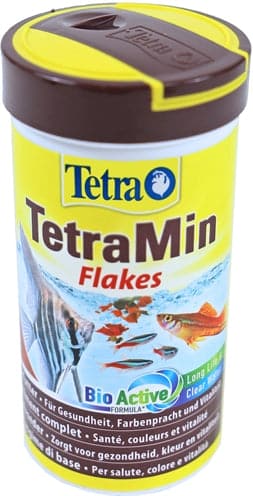
Tetramin Bio Active Vlokken Fish food 100 ml
Complete omnivorous freshwater flakes. Break into manageable portions and check the whole active shoal feeds; rotate with suitable small animal foods.
Check retailer for price0 retailers
View retailersPrices from the latest retailer update, excluding shipping. Check stock and delivery with the retailer.
Sources & review
This care guide draws on several specialist sources and was last checked on .
View the sources
- Zoological Journal of the Linnean Society — Melo et al. 2024, Phylogenomics of Characidae and phylogenetic classification
- California Academy of Sciences — Eschmeyer's Catalog of Fishes: Bario sanctaefilomenae; current status
- FishBase — Bario sanctaefilomenae (Steindachner, 1907) — Redeye tetra
- Seriously Fish — Moenkhausia sanctaefilomenae — specialist aquarium profile
- Wikimedia Commons; Cédricguppy - Loury Cédric — Moenkhausia sanctaefilomenae — aquarium photograph