Ornate tetra
Megalamphodus bentosi

The ornate tetra (Megalamphodus bentosi) is a peaceful South American shoaling fish with rosy tones and distinctive fins. It is also sold as the Bentos tetra or white-tipped tetra. It is often confused with the closely related rosy tetra (Megalamphodus rosaceus); the names are not interchangeable without checking identification. The ornate tetra needs a mature, clean aquarium and its own group of at least eight to ten. A roomy setup with plants, shade and open swimming space supports natural group behaviour.
Plan your aquarium →At a glance
- Temperature
- 20–28 °C
- pH
- 5.0–7.5
- GH
- 1–12 °dGH
- Aquarium length
- At least 90 cm
- Minimum aquarium volume
- At least 81 L
- Adult size
- Up to 4.5 cm
- Group size
- At least 8 individuals
- Temperament
- Peaceful
About this species
Megalamphodus bentosi is a small characin from the Amazon region. Its body is often silvery with a pink or reddish-brown wash. Males may develop more pronounced, strongly coloured dorsal and anal fins, while mature females are usually deeper-bodied. Older literature commonly calls the fish Hyphessobrycon bentosi. Current taxonomic sources use Megalamphodus bentosi (Durbin, 1908); related species such as M. rosaceus remain distinct taxa and are not merged as synonyms.
Seriously Fish reports about 45 mm standard length, measured without the caudal fin. The type locality is the lower Amazon near Óbidos in Pará, Brazil. Trade names include Bentos tetra and white-tipped tetra. Because related rosy tetras are more commonly offered and look similar, a shop label alone may not identify every fish with certainty.
Natural habitat
The species mainly inhabits sluggish tributaries, side arms and forest lakes, often near submerged roots, branches and marginal vegetation. The specialist profile describes natural water that may contain few dissolved minerals, be weakly buffered and stained brown by tannins. This describes ecological context; it is not a reason to create unstable water chemistry at home.
Use wood, plants and optionally aquarium-safe leaf litter to provide shelter. Floating plants can soften the light. Retain open swimming space for the shoal. Leaf litter is optional; remove material if it complicates water quality or maintenance. Ornate tetras can live in a planted community aquarium when it is mature, clean and appropriately stocked.
Aquarium and layout
Seriously Fish gives a minimum base footprint of about 90 × 30 cm and approximately 81 litres at a typical water depth. Treat this as the smallest source-based size, not a universal stocking formula. A longer aquarium gives the shoal more horizontal room. Keep at least eight to ten fish, ideally including both sexes. They show temporary social hierarchies, and males display more when companions are present.
The species needs a fully cycled, clean system. It tolerates organic waste poorly; the specialist source recommends routine weekly water changes. Combine these with suitable filtration, while avoiding a forceful jet across the entire tank. Provide plants and wood as shelter and ensure all fish can feed calmly. Do not introduce ornate tetras to a biologically immature aquarium; increase stocking gradually.
The stated 81 litres follows from the recommended base size and an example water depth. More volume alone does not replace length, maintenance or appropriate group size.
Water conditions
The specialist aquarium profile gives 20–28 °C, pH 5.0–7.5 and GH 1–12 dGH. These are broad care ranges; choose stable conditions appropriate to the fish’s source and previous water. Soft, mildly acidic water reflects many natural habitats, but there is no reason to acidify a stable aquarium abruptly.
The species is sensitive to accumulated organic pollution and should only be kept in a mature aquarium with consistent maintenance. The reviewed sources do not establish a species-specific KH target, so none is supplied. Test when appropriate and change conditions gradually. Natural tannin-stained, mineral-poor water is habitat context; brown colour or peat is not an independent health goal.
Behaviour and group size
The ornate tetra is peaceful and suits a carefully planned community. Keep at least eight to ten together; temporary dominance relationships and display behaviour develop within a group. Males tend to be slimmer and smaller and may show stronger colour and fins. Females are usually fuller-bodied. Visible differences vary with individual condition.
Choose companions of similar size and temperament, such as appropriate South American shoaling or bottom-dwelling fish. Avoid large predators and species that aggressively outcompete them for food. Rosy and ornate tetras are sometimes confused, so accurate identification matters when assessing tankmates. Shared pH or temperature alone does not prove a safe combination. Watch food intake, fin condition and whether every fish can reach cover.
Feeding
Megalamphodus bentosi is omnivorous. The specialist source lists small invertebrates, crustaceans, filamentous algae and fallen fruit among natural foods. In aquaria the fish may accept dry foods, but a varied menu that includes small frozen and live prey such as Daphnia, mosquito larvae and bloodworms is appropriate.
Fine granules and flakes make a practical staple when the fish eat them readily. The linked TetraMin Mini Granules is a small complete food; offer modest portions and check that less dominant fish also feed. Alternate it with suitable animal-based supplements. Remove leftovers and avoid overfeeding because this species needs clean water and excess food adds waste.
Breeding
The ornate tetra scatters eggs and provides no parental care. Fry may occasionally appear in a mature aquarium, but adults eat eggs they find. For controlled breeding, use a separate mature tank with very subdued light. Add a fine-leaved plant, spawning mop, marbles or a mesh that keeps eggs out of adult reach. An air-driven sponge filter provides gentle circulation.
The source recommends slightly acidic to neutral water and a temperature toward the upper end of the care range for breeding. Condition adults beforehand with varied foods. Eggs are often noticed the following morning; remove adults afterwards. Newly hatched fry need very fine foods such as infusoria or paramecium; only later can larger microorganisms or Artemia nauplii be offered. These are guidelines, not a guarantee of success. Maintain stable water and avoid rapid corrections.
Keeping with other species

Serpae tetra
Not recommendedThe ornate tetra is peaceful, but serpae tetras may nip fins, especially when their shoal is too small or swimming space is limited. The ornate tetra’s conspicuous dorsal and anal fins add uncertainty. Overlapping water values do not remove this behavioural risk. We therefore do not recommend this as a standard pairing; reconsider only with a spacious tank, a full serpae shoal and daily observation.
View species profile →Suitable products
Recommended staple foods
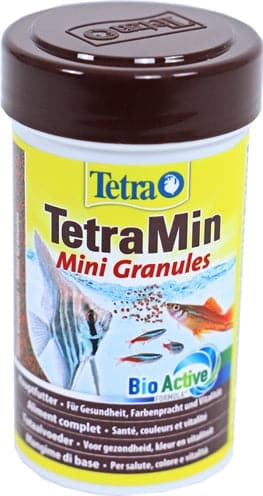
Tetra Min Minigranules Fish food 100 ml
Fine mini granules as a staple for a small omnivorous tetra. Check intake and rotate with suitable live or frozen foods.
Check retailer for price0 retailers
View retailersPrices from the latest retailer update, excluding shipping. Check stock and delivery with the retailer.
Sources & review
This care guide draws on several specialist sources and was last checked on .
View the sources
- Tetra — TetraMin Mini Granules — manufacturer product information
- Zoological Journal of the Linnean Society — Melo et al. 2024, Phylogenomics of Characidae and phylogenetic classification
- Creative Commons — Creative Commons Attribution 3.0 Unported
- Seriously Fish — Megalamphodus bentosi — specialist aquarium profile, revised 2026
- FishBase Consortium — Megalamphodus bentosi — FishBase
- World Register of Marine Species — WoRMS taxon list — accepted combination Megalamphodus bentosi
- Wikimedia Commons / Holger Krisp — Schmucksalmler Hyphessobrycon bentosi.jpg — Wikimedia Commons