Flame tetra
Hyphessobrycon flammeus

The flame tetra (Hyphessobrycon flammeus), also called the Rio tetra, is a small, peaceful South American shoaling fish. It needs a mature aquarium with stable, clean water because it tolerates organic pollution poorly. Keep a mixed group of eight to ten or more, with shaded planting and open swimming space. The species is commonly bred commercially; its native range in southeastern Brazil is under pressure. Choose healthy, well-fed captive-bred fish where possible and prepare the aquarium before introduction. This guide also covers identification, breeding and careful tankmate selection.
Plan your aquarium →At a glance
- Temperature
- 22–26 °C
- pH
- 5.8–7.5
- GH
- 5–12 °dGH
- Aquarium length
- At least 60 cm
- Minimum aquarium volume
- At least 54 L
- Adult size
- Up to 2.5 cm
- Group size
- At least 8 individuals
- Temperament
- Peaceful
About this species
The flame tetra is a characin from coastal waters and river systems in the Brazilian states of Rio de Janeiro and São Paulo. Its current name is Hyphessobrycon flammeus Myers, 1924. Trade names include flame, red and Von Rio tetra. A 2014 redescription clarified its identifying features and distribution. A recent phylogenomic classification places it within Acestrorhamphidae, while older references use the traditional family Characidae.
The adult remains small: Seriously Fish reports about 25 mm standard length, excluding the tail fin. A scientific description notes that males are usually smaller and more intensely red; dark tips on the pelvic and anal fins may occur in males. Both sexes can show a dark central area and pale tip on the dorsal fin. Trade strains and condition affect colour, so sex should not be judged from a single colour feature alone.
Natural habitat
The species is recorded from small, shallow, slow-flowing streams and coastal river systems. Sites include clear to brownish water, sandy bottoms and shade from low forest vegetation. It occurs in systems around Guanabara Bay, the middle Paraíba do Sul and Guandu, and the upper Tietê near São Paulo. Its exact native distribution remains under study; some São Paulo populations may have been introduced.
In an aquarium, gentle flow, plants and edge cover are appropriate. Sand, branching wood, floating plants and subdued light can bring out colour. Leave open swimming routes as well. Leaf litter is optional; keep water clean as organic material breaks down. The species does not require an extreme blackwater aquarium: source descriptions include both clear and brown water.
Aquarium and layout
Seriously Fish gives a 60 × 30 cm base and about 54 litres as the smallest tank to consider. Preserve the footprint; comparing litres alone can mislead. The fish is active and social, with temporary dominance behaviour among males. A mixed shoal of eight to ten or more gives natural behaviour room and prevents one fish from being persistently targeted.
Allow the aquarium to mature biologically before introduction. Use stable filtration, regular suitable water changes and adequate planting while keeping a clear swimming route. The species is intolerant of accumulated organic pollutants, so it is unsuitable for a newly started or neglected tank. Choose calm, small tankmates and avoid larger predators. A cover is a sensible precaution for small active fish.
Water conditions
Seriously Fish gives 20–26°C, pH 5.5–7.5 and GH 1–12 dGH. FishBase lists, based on the species redescription, an aquarium temperature of 22–28°C, pH 5.8–7.8 and hardness 5–25 dH. A cautious overlap is about 22–26°C, pH 5.8–7.5 and GH 5–12 dGH. The redescription also reports 22–28°C from observed natural conditions; a field range is not the same as a required aquarium setpoint. No reliable species-specific KH target was established.
Use this band as a guide rather than a sharp boundary. Consistency and low organic waste matter more than rapid correction. Check source water and the breeder’s or supplier’s conditions, then acclimate fish gradually. Do not add a buffer or mineral product without a measured reason.
Behaviour and group size
The flame tetra is peaceful, though males display and establish temporary dominance. In a spacious shoal, attention is shared and fish can show their fins. Eight to ten is a practical minimum; a larger group is often more social. Watch for persistent chasing, damaged fins or a fish that isolates itself. These signs call for more space, improved sightlines or a revised group.
Suitable companions are calm fish of similar size, such as small South American characins, pencilfish and small cory catfish. Non-predatory dwarf cichlids may work only if the layout offers enough space and cover. Avoid large predators and active fin-nippers. Serpae tetras are discouraged: fin-nipping and food competition outweigh any overlap in water conditions. Assess every combination by behaviour, adult size and available space.
Feeding
In the wild, the species takes small insects, worms, other small invertebrates and plant material. In aquaria, offer fine prepared food alongside small live or frozen prey such as Daphnia and mosquito larvae. Variety better reflects the reported omnivorous feeding than a single dry food.
Fine flakes or mini granules can serve as a daily staple if every fish can eat the particle size. Offer small portions and observe whether less dominant fish also get enough. Remove leftovers to keep organic load low. Existing TetraMin Mini Granules is an appropriate fine-grained option for small freshwater fish, but acceptance must be checked with the shoal; it is not an exclusive dietary prescription.
Breeding
The flame tetra is a free-spawning egg scatterer with no parental care. Controlled breeding uses a separate, mature, dimly lit tank. Fine-leaved plants, a spawning mop, marbles or mesh can keep eggs out of reach of adults. Keep water movement gentle but adequately oxygenated. Condition a healthy breeding group with varied small foods and remove the adults after spawning.
A scientific redescription reports females depositing about 200–330 oocytes on stones, plants or submerged debris; hatching was described after roughly two to three days. These are reported observations, not guaranteed yield or fixed timing for every aquarium. Larvae first need very fine food such as infusoria or Paramecium; introduce larger prey only when fry can manage it. Keep the rearing tank clean without siphoning up the young.
Keeping with other species

Serpae tetra
Not recommendedDiscouraged: Serpae tetras are more boisterous and may nip fins; the small, peaceful flame tetra can be stressed or injured. Food competition and inadequate group size increase risk. Shared water values do not make this pairing automatically suitable.
View species profile →Suitable products
Recommended staple foods
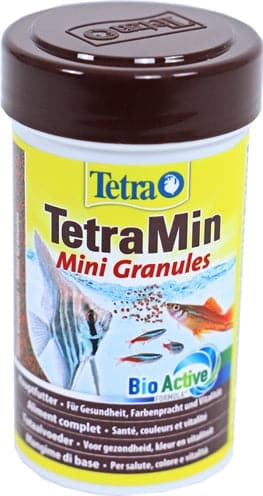
Tetra Min Minigranules Fish food 100 ml
Fine mini granules as a practical staple option for small freshwater fish. Offer small portions and check that all flame tetras take the particles.
Check retailer for price0 retailers
View retailersPrices from the latest retailer update, excluding shipping. Check stock and delivery with the retailer.
Sources & review
This care guide draws on several specialist sources and was last checked on .
View the sources
- Zoological Journal of the Linnean Society — Melo et al. 2024, Phylogenomics of Characidae and phylogenetic classification
- Creative Commons — Creative Commons Attribution 4.0 International
- Tetra — Red phantom tetras — Tetra Fishkeeper Blog
- Seriously Fish — Hyphessobrycon flammeus — species profile, revised 2026
- FishBase — Hyphessobrycon flammeus summary
- Neotropical Ichthyology — Carvalho, Jesus & Langeani (2014), Redescription of Hyphessobrycon flammeus Myers, 1924
- ITIS / Catalog of Fishes — ITIS report — Hyphessobrycon flammeus
- Igor Balashov / Wikimedia Commons — Hyphessobrycon flammeus — iNaturalist photo 319666874