Diamond tetra
Makunaima pittieri

The diamond tetra is the aquarium trade name for Makunaima pittieri, formerly called Moenkhausia pittieri. It is native to Venezuela’s Lake Valencia drainage. Juveniles can look rather plain and silvery; reflective scales and longer male fins become more evident as the fish mature and settle. Keep at least six in a mature aquarium with open swimming room and planted, sheltered margins. The species-specific Seriously Fish guidance is 24–28°C, pH 5.5–7 and GH 5–12. A suitable shoal can reduce fin nipping within the group, but it does not replace adequate space, compatible tankmates or observation.
Plan your aquarium →At a glance
- Temperature
- 24–28 °C
- pH
- 5.5–7.0
- GH
- 5–12 °dGH
- Aquarium length
- At least 60 cm
- Minimum aquarium volume
- At least 68 L
- Adult size
- Up to 6 cm
- Group size
- At least 6 individuals
- Temperament
- Peaceful, May nip fins
About this species
The current name in Eschmeyer’s Catalog of Fishes is Makunaima pittieri (Eigenmann, 1920). It was originally described as Moenkhausia pittieri, a name still widely used in shops, hobby books and image archives. The 2024 phylogenomic classification by Melo et al. placed the tetra in Makunaima and the family Acestrorhamphidae. These two binomials refer to the same species, not separate fish.
The diamond tetra is endemic to Lake Valencia and surrounding waters in northern Venezuela. The specialist species profile reports a maximum of about 60 mm standard length, measured without the caudal fin. Juveniles often enter trade before the characteristic reflective scales and adult fin shape are fully developed, so do not judge a young fish by colour alone.
The common name refers to the reflected light from its scales. Mature males tend to have longer dorsal, anal and pelvic fins with a violet sheen; females are often deeper-bodied. These are typical traits, not a reliable way to sex every juvenile.
Natural habitat
Its natural range is around Lake Valencia in Venezuela. The species is recorded from shallow vegetated lake margins and slow-flowing tributaries. This supports an aquarium with plants along the edges, sheltered retreats and open midwater. No single plant species or exact current speed is established for all localities.
Seriously Fish describes the lake’s water quality as heavily affected by agriculture, industry and eutrophication. Poor conditions in a natural habitat are not care instructions: do not reproduce pollution in an aquarium. Aim for stable, clean water and let the filter mature biologically before adding fish.
The species profile says many fish in trade are commercially bred. Origin depends on the supplier and batch; appearance alone cannot prove whether a particular fish was captive-bred or wild-caught.
Aquarium and layout
For a small group, Seriously Fish gives a tank base of about 60 × 38 cm and a volume around 68 litres. Treat this as the species profile’s documented lower recommendation, not as a guarantee that every community stocking plan will fit. A longer aquarium gives these midwater swimmers more horizontal room; allow additional space for tankmates and their adult size.
Keep at least six diamond tetras together; the specialist source gives six to eight as a shoal size at which squabbling and fin nipping are usually contained within the group. Provide dense planting along the rear and sides, perhaps some floating cover, while retaining open swimming space. In very bright, bare tanks they may appear skittish.
Use reliable filtration with even flow and good oxygen exchange. A secure cover is sensible for active fish. After introduction, check that all individuals feed, fins remain intact and the group does not stay hidden continuously.
Water conditions
Seriously Fish gives species-specific guidance of 24–28°C, pH 5.5–7.0 and GH 5–12°dGH. Keep temperature stable; these ranges are husbandry guidance, not a reason to make rapid corrections if an aquarium is just outside them. Avoid abrupt water chemistry changes to chase a number.
The species can be maintained in a range of conditions, according to the source, but tank-bred specimens often show their best colour below neutral pH. Habitat observations and aquarium guidance are different kinds of evidence. No KH range is supplied here because the consulted species profile does not establish one.
Test water with appropriate equipment and watch behaviour and appetite alongside measurements. Regular partial water changes and a maintained, cycled filter help control waste. Do not use chemicals to force pH or hardness changes quickly.
Behaviour and group size
Diamond tetras are peaceful shoaling fish, but their relatively robust build and adult size mean they should not be treated like tiny nano tetras. Keep a shoal of at least six; in undersized groups, skittishness and fin nipping may become more noticeable. Males may display and have brief disputes. Provide room and observe whether this remains limited.
Calm medium-sized tankmates may work when temperature, chemistry, adult size, swimming zone and social needs also match. Avoid large predators, persistent fin nippers and very small animals that could be viewed as prey. Tiny shrimp are not automatically safe. A peaceful label does not guarantee compatibility: feeding competition and behaviour in the actual aquarium matter.
The elongated adult fins can be vulnerable to nipping. After mixing species, watch for ragged fins, hiding, missed meals and persistent pursuit. Have a way to adjust the stocking if problems develop.
Feeding
The specialist profile describes this species as an easy feeder that accepts a varied diet. Offer an omnivorous mix of suitable dry food, supplemented with small frozen or live prey such as daphnia, brine shrimp or mosquito larvae in appropriate portions. A small tropical fish food is practical; do not offer pieces the fish cannot readily take.
Feed measured small portions rather than one large amount. Remove leftovers and check that less dominant fish can feed. A varied diet supports condition and adult colour, although colour development also depends on age, health, lighting and background.
The existing product link below is a complete omnivorous freshwater flake food. Crumble flakes if needed and check intake; this is not a claim about a measured mouth or flake size. Rotate it with suitable small animal foods.
Breeding
Seriously Fish describes breeding in a separate, dimly lit tank with fine plants or a barrier that keeps eggs out of reach of adults. The species scatters eggs and gives no parental care; adults may eat eggs. Use stable conditions in a breeding setup and do not confuse breeding guidance with routine community care.
The source lists softer, more acidic spawning conditions than general maintenance guidance: pH 5.5–6.5, GH 1–5 and about 26.5–29°C. These are targeted breeding parameters, not required values for every diamond tetra. A separate spawning attempt needs preparation, suitable adults and appropriate fry food. Eggs and newly hatched larvae are small; outcomes vary with each spawn and conditions.
Remove the adults once eggs are noticed. Keep the breeding tank clean without siphoning eggs or larvae, and feed fry only once free-swimming and able to take suitable food particles.
Keeping with other species

Neon tetra
Suitable with conditionsConditional only: water ranges overlap, but adult diamond tetras are larger and each species needs its own shoal. Provide more than minimum space and watch feeding, pursuit and size difference. Shared pH and temperature alone do not establish a safe pairing.
View species profile →Suitable products
Recommended staple foods
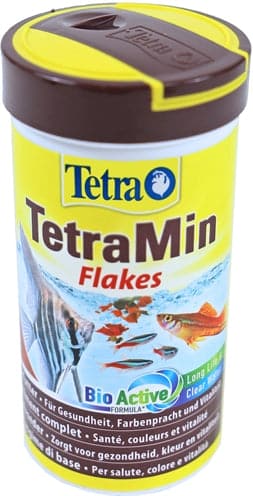
Tetramin Bio Active Vlokken Fish food 100 ml
Complete omnivorous freshwater flakes. Crumble if needed and check that diamond tetras take them; rotate with small animal foods.
Check retailer for price0 retailers
View retailersPrices from the latest retailer update, excluding shipping. Check stock and delivery with the retailer.
Sources & review
This care guide draws on several specialist sources and was last checked on .
View the sources
- Zoological Journal of the Linnean Society — Melo et al. 2024, Phylogenomics of Characidae and phylogenetic classification
- California Academy of Sciences — Eschmeyer's Catalog of Fishes: Makunaima pittieri; updated 13 August 2026
- FishBase — Makunaima pittieri (Eigenmann, 1920) — Diamond tetra
- Seriously Fish — Makunaima pittieri — species profile, revised 2026
- Wikimedia Commons; OpenCage — Moenkhausia pittieri.jpg — photograph