Common molly
Poecilia sphenops

The common molly (Poecilia sphenops), also called the short-finned molly, is a livebearing fish native to Central America and northern South America. It occurs in fresh and brackish habitats, but aquarium health depends especially on adequate minerals and stable alkaline water. Allow for about 7.5–8 cm standard length and use a specialist baseline footprint of 90 × 30 cm (about 81 litres at 30 cm water depth). Mollies are usually peaceful, yet they do not suit every community: tankmates must also tolerate hard, alkaline water. “Black molly” and other colour labels do not guarantee a pure species identity; many trade forms are selectively bred and some have been crossed with other mollies.
Plan your aquarium →At a glance
- Temperature
- 21–28 °C
- pH
- 7.5–8.2
- GH
- 15–30 °dGH
- Aquarium length
- At least 90 cm
- Minimum aquarium volume
- At least 81 L
- Adult size
- Up to 8 cm
- Group size
- At least 3 individuals
- Temperament
- Peaceful
About this species
Poecilia sphenops belongs to the family Poeciliidae and order Cyprinodontiformes. Eschmeyer’s Catalog of Fishes accepts Poecilia sphenops Valenciennes, 1846. Its shorter dorsal fin broadly distinguishes it from sailfin mollies, although identifying cultivated trade strains can be difficult. Wild fish are usually grey to olive and may show small dark spots. Aquarium strains include black, gold, silver and spotted forms. These are colour or breeding labels, not proof that every fish is genetically pure P. sphenops. Balloon-shaped forms with an unusually shortened, rounded body may have welfare problems and warrant caution.Natural habitat
The species is native to Central America. Sources describe a range from Mexico south through Nicaragua, Honduras and El Salvador; aquarium references also mention Colombia and Venezuela. Exact range limits and separation from related mollies remain taxonomically complex. It inhabits warm lowland waters, including fresh and brackish coastal habitats. Salinity tolerance does not mean aquarium salt is routinely required. In freshwater care, adequate hardness and minerals are the central concern.Aquarium and layout
Provide open swimming space, robust planting around the edges and calm shelter. The specialist profile gives a 90 × 30 cm footprint and about 81 litres at 90 × 30 × 30 cm. Treat this as a sourced baseline, not a guarantee for every stocking plan or breeding group. Use a mature filter and regular water changes; mollies produce fry and populations can grow quickly. Choose plants and décor that suit hard water. Keep several females per male to spread persistent courtship, or keep an all-female group.Water conditions
Maintain about 21–28 °C. Across the sources consulted, a conservative overlap is roughly pH 7.5–8.2 and hardness 15–30 °dGH. This overlap is a practical synthesis, not a reason to target extremes. Stable alkaline water with calcium and magnesium matters more than adding salt. Seriously Fish warns that soft, acidic water may undermine health and explicitly says extra salt is unnecessary. Measure your source water and avoid abrupt changes. If your tap water is persistently soft and acidic, consider another species or use carefully monitored water conditioning.Behaviour and group size
Mollies are generally peaceful and active. Their main compatibility constraint is their preference for hard, alkaline water, so choose tankmates known to tolerate the same chemistry. Overlapping water values alone do not prove social compatibility. Males may pursue females persistently; keep several females per male or an all-female group. Adults may eat fry. Mollies can be kept with other Poecilia, but related species may interbreed; avoid mixing them if maintaining pure lines matters. Trade names such as “molly” should not be taken as proof of a pure taxon because ornamental strains may be hybrids.Feeding
The common molly is an omnivore that takes small benthic animals and organic matter in nature. Offer a complete tropical flake food in modest portions and check that the fish eat it readily. Regularly supplement with plant- or algae-rich foods and suitable small animal foods, such as appropriate frozen foods. A varied menu is preferable to an exclusively protein-rich dry diet. Remove leftovers and feed only what is eaten promptly to help keep water stable.Breeding
Poecilia sphenops is livebearing; fry are born free-swimming. Dense plants can give young fish cover, although adult mollies may eat them. Plan in advance for raising or responsibly rehoming offspring. Sources differ substantially on gestation: FishBase gives about 28 days, while Seriously Fish reports around eight weeks. We therefore do not state an exact duration or guaranteed brood size. Males are smaller and have a gonopodium, a modified anal fin; females are usually deeper-bodied. Separate trade strains and related species if you want to avoid crosses.Keeping with other species

Sailfin molly
Not recommendedThese two molly species can interbreed readily in aquaria. Do not keep them together if you want species-true offspring; keep one molly species per tank. Overlapping water parameters do not remove this risk.
View species profile →Suitable products
Recommended staple foods
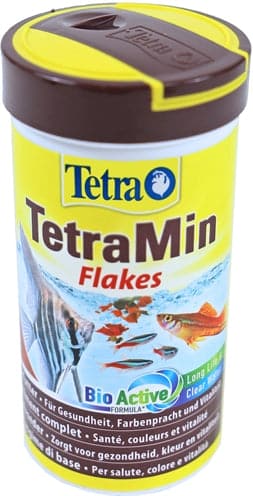
Tetramin Bio Active Vlokken Fish food 100 ml
Complete tropical flakes as a practical staple for an omnivorous diet. Supplement with vegetable/algae-rich and suitable small animal foods; offer modest portions and check intake.
Check retailer for price0 retailers
View retailersPrices from the latest retailer update, excluding shipping. Check stock and delivery with the retailer.
Sources & review
This care guide draws on several specialist sources and was last checked on .
View the sources
- California Academy of Sciences — Eschmeyer’s Catalog of Fishes — Poecilia sphenops
- GBIF — GBIF Backbone Taxonomy — Poecilia sphenops
- Seriously Fish — Seriously Fish — Short-finned Molly / Poecilia sphenops
- FishBase — FishBase — Poecilia sphenops species summary
- University of the West Indies — The Online Guide to the Animals of Trinidad and Tobago — Common Molly
- U.S. Fish and Wildlife Service — U.S. Fish and Wildlife Service — Mexican Molly ecological risk screening
- Dnoerholm / Wikimedia Commons — Poecilia sphenops wild form — Wikimedia Commons
- Tetra — TetraMin Flakes — manufacturer product information