Celestial pearl danio
Danio margaritatus
The celestial pearl danio (Danio margaritatus), also sold as the galaxy rasbora, is a tiny, boldly patterned shoaling fish from Myanmar. Its dark blue-green body, pale pearl-like spots and red-tinted fins are most visible when the fish feel secure. Small size does not make it a carefree choice for a newly set-up nano tank: males spar, and shy individuals can disappear among boisterous tank mates. Choose a mature, stable aquarium with dense planting, gentle flow and a substantial group. Use food small enough to swallow and check that the more reticent fish get their share.
Plan your aquarium →At a glance
- Temperature
- 20–26 °C
- pH
- 6.5–7.5
- GH
- 5–15 °dGH
- Aquarium length
- At least 45 cm
- Minimum aquarium volume
- At least 41 L
- Adult size
- Up to 2.1 cm
- Group size
- At least 20 individuals
- Temperament
- Peaceful
About this species
The accepted name is Danio margaritatus. It was originally described as Celestichthys margaritatus; “galaxy rasbora” is a trade name, not a taxonomic rasbora. Adults reach about 21 mm standard length. The blue to blue-green body carries conspicuous pale spots. Males usually show stronger red and black fin markings, while females tend to be fuller-bodied and less vivid. Captive lines may have aberrant fin patterns or deformities, so assess body shape, swimming and general condition as well as colour.Natural habitat
The type locality is near Hopong in Shan State, Myanmar, at roughly 1,040 m elevation. The specialist profile describes a shallow, spring-fed, permanently flooded grassland pool. Its clear water is about 30 cm deep and supports dense aquatic growth, including Elodea, Egeria and Blyxa. The species has since been recorded in parts of the Salween drainage and northern Thailand. These observations describe its known habitats; they do not mean every aquarium must recreate one exact pool or water chemistry.Aquarium and layout
Seriously Fish gives a minimum base of 45 × 30 cm and about 41 litres for a group. The footprint recommendation reflects sparring among males; it is not a guarantee that every community aquarium of that volume is suitable. Provide dense fine-leaved planting and broken sightlines, a dark substrate and optional floating cover. Leave swimming space and use gentle filtration. Avoid boisterous or much larger tank mates that may make the danios hide or miss food. Add them only to a biologically mature, stable aquarium.Water conditions
The published care range is 20–26 °C, pH 6.5–7.5 and GH 5–15 dGH. FishBase also reports 22–24 °C from a field observation in shallow habitat in January 2007; that is a local measurement, not an alternative aquarium-care range. Keep temperature and chemistry stable within the care range. Consider the stock’s origin and transport water, and avoid rapid pH or hardness corrections that add stress.Behaviour and group size
This social fish should be kept in a group; Seriously Fish recommends ideally 20 or more. Celestial pearl danios form loose shoals rather than a tightly synchronised school. Males spar regularly and may nip fins within their own group. Larger numbers spread attention and often make the fish bolder. The specialist profile names small Myanmar danios and Microdevario as potential companions. Microdevario kubotai may suit them conditionally because of similar size and overlapping water ranges. Danio erythromicron is discouraged because hybridisation may occur. Larger or boisterous fish can intimidate celestial pearl danios or outcompete them for food.Feeding
The species likely eats small invertebrates, algae and zooplankton. In aquaria it accepts suitably small dry food, but this should not be its only diet. Offer regular small portions of live or frozen foods such as Daphnia and Artemia. Newly imported or thin fish may struggle to acclimatise; start with small live prey and introduce dry food gradually. They rarely feed at the surface, so floating foods are a poor choice. Feed sparingly and confirm that every fish is actually eating.Breeding
Celestial pearl danios scatter eggs and provide no parental care. A few fry may appear in a mature, densely planted aquarium, but adults eat eggs and larvae. Deliberate breeding needs a separate mature setup with fine-leaved spawning material. Remove the adults after spawning and plan for tiny larvae that first need infusoria or another microscopic food. Artemia nauplii are appropriate only once the fry can take them. Breeding is a dedicated project, not a guaranteed outcome in a community tank.Suitable products
Supplementary foods

Tropical Dafnia 100ml
Dried Daphnia for supplementary variety; not a sole or guaranteed staple food.
Check retailer for price0 retailers
View retailers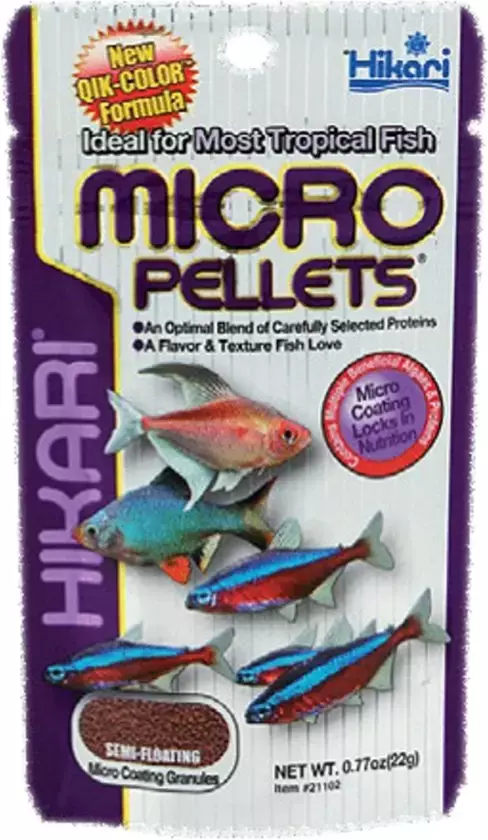
Hikari Micro pellets 22gr - Vissenvoer
Small micro pellet described by the manufacturer for small-mouthed fish. Offer tiny portions after acclimation and confirm intake; always vary the diet.
Check retailer for price0 retailers
View retailersPrices from the latest retailer update, excluding shipping. Check stock and delivery with the retailer.
Sources & review
This care guide draws on several specialist sources and was last checked on .