Buenos Aires Tetra
Psalidodon anisitsi
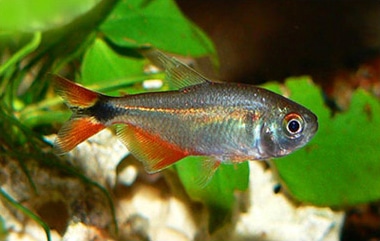
The Buenos Aires tetra, now generally called Psalidodon anisitsi, is an active shoaling fish from the Paraná and Uruguay basins. It grows larger than many familiar tetras, swims strongly, may eat soft aquarium plants and can sometimes nip fins. Keep at least eight to ten fish in a long, spacious, mature aquarium with robust tankmates. This guide covers current taxonomy, habitat, suitable housing, diet and breeding.After introduction, regularly check fins, feeding access and how the available swimming space is shared.
Plan your aquarium →At a glance
- Temperature
- 16–28 °C
- pH
- 5.5–8.5
- GH
- 1–20 °dGH
- Aquarium length
- At least 90 cm
- Minimum aquarium volume
- At least 81 L
- Adult size
- Up to 6 cm
- Group size
- At least 8 individuals
- Temperament
- Territorial
About this species
Recent catalogues accept Psalidodon anisitsi (Eigenmann, 1907). The familiar aquarium name Hyphessobrycon anisitsi remains widely used; older names include Hemigrammus anisitsi, H. caudovittatus and Hyphessobrycon erythrurus. The common name Buenos Aires tetra is geographically misleading: the species ranges broadly through the Paraná and Uruguay basins, while some records from Buenos Aires Province are attributed to the similar H. togoi.
Seriously Fish reports about 60 mm standard length. FishBase gives a maximum of 13.2 cm total length, a different measurement and a conspicuous discrepancy that should not be treated as the same value. We preserve the measurement bases rather than presenting one falsely precise maximum. Males are slimmer, somewhat smaller and often more intensely coloured; females become deeper-bodied.
Natural habitat
The species occurs in Brazil, Paraguay, Argentina and Uruguay, mainly in the Paraná system and Uruguay drainage. It is found more often in small streams and tributaries than in major channels, but also inhabits floodplain lakes, backwaters and oxbows. Its natural range is subtropical, with abundant rainfall and relatively mild winters; it is not strictly a tropical fish.
A robustly structured aquarium with plants, wood and some water movement provides cover and swimming space. Soft plants may be eaten, so choose sturdy species attached to wood or rock, or consider artificial plants. Cover along the edges and an open central zone support both retreat and active swimming.
Aquarium and layout
Seriously Fish gives a base of 90 × 30 cm, around 81 litres, as the smallest aquarium to consider. Length and floor space matter; litres alone do not show the available swimming room. Keep at least eight to ten fish so social interaction is directed toward one another. A biologically mature tank, stable filtration and regular water changes are important even though the species tolerates a broad range of water conditions.
This is a large, energetic tetra. Use a secure lid, robust decor and plants that can withstand grazing. Plan the community around adult size and activity, not juvenile shop size. Observe feeding, fin condition and whether subordinate fish can find cover. A small aquarium or undersized group may intensify behaviour toward tankmates.
Water conditions
Seriously Fish gives 16–28 °C, pH 5.5–8.5 and GH 1–20 dGH. The broad temperature range reflects its subtropical origin; the profile cautions against keeping the fish for long periods at the warm upper end. These are care limits, not a reason to change conditions abruptly. No reliable species-specific KH target has been established.
Choose stable values suited to the fish and its tankmates. Avoid sudden changes in temperature or mineral content and do not correct pH without measurement and a clear reason. Provide good oxygenation and keep waste low. Gradual acclimation is more important than chasing one exact number.
Behaviour and group size
Buenos Aires tetras are active and social, with loose hierarchies and rivalry between males. The species has a fin-nipping reputation, especially when too few are kept or space is limited. The specialist minimum is eight to ten fish. Even in a proper group, observe interactions: repeated chasing, damaged fins or withdrawn tankmates call for a change.
Choose robust fish of similar size and activity, ideally open-water swimmers. Very shy, slow or long-finned fish are poor choices, as are large predators and fish small enough to be swallowed. Compatibility depends on adult size, aquarium length, group size and territory. Overlapping water values alone do not establish a safe pairing.
Feeding
The species is probably a foraging omnivore. Worms, insects, zooplankton and smaller amounts of plant matter fit its reported natural diet. In aquaria it accepts quality flakes and granules, supplemented with small live or frozen foods such as mosquito larvae, Daphnia and Artemia. Some dry food can include plant or algal ingredients.
Offer variety in portions that are eaten promptly and distribute food so subordinate fish can feed. Remove leftovers. An existing complete freshwater granule food can form part of the menu, but should not be the only food offered. Also account for grazing on soft aquarium plants; simply adding extra dry food is not a reliable way to prevent it.
Breeding
The Buenos Aires tetra scatters eggs and provides no parental care. Fry may occasionally appear in a mature aquarium, but adults eat eggs and larvae. Controlled breeding is better attempted in a separate, mature, very dimly lit tank. A fine mesh, marbles, spawning mop or fine-leaved plants can keep eggs out of reach. Provide oxygen and gentle water movement.
Condition healthy adults beforehand with varied food. The specialist profile reports that a well-conditioned female may release up to about 2,000 eggs; this is a reported maximum, not an expected yield. Eggs typically hatch within 24–36 hours. First foods must be very fine, such as Paramecium or suitable powdered food; add Artemia nauplii only when fry are large enough. Keep the tank clean without disturbing larvae.
Keeping with other species

Serpae tetra
Not recommendedDiscouraged: both species may nip fins and are active shoaling characins. Together they can increase pressure on fins and shy tankmates; a larger aquarium and proper group sizes do not remove this behaviour.
View species profile →Suitable products
Recommended staple foods
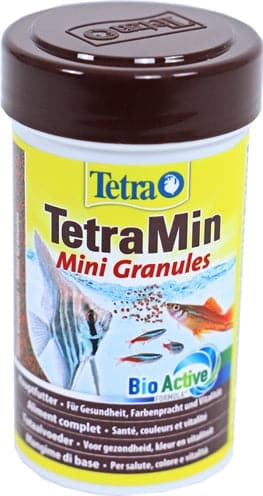
Tetra Min Minigranules Fish food 100 ml
Existing complete freshwater granules as part of a varied omnivorous diet. Combine with small animal-based frozen or live foods and monitor intake.
Check retailer for price0 retailers
View retailersPrices from the latest retailer update, excluding shipping. Check stock and delivery with the retailer.
Sources & review
This care guide draws on several specialist sources and was last checked on .
View the sources
- Creative Commons — Creative Commons Attribution-ShareAlike 3.0 Unported
- Seriously Fish — Hyphessobrycon anisitsi species profile, revised 2026
- FishBase — Psalidodon anisitsi summary
- California Academy of Sciences — Eschmeyer Catalog of Fishes species record
- Nick Sc / Wikimedia Commons — Hyphessobrycon anisitsi — Buenos Aires tetra