Bleeding Heart Tetra
Megalamphodus erythrostigma

The bleeding heart tetra (Megalamphodus erythrostigma) is a relatively large, peaceful shoaling fish from the upper Amazon basin. Its distinctive red shoulder spot gives it its common name. Adult males develop longer fins and may show mild territorial behaviour toward one another. Keep at least eight to ten fish in a mature, spacious aquarium with open swimming room, shade and cover. This guide covers current taxonomy, natural habitat, water conditions, diet and reproduction.When planning a community aquarium, also consider adult size, food competition and the calm temperament of its other inhabitants.
Plan your aquarium →At a glance
- Temperature
- 21–28 °C
- pH
- 4.0–7.5
- GH
- 1–12 °dGH
- Aquarium length
- At least 90 cm
- Minimum aquarium volume
- At least 81 L
- Adult size
- Up to 6 cm
- Group size
- At least 8 individuals
- Temperament
- Peaceful, Territorial
About this species
The current combination used in recent specialist literature is Megalamphodus erythrostigma (Fowler, 1943). Many aquarium sources still use Hyphessobrycon erythrostigma; Hemigrammus erythrostigma and Hyphessobrycon rubrostigma are historical names for the same species. The red shoulder mark is a distinctive feature. Seriously Fish reports a maximum of about 60 mm standard length, excluding the tail fin.
Adult males grow larger and become more intensely coloured, with extended dorsal, pelvic and anal fins. Females are rounder, especially when carrying eggs. Colour and fin shape may be less pronounced in young or stressed fish. Assess the whole pattern and do not treat older trade names as separate species.
Natural habitat
The species occurs in the upper Amazon basin where Brazil, Peru and Colombia meet, from the Purus drainage at least as far upstream as the Nanay near Iquitos. It inhabits sluggish tributaries, side arms and forest lakes, often among submerged roots, branches and marginal plants. Recorded sites include both soft, brown-stained water and a turbid whitewater locality, so a single blackwater description does not represent its full natural range.
Provide wood, plants and shaded areas in the aquarium. Floating plants are optional; retain an open swimming zone. Leaf litter can add cover and microbial life but is not essential and needs maintenance because decomposition can affect water quality. A dark substrate may enhance the colours, but is not a biological requirement.
Aquarium and layout
Seriously Fish recommends a base of about 90 × 30 cm and roughly 81 litres as the smallest aquarium to consider. Prioritise length and floor space: a tall, narrow aquarium of the same volume is not equivalent. The fish reaches around 6 cm standard length and uses a generous swimming area. Keep a mixed group of at least eight to ten specimens.
The tank must be biologically mature, stable and clean. The species tolerates organic waste accumulation poorly, so plan regular water changes and avoid overfeeding. Plant the sides, add wood for cover and create visual breaks so adult males can avoid one another. Do not introduce the fish to a newly started aquarium. Check that all fish feed and that no individual faces persistent chasing.
Water conditions
The species-specific aquarium range from Seriously Fish is 21–28 °C, pH 4.0–7.5 and GH 1–12 dGH. These are broad care limits, not values to reach abruptly. Field research describes more acidic water at some locations but also a turbid whitewater site. Natural sites show variation and cannot all be translated into one aquarium target. No reliable species-specific KH target has been established.
Choose stable values within a suitable range and keep ammonia and nitrite at zero. Avoid rapid pH corrections and major temperature or mineral changes. Acclimate new fish gradually and match maintenance to measured water quality. Clean, stable conditions matter more than reproducing one extreme location.
Behaviour and group size
Bleeding heart tetras are generally peaceful and social. Adult males may display and show some territorial behaviour toward one another. A group of eight to ten or more distributes attention. Provide plants, wood and sight breaks so a fish can withdraw. Persistent chasing, damaged fins or an individual unable to reach food are signs to review space or group composition.
Choose calm, similar-sized tankmates such as characins, hatchetfish, pencilfish, smaller corydoras or non-predatory medium-sized cichlids in a large aquarium. Avoid large predators, tiny prey-sized fish and boisterous fin nippers. Water values alone do not ensure compatibility: adult size, activity, territoriality, shoaling needs and swimming length also matter.
Feeding
The species is an opportunistic omnivore. Stomach-content research reports fruit remains, aquatic insects and larvae, with proportions varying between sites. In aquaria it generally accepts quality flakes and granules, supplemented with small live or frozen foods such as mosquito larvae, Daphnia and Artemia. Some prepared foods may include plant or algal ingredients.
Offer variety in portions that are eaten promptly. Distribute food so less dominant fish can feed and remove leftovers to limit organic waste. Small pieces of fresh fruit may be taken, but leave them in the aquarium only briefly to protect water quality. Fruit is an occasional supplement, not a replacement for complete fish food.
Breeding
The bleeding heart tetra scatters eggs and provides no parental care. Adults may eat eggs and larvae, so breeding is best attempted in a separate, mature aquarium. Use subdued light, fine-leaved plants or a spawning mop, and optionally a mesh that lets eggs fall out of reach. Provide gentle water movement and adequate oxygen. The specialist profile does not give a reliable fixed egg count or universal incubation period.
Condition healthy adults beforehand with varied small foods. Remove them after spawning and keep the aquarium clean without disturbing eggs or larvae. Match first foods to fry size; very fine powdered food or infusoria may be needed before larger prey can be eaten. Results depend on fish condition and setup and are not guaranteed.
Keeping with other species

Serpae tetra
Not recommendedDiscouraged: adult Serpae tetras may nip fins. The bleeding heart tetra has extended fins and needs calm tankmates; injury, stress and food competition are credible risks. Overlapping water values do not make this pairing safe.
View species profile →Suitable products
Recommended staple foods
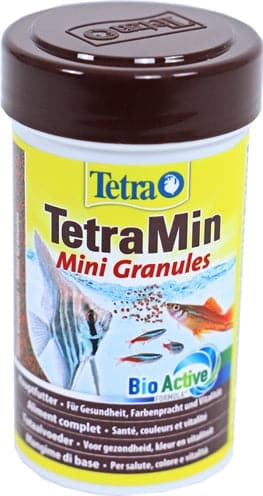
Tetra Min Minigranules Fish food 100 ml
Existing complete freshwater granules as part of a varied omnivorous diet. Rotate with suitable animal-based frozen or live foods.
Check retailer for price0 retailers
View retailersPrices from the latest retailer update, excluding shipping. Check stock and delivery with the retailer.
Sources & review
This care guide draws on several specialist sources and was last checked on .
View the sources
- Creative Commons — Creative Commons Attribution-ShareAlike 3.0 Unported
- Seriously Fish — Megalamphodus erythrostigma profile, revised 2026
- FishBase — Megalamphodus erythrostigma summary
- California Academy of Sciences — Eschmeyer Catalog of Fishes species record
- H. Zell (Llez) / Wikimedia Commons — Hyphessobrycon erythrostigma — Wilhelma 01