Blackline penguinfish
Thayeria boehlkei

The blackline penguinfish is a peaceful, active shoaling tetra with a distinctive black stripe that angles into the lower tail lobe. ‘Penguin tetra’ is also used for the related Thayeria obliqua, so check the stripe and the scientific name when buying. Keep at least six, preferably ten or more, in a long aquarium with open swimming room. The fish naturally swims at a head-up angle and does better in a group than alone. This guide separates the species from other Thayeria and considers space, water and social needs together.
Plan your aquarium →At a glance
- Temperature
- 22–28 °C
- pH
- 5.5–8.0
- GH
- 0–20 °dGH
- Aquarium length
- At least 60 cm
- Minimum aquarium volume
- At least 68 L
- Adult size
- Up to 3.6 cm
- Group size
- At least 5 individuals
- Temperament
- Peaceful
About this species
Eschmeyer's Catalog of Fishes accepts Thayeria boehlkei Weitzman, 1957. Recent classification places it in Acestrorhamphidae. The common name is not unique: the original ‘penguin fish’ was T. obliqua, while T. boehlkei is now often sold under the same trade name.
Look for the broad black stripe running from the gill cover along the flank and down into the lower caudal lobe. In T. obliqua the stripe follows a different path and fades sooner. The characteristic head-up, angled swimming posture is normal for this genus. FishBase and Seriously Fish report a maximum standard length of about 3.6 cm, measured to the tail base rather than including the tail.
Adult females may look rounder when carrying eggs; males may be slimmer and more intensely coloured. These are clues, not a reliable way to sex juveniles.
Natural habitat
Seriously Fish describes the species from the upper Amazon region of Peru and the Rio Araguaia in Brazil, while noting that its distribution may not be fully established. The Araguaia basin includes varied habitats, from plant-rich wetlands to shaded forest streams. No single aquarium layout represents every natural site.
The species is widely kept and is the best-known Thayeria in the hobby. That does not establish whether a particular fish was captive-bred or wild-caught. Ask about the batch origin if needed and acclimate new fish carefully.
Aquarium and layout
Seriously Fish gives a footprint of about 60 × 38 cm and roughly 68 litres as suitable for a small group. Larger numbers need a larger aquarium. Provide a long swimming route and leave the middle open; a tall, short tank is not an equivalent substitute. The source minimum is six, with ten or more a more practical target.
Plant the margins and back more densely. Wood, a dark substrate and floating plants add structure and shade without blocking the swimming lane. A mature filter and routine water changes matter more than peat or other attempts to force blackwater conditions. Use a lid, as active fish can jump when startled.
Water conditions
Seriously Fish lists 22–28°C, pH 5.5–8 and GH up to 20 dGH. FishBase confirms aquarium groups of five or more and a minimum tank length of 60 cm. These ranges describe tolerance; they do not mean sudden changes are safe. Keep conditions stable and acclimate new fish gradually.
The consulted sources do not establish a reliable species-specific KH limit, so none is supplied. Test consistently and maintain the aquarium instead of using chemicals to force an exact pH.
Behaviour and group size
Blackline penguinfish are peaceful shoaling fish, but they swim actively and may not compete well with very large or boisterous tankmates. Maintain a proper group of their own; Seriously Fish recommends at least six and preferably ten or more. Fin-nipping is sometimes reported, but the specialist profile says it is generally less evident in a sufficiently large shoal. Individual behaviour and space still matter.
Choose companions by adult size, swimming zone, speed, temperament and feeding access. Avoid predators that could swallow them and fish that outcompete them for food. Shared water values alone do not establish compatibility. Rework the combination if chasing persists, fins are damaged or fish miss meals.
Feeding
In nature the species feeds on small invertebrates such as insects, worms and crustaceans. In aquariums it usually accepts flakes and granules; vary these with small frozen or live foods such as Daphnia, brine shrimp and mosquito larvae. Its mouth is small, so offer manageable portions, ideally spread out rather than dropped in one large cloud.
A complete omnivorous flake from the existing product catalogue can be used as a staple. Add suitable small foods and check that less assertive shoal members also feed.
Breeding
This is an egg-scattering species that can be bred relatively easily, but adults eat the eggs. Use a separate, very dim breeding aquarium with fine-leaved plants or a spawning mop; a mesh can keep eggs out of adult reach. Condition the adults beforehand with varied small live or frozen foods. A small group or a carefully chosen pair can be used.
Remove adults as soon as eggs are laid. Seriously Fish reports hatching in about 12–24 hours and free swimming a few days later. Keep the early stages dark and feed newly free-swimming fry very fine foods, increasing size when they can manage it. Breeding conditions are not routine care targets.
Suitable plants

Java fern
Suitable: Java fern fits within the reviewed temperature and pH ranges for blackline penguinfish. Attach its rhizome to wood along the margin and leave the active midwater lane open.
- Light
- Low, Moderate
- CO₂
- CO₂ injection not needed
Suitable products
Recommended staple foods
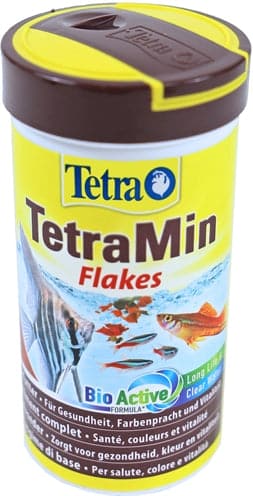
Tetramin Bio Active Vlokken Fish food 100 ml
Complete omnivorous flakes as a staple for this small omnivore/micropredator. Offer small portions and vary with suitable small animal foods.
Check retailer for price0 retailers
View retailersPrices from the latest retailer update, excluding shipping. Check stock and delivery with the retailer.
Sources & review
This care guide draws on several specialist sources and was last checked on .