Black skirt tetra
Gymnocorymbus ternetzi

The black skirt tetra, also called black tetra or black widow tetra, is a robust South American shoaling fish. It grows larger than many familiar small tetras: FishBase records up to 7.5 cm standard length. Provide a long aquarium with open swimming space, edge planting and a proper group. This active species may nip fins when kept in too small a shoal or with slow, long-finned tankmates. When buying, look for intact fins, normal breathing and active but unpanicked shoaling. This guide covers the standard form and distinguishes it from cultivated varieties. Group size, space and carefully chosen tankmates together influence whether the fish remains settled; water values alone cannot answer that.
Plan your aquarium →At a glance
- Temperature
- 20–26 °C
- pH
- 6.0–7.0
- GH
- 5–20 °dGH
- Aquarium length
- At least 75 cm
- Minimum aquarium volume
- At least 68 L
- Adult size
- Up to 7.5 cm
- Group size
- At least 5 individuals
- Temperament
- Peaceful, May nip fins
About this species
Gymnocorymbus ternetzi was described by Boulenger in 1895 as Tetragonopterus ternetzi. Eschmeyer's Catalog of Fishes accepts the current combination Gymnocorymbus ternetzi in Acestrorhamphidae. In the aquarium trade it appears as black skirt tetra, black tetra, black widow tetra and petticoat tetra. Golden, pale and long-finned forms are cultivated forms of the same species; brightly dyed fish may also be sold and are not natural colour varieties.
The deep, laterally compressed body has dark vertical bars and a broad anal fin that gives the fish its skirt-like outline. The intense black juvenile colour fades in many adults. A lighter adult colour alone is therefore not evidence of disease. FishBase reports a maximum standard length of 7.5 cm; standard length ends at the base of the tail.
Males are generally slimmer and slightly smaller, with more pointed dorsal and anal fins. Sexing young fish is unreliable; a fuller female may simply be carrying eggs.
Natural habitat
The species is native to the Paraguay and Guaporé river basins in South America. The Catalog of Fishes lists parts of Argentina, Bolivia, Brazil, Paraguay and Peru. In streams and tributaries, fish use mainly the middle and upper water layers. Local conditions vary, so a home aquarium does not need to reproduce one exact biotope.
The species has been bred at scale for many years and Seriously Fish describes it as ubiquitous in the trade. That does not establish the origin of any particular shipment; ask the retailer when provenance matters and assess the condition of the fish.
Aquarium and layout
Seriously Fish recommends a footprint of about 75 × 30 cm and approximately 68 litres for a group. FishBase gives a minimum length of 60 cm and groups of five or more. Because the fish is active and fin-nipping can occur in undersized groups, 75 cm is the more useful starting point; choose a larger aquarium for a full shoal and tankmates. Volume alone is not enough: length and an unobstructed swimming route matter.
Keep the middle open. Place plants, roots or decor mainly along the back and sides, and add floating plants if you want subdued light. Use a mature filter, steady oxygenation and a secure lid. Introduce fish only after the aquarium is stable and biologically established.
Water conditions
The sources overlap at 20–26°C, pH 6–7 and GH around 5–19/20 dGH. FishBase gives a wider pH range up to 8, while Seriously Fish recommends 6–7; this guide therefore uses the more conservative pH range. Stability matters more than chasing a precise number. The species can adapt to different conditions, but rapid changes remain stressful.
The sources do not establish a reliable species-specific KH target, so none is supplied. Test consistently, maintain water quality through routine care, and avoid chemicals used solely to force a number.
Behaviour and group size
Black skirt tetras are active shoaling fish that usually move peacefully through midwater. The specialist care profile warns about fin-nipping and notes that a group of twelve or more can keep more of the squabbling within the shoal. This is not a guarantee and does not replace the space a larger group needs. Choose tankmates of appropriate adult size with similar activity.
Slow, long-finned fish such as bettas and fancy varieties are poor companions. Very small fish or shrimp fry may be at risk because of the tetra's size and opportunistic feeding. Compatibility depends on more than shared temperature or pH: consider adult size, swimming zone, shoal size, aquarium length and feeding competition. Separate fish if chasing persists, fins are damaged or some animals cannot reach food.
Feeding
This is an omnivore. Use a complete quality flake or suitable granules as a staple and vary the diet with small frozen or live foods such as Daphnia and mosquito larvae. Offer portions that can be eaten promptly and remove leftovers. Distribute food so subordinate fish can feed too.
An existing complete omnivorous flake can serve as staple food. That does not make one product a substitute for dietary variety; watch feeding and avoid overfeeding.
Breeding
Black skirt tetras are relatively straightforward egg scatterers, but adults eat their eggs. For a deliberate breeding attempt, use a separate dimly lit aquarium with fine-leaved plants, a spawning mop or a mesh that lets eggs fall out of reach. Condition the adults with varied food. A small group or a carefully selected pair can be used; avoid prolonged stressful chasing.
Remove the adults as soon as eggs are seen. Seriously Fish reports hatching in roughly 18–36 hours, with fry becoming free-swimming a few days later. Keep the breeding aquarium subdued at first and feed newly free-swimming fry very fine foods, moving to larger foods as they can take them. Breeding conditions differ from everyday maintenance and should not be presented as routine targets.
Suitable plants

Java fern
Suitable: Java fern shares a verified temperature range of 22–26°C and pH 6–7 with the black skirt tetra. Attach its rhizome to wood near the margins and keep midwater open for the active shoal. Do not bury the rhizome.
- Light
- Low, Moderate
- CO₂
- CO₂ injection not needed
Suitable products
Recommended staple foods
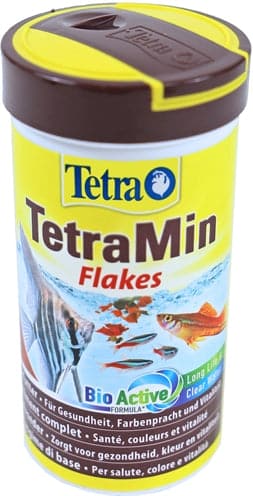
Tetramin Bio Active Vlokken Fish food 100 ml
Complete omnivorous freshwater flakes. Offer small portions and check subordinate fish feed too; rotate with small frozen or live foods.
Check retailer for price0 retailers
View retailersPrices from the latest retailer update, excluding shipping. Check stock and delivery with the retailer.
Sources & review
This care guide draws on several specialist sources and was last checked on .
View the sources
- California Academy of Sciences — Eschmeyer's Catalog of Fishes: Gymnocorymbus ternetzi current status
- FishBase — Gymnocorymbus ternetzi — species summary
- Seriously Fish — Gymnocorymbus ternetzi — aquarium profile
- U.S. Geological Survey, Nonindigenous Aquatic Species — Black tetra (Gymnocorymbus ternetzi)
- Wikimedia Commons; Corydoras-adolfoi; attribution © Nicklas Iversen / akvaportalen.no — Black tetra (Gymnocorymbus ternetzi) aquarium photograph