Black phantom tetra
Megalamphodus megalopterus

The black phantom tetra (Megalamphodus megalopterus) is a popular, peaceful South American shoaling fish. Males stand out with deep black, enlarged fins, while females are deeper-bodied with reddish lower fins. This mix of calm behaviour and visible display makes the species suitable for a carefully planned community aquarium. Keep a mixed group of eight to ten or more in a mature tank with plants, wood and open swimming room. Stable water and a varied diet matter more than imitating one précise natural colour or habitat.
Plan your aquarium →At a glance
- Temperature
- 22–28 °C
- pH
- 6.0–7.0
- GH
- 1–12 °dGH
- Aquarium length
- At least 80 cm
- Minimum aquarium volume
- At least 72 L
- Adult size
- Up to 3.6 cm
- Group size
- At least 8 individuals
- Temperament
- Peaceful
About this species
The black phantom tetra is a characid from Bolivia and western Brazil. Its range includes upper tributaries of the Madeira, including the Guaporé/Iténez, and the upper Paraguay. The accepted name is Megalamphodus megalopterus; Hyphessobrycon megalopterus remains a common older combination. Seriously Fish also lists Megalamphodus rogoaguae as an earlier name. These names do not represent separate aquarium species.
Seriously Fish gives about 36 mm standard length, excluding the tail. Males have dark dorsal, anal and pelvic fins, which may be enlarged. Females are deeper-bodied and often have reddish pelvic, anal and adipose fins. The distinction can be less obvious in individual fish or under different conditions. A long-finned trade strain exists, but it is a cultivated form rather than a separate species.
Natural habitat
The species inhabits still or sluggish tributaries, backwaters, ponds and small lakes. It aggregates around marginal vegetation and submerged tree roots. In parts of the Pantanal, small characins may occur in clear water with abundant aquatic plants. A dark blackwater setup is therefore not the only suitable interpretation of its habitat.
Sand, branching wood and edge planting create shelter. Leave open water for shoaling. Leaf litter can optionally provide cover and micro-organisms, but is not essential; remove decaying material before it affects water quality. A clear planted community aquarium can work as well. The useful lesson from the natural habitat is a calm, sheltered environment with good water quality, not an exact copy of one local water chemistry.
Aquarium and layout
Seriously Fish gives a base footprint of 80 × 30 cm and about 72 litres as the smallest tank to consider. This is a source-based size, not a universal stocking rule. Preserve the footprint and length even if a taller aquarium has the same volume. A mixed shoal of at least eight to ten suits its social behaviour; males may display and establish temporary dominance hierarchies.
Use sand or another safe substrate, wood and planted edges with an open swimming lane. A mature filter and consistent maintenance help keep conditions stable. Avoid a current so strong that it removes all quiet areas. The fish is peaceful, but do not house it with predators or pushy species that monopolise food and space. The approximately 72-litre figure follows from the minimum footprint and an example height; volume alone does not determine suitability.
Water conditions
Seriously Fish gives 20–28 °C, pH 5.0–7.0 and GH 1–12 dGH. FishBase reports 22–28 °C, pH 6.0–7.5 and no dependable lower hardness endpoint. This guide uses the cautious overlap of 22–28 °C and pH 6.0–7.0. The GH range is attributed only to Seriously Fish. No reliable species-specific KH target was found.
Keep chosen values stable and acclimate fish gradually. The sources do not support a need for sudden acidification, peat or a special mineral-free régime. Monitor temperature and water quality routinely and adapt water changes to the aquarium. Where source ranges differ, the overlap is a practical cautious range, not a sharp biological boundary; stable conditions within it are the goal.
Behaviour and group size
The black phantom tetra is generally very peaceful. In a group of eight to ten or more, temporary social hierarchies develop. Males may spread their fins and display for females. This display is characteristic; watch that it remains brief and does not become injury or continual chasing.
Calm, similarly sized characins, small hatchetfish, pencilfish and suitable small or medium non-predatory cichlids may be appropriate, depending on the full stocking plan. Avoid aggressive fin nippers and large predators. Serpae tetras are also discouraged because their fin-nipping behaviour may conflict with this species’ prominent fins. Consider behaviour, swimming room and food competition; shared water ranges alone are not enough. Plants or wood can help break lines of sight.
Feeding
The species is likely omnivorous. The specialist profile lists small invertebrates, crustaceans, filamentous algae and fallen fruit among natural foods. In aquaria it may eat dried foods, but a varied menu with small frozen and live prey such as mosquito larvae, daphnia or Moina is recommended.
Fine granules and flakes can serve as a practical staple when readily eaten. Spread food so less dominant fish also get a share. Small portions limit waste and help protect water quality. Rotate food sources rather than relying on one prey as a complete diet. No particular brand is required; a linked existing product is a suitable option, not a biological prescription.
Breeding
The black phantom tetra is a free-spawning egg-scatterer with no parental care. A few fry may appear in a mature aquarium, but adults will eat accessible eggs. For controlled breeding, use a separate mature tank with subdued light and fine mesh, marbles, fine-leaved plants or a spawning mop. An air-powered sponge filter or airstone provides oxygen and gentle movement.
The source recommends slightly acidic to neutral water and a temperature toward the warm end of the normal range; there is no reason to present one exact setpoint as universal. Condition adults with varied foods. A pair or small group may spawn after introduction, often the next morning, though timing varies. Remove adults once eggs are confirmed. Newly hatched fry need very fine food such as Paramecium or suitable dust food around 5–50 microns; introduce nauplii or microworms later when the fry are large enough.
Keeping with other species

Serpae tetra
Not recommendedDiscouraged: the black phantom tetra is peaceful, but Serpae tetras may nip fins. The prominent, enlarged fins of adult males are especially vulnerable. Even where temperatures overlap, the behavioural risk remains; a larger aquarium does not automatically make the combination safe. Choose calmer companions and watch for fin damage and feeding competition after any introduction.
View species profile →Suitable products
Recommended staple foods
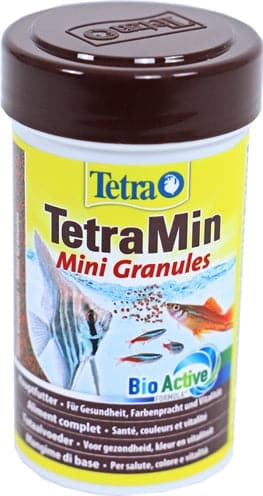
Tetra Min Minigranules Fish food 100 ml
Fine complete mini granules as a staple option for small freshwater fish. Offer modest portions, check that all fish take the particles, and rotate with suitable small live or frozen foods.
Check retailer for price0 retailers
View retailersPrices from the latest retailer update, excluding shipping. Check stock and delivery with the retailer.
Sources & review
This care guide draws on several specialist sources and was last checked on .
View the sources
- Tetra — TetraMin Mini Granules — manufacturer product information
- Seriously Fish — Megalamphodus megalopterus — species profile, revised 2026
- FishBase — Megalamphodus megalopterus, Black phantom tetra — FishBase
- ITIS — ITIS report — Megalamphodus megalopterus
- NCBI — NCBI Taxonomy Browser — Megalamphodus megalopterus
- Vertebrate Zoology — D. Bork, A. Zarske and H.J. Richter — source of the female photograph
- Wikimedia Commons — Hyphessobrycon megalopterus (31473-B).png — Wikimedia Commons
- Creative Commons — Creative Commons Attribution 4.0 International