Rotala wallichii care
Rotala wallichii
Rotala wallichii is a fine-leaved Asian stem plant whose growing tips may turn pink, orange or red under suitable conditions. Tropica describes it as demanding, and Flowgrow also reports a difficult plant that needs strong light and CO2. This guide explains where the sources agree and why they rate growth differently. It suits an aquarium where lighting, injected CO2 and nutrition can be kept stable. If those conditions are unavailable, choose an easier plant instead.
Plan your aquarium →At a glance
- Difficulty
- Moderate
- Plant height
- 10–50 cm
- Growth rate
- Moderate, Fast
- Placement
- Midground, Background
- Temperature
- 15–30 °C
- pH
- 5.0–7.0
- Light
- High
- CO₂
- Required
- Nutrient uptake
- Through roots and water
- Substrate
- Sand, Gravel
- Propagation
- Cuttings
About this plant
Rotala wallichii (Hook.f.) Koehne is an accepted species in the family Lythraceae. Kew lists Ammannia wallichii, Hydrolythrum wallichii and Ammannia myriophylloides as synonyms, not separate aquarium species. In a tank it forms upright stems with narrow, finely divided leaves. New tips may become pink, orange or red when conditions support healthy growth. Colour alone is not proof of plant health; also check new growth and stem firmness.
Natural habitat
Kew gives a range from India to parts of East and Southeast Asia and classifies the species as a wet-tropical helophyte. Flowgrow describes its source waters as soft and slightly acidic. These broad ecological details are not a precise recipe for every aquarium. Grower profiles give different cultivation ranges, so keep conditions stable and choose values that also suit the livestock and other plants in the tank.
Placement in the aquarium
Plant the stems in a group in the midground or background, where they can grow upward. Tropica also mentions foreground use, but the plant stays low there only with regular topping and replanting. Avoid packing stems so tightly that lower portions remain in deep shade. After planting, allow roots to establish and avoid repeatedly moving the group, which makes it harder to assess new growth.
Light
Tropica rates the light demand high; Flowgrow describes it as medium to high and associates brighter light with compact growth and colour. No reliable species-specific PAR value has been established here. Do not turn an older watts-per-litre figure into a universal LED prescription. Provide even lighting, avoid sudden large increases and assess new tips. Pale or weak growth can have several causes, so also check CO2, nutrition and shading.
CO₂
Stable CO2 supply matters for demanding growth. Tropica classifies the need as high, while Flowgrow calls CO2 indispensable for good growth. Flowgrow also lists a concentration range, but it is not a safe setting for every aquarium. Excess CO2 can harm animals. Increase it gradually, watch fish for stress and avoid daily swings. Without injection, growth may be weaker; in that case, a less demanding species is usually a better fit.
Nutrition and fertilisation
Flowgrow recommends balanced nutrition, but its page contains values that should not be treated as one unambiguous target range. Avoid deficiencies without dosing to a single profile number. Tropica explains that aquarium plants can take up nutrients through leaves and roots. Match liquid fertiliser and substrate nutrition to the rest of the tank, measure when useful and avoid changing several doses at once.
Substrate and root feeding
This is a stem plant that is planted in substrate and can be propagated from cuttings. Choose a bed that holds stems securely; the sources do not prescribe one specific substrate product. An inert substrate may need a suitable nutrient plan, while a nutrient substrate releases compounds of its own. Keep lower leaves above the substrate. If stems loosen, replant them and check whether current or digging animals disturb the group.
Growth and pruning
The source ratings differ: Tropica calls growth medium, while Flowgrow calls it fast. Lighting, CO2, available nutrients and measurement context can affect that assessment. In favourable conditions, the plant may grow beyond the intended layout. Trim the tops and use healthy cuttings to renew the group. Remove weak, shaded lower stems carefully rather than leaving them indefinitely.
Propagation
Flowgrow describes propagation from top and lateral-shoot cuttings. Snip a healthy tip and replant it in the substrate; the remaining stem may produce side shoots. Use clean scissors and leave enough leaves on each cutting. Replant firm sections without slime or obvious damage. New cuttings may temporarily show different colours while adjusting to the light.
Suitable fish and animals
This draft names no fish, shrimp or snail as a proven pairing. A plant sold for aquariums is not automatically safe from plant-eaters or burrowing animals. Consider adult size, behaviour, grazing and whether stems can remain anchored. Shared pH or temperature values alone do not prove compatibility. Unknown combinations need observation, and damaged plants should be replaceable.
The guide explains how planting can provide cover. No plant species have yet been linked as reviewed combinations, so no automatic recommendations are shown.
Possible problems
If new tips stay green or stems become sparse, first review light, CO2 stability, nutrition and shading within the group. These are possible factors, not a diagnosis from one symptom. Remove brown or slimy portions and replant only healthy cuttings. Make changes gradually and record them. Since Tropica and Flowgrow rate growth differently, assess the plant over several weeks in your own aquarium.
Care for this plant
Tools
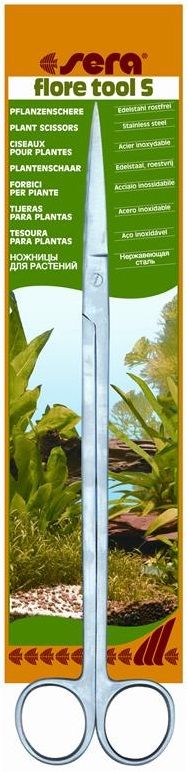
Sera Flore Tool S plantenschaar
OptionalThese 26 cm aquarium scissors are designed for trimming aquarium plants. Use them only when the plant actually needs cutting back.
Check retailer for price0 retailers
View retailersPrices from the latest retailer update, excluding shipping. Check stock and delivery with the retailer.
Sources & review
This care guide draws on several specialist sources and was last checked on .