Hygrophila pinnatifida care
Hygrophila pinnatifida
Hygrophila pinnatifida is an Indian aquarium plant with deeply divided leaves. The undersides are often dark red, while the upper surface can be brown to olive green. It produces upright shoots as well as creeping runners that can attach to wood or stone with roots. Specialist profiles rate its care as moderate. Light, CO2 and nutrients affect its form, but the sources do not establish one exact target for every aquarium setup.
Plan your aquarium →At a glance
- Difficulty
- Moderate
- Plant height
- 5–40 cm
- Growth rate
- Moderate
- Placement
- Foreground, Midground
- Temperature
- 18–28 °C
- pH
- 5.0–8.0
- Light
- Moderate, High
- CO₂
- Optional
- Nutrient uptake
- Through roots and water
- Substrate
- Sand, Gravel
- Propagation
- Runners, Cuttings
About this plant
Hygrophila pinnatifida (Dalzell) Sreem. is an accepted species in the family Acanthaceae. Kew lists Adenosma pinnatifida, Cardanthera pinnatifida, Nomaphila pinnatifida and Synnema pinnatifidum as synonyms, not separate aquarium species. The plant is known for pinnately divided leaves. Underwater leaves may be brown or olive above and burgundy underneath. It forms upright shoots and creeping stems that can attach to hardscape with roots.
Natural habitat
Kew gives India as the native range and describes a wet-tropical plant. Flowgrow reports streams in western India and describes both submerged and emergent growth forms. This broad habitat context does not predict exactly how the plant will grow in every aquarium. Tank conditions should also suit the fish and invertebrates sharing the water.
Placement in the aquarium
Use it as a compact midground group or as lower runners in the foreground. Creeping stems can root on wood or stone; loosely attach them if needed until they hold. Do not bury creeping stems as if they were a rhizome plant. A small group against a calm background shows the leaf pattern well. Trimming the tips helps shape growth; leave space between leaves for light and circulation.
Light
Flowgrow says the species tolerates medium light and can grow more compactly under brighter conditions; Tropica rates its demand medium. Start with even light and adjust gradually. No reliable species-specific PAR value has been established, so a watts-per-litre figure is not a precise LED setting. If stems stretch or leaves become smaller, also check shading, CO2, nutrition and how long the plant has had to adapt.
CO₂
CO2 can support growth, but the profiles do not establish that injection is mandatory in every aquarium. Tropica rates the need medium and Flowgrow recommends a good supply. If you inject CO2, keep it stable and controlled; do not increase it abruptly to force colour. Fish and shrimp determine a safe upper limit. Without injection, growth may differ and patience may be needed.
Nutrition and fertilisation
Flowgrow recommends balanced nutrition and notes that small pinhole marks on older leaves may indicate potassium deficiency. The symptom can have other causes, so do not add one nutrient automatically without checking the whole setup. Tropica explains that aquarium plants can absorb nutrients through leaves and roots. Match water fertilisation and any substrate feeding to plant mass, light and the rest of the aquarium.
Substrate and root feeding
Flowgrow says substrate choice appears less important than for plants with large root systems. Its small roots can attach to sand or gravel, while creeping parts may also cover wood or stone. Do not bury the plant deeply. To green hardscape, place a runner against the surface and give it time to attach.
Growth and pruning
Tropica and Flowgrow rate growth medium, while Flowgrow notes that light, nutrition and CO2 change the rate. In stronger conditions, upright shoots may reach the surface faster; with fewer resources, the plant may spread slowly. Trim overly long tips and use healthy runners to renew a group. Remove old, damaged leaves carefully without pulling away the roots that anchor the plant.
Propagation
Flowgrow lists runners, plantlets, cuttings and daughter plants as propagation routes. Rooted lateral runners have the clearest support; the source warns that tip cuttings from upright shoots may establish poorly. Separate a runner once it has its own roots and attach it where desired. Detached leaves may form adventitious plantlets, but this is less predictable than a rooted runner.
Suitable fish and animals
This guide names no fish, shrimp or snail as a proven pairing. A plant kept in many aquariums is not necessarily safe from every animal. Consider grazing, digging and the risk of hardscape plants being pulled loose. Overlapping temperature or pH values alone do not prove compatibility. Observe new combinations and resecure runners if needed.
The guide explains how planting can provide cover. No plant species have yet been linked as reviewed combinations, so no automatic recommendations are shown.
Possible problems
Flowgrow notes that small holes in older leaves may occur with potassium deficiency, but this is not a definitive diagnosis. Also check other nutrients, light, CO2 and physical damage. Long, sparse growth can be related to light and nutrient supply; change one factor at a time. If an attached shoot comes loose, put it back and wait for new roots rather than pushing it deep into the substrate. Remove slimy or rotting plant material.
Care for this plant
Tools
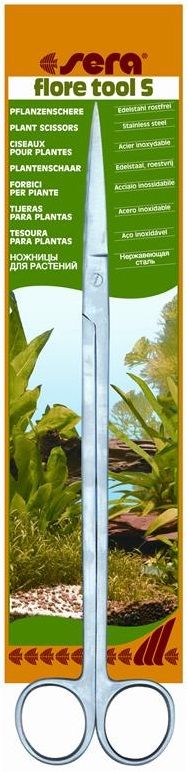
Sera Flore Tool S plantenschaar
OptionalThese 26 cm aquarium scissors are designed for trimming aquarium plants. Use them only when the plant actually needs cutting back.
Check retailer for price0 retailers
View retailersPrices from the latest retailer update, excluding shipping. Check stock and delivery with the retailer.
Sources & review
This care guide draws on several specialist sources and was last checked on .