Heteranthera zosterifolia
Heteranthera zosterifolia

Heteranthera zosterifolia is a fast-growing South American stem plant with bright green, alternate leaves. Tropica describes it as an easy aquarium plant; Dennerle notes that good lighting and CO2 encourage compact growth. Reported mature height varies between profiles, and pruning also shapes the plant. Frequent trimming is important because side shoots can form a dense canopy that shades lower leaves. It is suited to the midground or background of a freshwater aquarium.
Plan your aquarium →At a glance
- Difficulty
- Easy
- Plant height
- 20–40 cm
- Growth rate
- Fast
- Placement
- Midground, Background
- Temperature
- 20–26 °C
- pH
- 5.0–8.0
- Light
- Low, Moderate, High
- CO₂
- Optional
- Nutrient uptake
- Through roots and water
- Substrate
- Sand, Gravel
- Propagation
- Cuttings
About this plant
Kew accepts Heteranthera zosterifolia Mart. in the family Pontederiaceae. Schollera zosterifolia and Heteranthera osteniana are synonyms, not separate aquarium plants. It grows as a stem plant with alternate leaves and numerous side shoots. Bright green foliage can form a dense canopy if the tips are not thinned regularly.
Natural habitat
Kew gives a native range from Brazil to northern Argentina. Dennerle describes observations in Brazil’s Rio da Prata, including clear water at depth. This provides geographic context rather than a complete aquarium prescription. Keep conditions stable and consider the needs of all livestock in the tank.
Placement in the aquarium
Use stems in the midground or background. Dennerle lists both areas; the plant’s height makes foreground use practical only with frequent trimming. Plant stems with some space between them so water and light can reach lower growth. After planting, check that stems are secure and will not be dislodged by flow or animals.
Light
Tropica describes the plant as easy and lists low average light demand; Dennerle notes that good light supports compact growth. The profiles reflect different cultivation contexts. No exact PAR target has been established. Start with even lighting, avoid sudden increases and check that dense groups do not shade their lower leaves.
CO₂
Tropica indicates medium CO2 demand. Dennerle says CO2 fertilisation supports compact growth, but does not establish it as a universal requirement. CO2 can be useful, but there is no fixed concentration for every aquarium. If injecting, adjust gradually and observe fish and invertebrates. The plant may still grow without injection, although its form can be looser.
Nutrition and fertilisation
The reviewed species profiles do not provide a unique fertiliser dose. Tropica’s general aquarium plant guidance describes both substrate nutrition and liquid fertiliser in the water. Match a chosen approach to plant mass, substrate and other species. Do not respond to one discoloured leaf with a large dose; also check light, CO2, water quality and leaf age.
Substrate and root feeding
Plant stems in a substrate that allows the roots to anchor. The sources do not prescribe a specific substrate; sand and gravel are common planting media, not species-specific requirements. A nutrient substrate may be part of a chosen setup. Trim damaged lower growth and replant healthy tops if a group becomes sparse.
Growth and pruning
Dennerle describes rapid growth under good light, and Tropica notes abundant side shoots. In favorable conditions the plant can become dense quickly and shade its lower leaves. Trim the tips regularly and thin crowded groups. Growth speed depends on light, CO2, nutrients and adjustment after transport.
Propagation
Propagate with healthy stem cuttings. Cut a firm top and replant it in the substrate; Tropica describes this method as easy. Dennerle also notes roots forming on stems. Use clean tools and retain enough leaves on each cutting. Replant healthy sections and allow new roots to establish.
Suitable fish and animals
No controlled list of animals specifically tested with Heteranthera zosterifolia is available in this draft. Consider plant-eating fish, bottom-dwelling animals and species that may dislodge stems. Matching water values alone does not prove compatibility. Observe new inhabitants and protect freshly planted stems until they root.
The guide explains how planting can provide cover. No plant species have yet been linked as reviewed combinations, so no automatic recommendations are shown.
Possible problems
Darkening or dying lower leaves can occur when a dense group blocks light, although other care factors may also contribute. This is not a definitive diagnosis. Thin the plant, check lighting and stability, and avoid changing several conditions at once. Remove slimy leaves and replant healthy tops if the base becomes bare.
Care for this plant
Tools
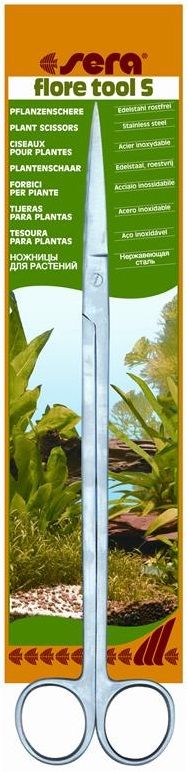
Sera Flore Tool S plantenschaar
OptionalAn optional tool for trimming this fast-growing stem plant. Scissors are not essential for care.
Check retailer for price0 retailers
View retailersPrices from the latest retailer update, excluding shipping. Check stock and delivery with the retailer.
Sources & review
This care guide draws on several specialist sources and was last checked on .