Common hornwort care | Ceratophyllum demersum
Ceratophyllum demersum
Common hornwort (Ceratophyllum demersum) is a fast-growing, rootless aquatic plant that can float freely or sit among other stems. Growers disagree about its light demand: Tropica rates it low, while Dennerle recommends strong light. Start with moderate light and observe new growth. It does not need nutrient soil, but plan for regular thinning and pruning. The growers also list a broad temperature and pH span, which is not a guarantee for every aquarium setup. Let the needs of fish and invertebrates take priority.
Plan your aquarium →At a glance
- Difficulty
- Easy
- Plant height
- 5–120 cm
- Growth rate
- Fast
- Placement
- Background, Floating
- Temperature
- 1–28 °C
- pH
- 6.0–8.0
- Light
- Low, High
- CO₂
- Optional
- Nutrient uptake
- Through the water column
- Substrate
- Sand, Gravel
- Propagation
- Cuttings
About this plant
Ceratophyllum demersum is an accepted, cosmopolitan species in the family Ceratophyllaceae. Aquarium shops commonly call it common hornwort. It has branched stems with firm, finely divided leaves. Unlike many stem plants, it does not form ordinary roots, so it can grow freely in the water column. Tropica and Dennerle list it for aquarium use in a range of layouts, but its growth can demand space and maintenance. Do not confuse it with soft hornwort, Ceratophyllum submersum; that is a different species.
Natural habitat
Kew records the species as cosmopolitan. Dennerle lists 1–28 °C and pH 6–8 in its plant profile. The temperature span in particular is unusually broad; treat it as a source-reported range, not an optimum or a promise that other aquarium animals tolerate those temperatures. The Dutch distribution atlas describes the plant in nutrient-rich fresh or weakly brackish water, from still to gently flowing habitats. These are field observations, not an aquarium recipe: do not add salt because of the natural range. In an aquarium, allow room, keep conditions stable and collect loose fragments rather than trying to recreate one specific wild site.
Placement in the aquarium
Ceratophyllum demersum may float freely, form a background group or be held loosely among stones or wood. It has no root system that must grow into the substrate. Sand or gravel can hold a stem in place, but it is not a required nutrient bed. Leave the tips and side branches room to grow and prevent the plant from sealing the whole surface. This keeps light available to plants below and preserves open swimming space for fish and shrimp.
Light
The growers give different light ratings. Tropica classifies demand as low, whereas Dennerle recommends strong light. No species-specific PAR threshold was located. Start with moderate light and adjust gradually while watching new growth and shade cast by the plant. Growth may differ in lower light from a brightly lit, heavily fertilised nursery setup. Avoid changing lighting, CO2 and fertiliser at the same time; otherwise the cause of a response is hard to identify.
CO₂
Injected CO2 is not established as a requirement for keeping this species in an aquarium. Tropica lists low demand; Dennerle reports 10–20 mg/L in its profile. That difference may reflect growth and cultivation conditions. Treat CO2 as a possible growth aid, not a compulsory target for every tank. Match any addition to the whole aquarium and its animals, avoid rapid swings and follow the normal safety checks for the equipment.
Nutrition and fertilisation
The plant obtains nutrients from the surrounding water in practical aquarium culture; this fits its rootless, free-floating form. Dennerle describes rapid growth, but that does not mean a high fertiliser dose is automatically needed. Consider the full plant mass, water changes and measured nutrients before adding anything. If the aquarium shows a real need, use an existing liquid plant fertiliser according to its label. No specific product has been approved as a match in this guide.
Substrate and root feeding
Nutrient soil and root tabs are not necessary for Ceratophyllum demersum because it does not make ordinary roots. To keep a group in one place, the stems may be held loosely in sand or gravel without burying them deeply. Part of each stem should remain free in the water. Avoid a thick substrate layer used to force stems down; trapped or damaged parts may decay or detach.
Growth and pruning
Dennerle describes growth as very fast. Tropica gives an average height after two months and mentions stems reaching 80 cm in its profile text; Dennerle lists up to 120 cm. These figures come from different cultivation descriptions and are not a fixed final size. Trim long tips when they obstruct swimming space, filter intakes or lighting. Remove dead parts and check for loose fragments, which may continue growing elsewhere.
Propagation
Dennerle describes propagation by head cuttings and side shoots. Cut a healthy tip and leave it floating or hold it loosely where you want it. Side branches can also develop into new stems. Use sharp scissors and remove loose leaves after trimming, especially near a filter intake. The grower profiles support this straightforward vegetative propagation; seed propagation is not needed for ordinary aquarium cultivation.
Suitable fish and animals
We do not name any fish or invertebrate as a guaranteed compatible pairing. A dense group can provide general cover, but that does not prove a safe combination with a named species. Consider the light needs of other plants, open swimming room and the chance that animals may dislodge the stems. Assess fish, shrimp and snails separately for behaviour, adult size and water needs. Overlapping pH or temperature values alone do not establish compatibility.
The guide explains how planting can provide cover. No plant species have yet been linked as reviewed combinations, so no automatic recommendations are shown.
Possible problems
Fast growth can cover the surface and shade other plants. Thin the group regularly and remove loose fragments, particularly near filters and pumps. Because sources disagree about light, the plant may respond differently from what a single rating suggests; adjust lighting and nutrients one step at a time. Do not rinse equipment in natural water or discard trimmings into ponds, streams or drains that lead directly to surface water. This reduces the risk of spread outside the aquarium.
Care for this plant
Tools
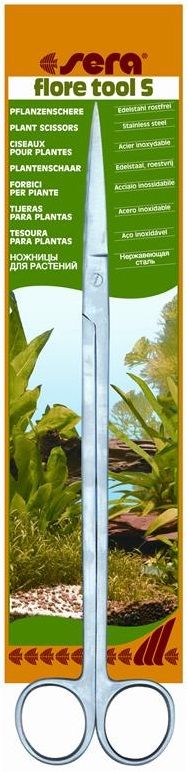
Sera Flore Tool S plantenschaar
OptionalThese 26 cm aquarium scissors are designed for trimming aquarium plants. Use them only when the plant actually needs cutting back.
Check retailer for price0 retailers
View retailersPrices from the latest retailer update, excluding shipping. Check stock and delivery with the retailer.
Sources & review
This care guide draws on several specialist sources and was last checked on .
View the sources
- Royal Botanic Gardens, Kew — Ceratophyllum demersum L. — Plants of the World Online
- Integrated Taxonomic Information System — Ceratophyllum demersum — ITIS
- Tropica Aquarium Plants A/S — Ceratophyllum demersum — plant profile
- Dennerle Plants GmbH — Ceratophyllum demersum — plant profile
- FLORON / NDFF Verspreidingsatlas — Ceratophyllum demersum — NDFF Verspreidingsatlas