Wrestling halfbeak
Dermogenys pusilla

The wrestling halfbeak (Dermogenys pusilla) is a live-bearing fish that spends almost all its time just below the surface. Its lower jaw projects forward; it takes small insects and crustaceans and can jump powerfully when startled. A tight-fitting lid, broad surface area and calm acclimation are essential. The aquarium profile gives 24–28°C, pH 7–8 and GH 10–19°dGH. Hard freshwater is usually sufficient; salt is not a default requirement. In nature it takes small prey at the surface, so in the aquarium both nutritional variety and access to food matter. Watch each fish to make sure it is feeding. Allow for differences between source populations and avoid rapid changes in temperature, hardness or salinity.
Plan your aquarium →At a glance
- Temperature
- 24–28 °C
- pH
- 7.0–8.0
- GH
- 10–19 °dGH
- Aquarium length
- At least 60 cm
- Minimum aquarium volume
- At least 68 L
- Adult size
- Up to 5.5 cm
- Group size
- At least 1 individuals
- Swimming zone
- Surface
- Temperament
- May jump
About this species
Dermogenys pusilla Kuhl & van Hasselt, 1823 belongs to Zenarchopteridae within Beloniformes. Older aquarium literature also uses the spelling D. pusillus; it is retained here as a search alias. Do not confuse this species with other halfbeaks sold under the same broad trade name, including D. siamensis and D. sumatrana. FishBase lists Java as the distribution, whereas some aquarium accounts give a much wider Southeast Asian range. Changing species limits and uncertain trade identification mean that a fish carrying this general label cannot always be assigned confidently to a locality.Natural habitat
FishBase records rivers, streams, canals, ditches, ponds and lakes, often in still or slow water where plants reach the surface. Seriously Fish notes occasional occurrence in semi-brackish mangrove conditions. That does not make salt necessary: the aquarium profile says hard, alkaline freshwater is generally suitable. Ask about locality and water history for unusual captive lines, and never change salinity abruptly.Aquarium and layout
Seriously Fish gives a 60 × 38 cm footprint and about 68 litres at 30 cm depth as a lower limit for a small group. Treat that as a starting floor, not a universal stocking guarantee. Surface area matters more than extra depth. Place floating plants in patches and plant around the edges while leaving an open feeding lane. Fit a sturdy lid with no gaps: these fish jump. Mature, calm filtration and small, regular water changes help prevent sudden shifts.Water conditions
The specialist aquarium profile gives 24–28°C, pH 6.5–8.0 and GH 10–20°dGH. FishBase lists environmental values of 24–28°C, pH 7–8 and hardness 9–19. For pH and GH the structured ranges use the overlap: pH 7–8 and GH 10–19°dGH. Keep temperature stable. The species tolerates slight brackishness, but the aquarium source says hard freshwater is normally adequate, so do not add salt automatically.Behaviour and group size
Halfbeaks stay near the surface and can be nervous, especially after transport or sudden movement. They jump readily and may injure the delicate jaw if they hit glass. Males can spar by locking jaws. The specialist profile suggests either one male or several males with room to disengage; no fixed sex ratio is proven for every aquarium. Large, fast or aggressive tankmates can intimidate them or outcompete them at feeding time. We do not publish named tankmate pairings without a separate check of both species and the actual aquarium.Feeding
This is a carnivore that picks small insects, larvae, worms and crustaceans from the surface. Seriously Fish calls fruit flies an ideal food and says brine shrimp and bloodworm are accepted. Some individuals need patient training before taking dry food. Offer small portions that remain accessible at the surface, vary suitable live or frozen prey, and remove leftovers. Live Artemia is available in the existing catalogue and is linked as a supplement. No sufficiently evidenced staple product also passes the current matching gate.Breeding
Dermogenys pusilla is live-bearing. FishBase reports broods of roughly 10–30 young. A peer-reviewed study found different forms of embryo development among populations identified as D. pusilla, so one gestation schedule or reproductive mechanism should not be generalised to every population. Seriously Fish notes stress and condition as possible factors in stillbirths. Keep adults well conditioned and stable, provide surface refuge, and prepare a separate rearing tank because adults may eat fry. Record broodstock provenance and do not mix unidentified halfbeak lines.Suitable products
Recommended staple foods
No staple food in the existing catalogue is sufficiently supported for this carnivorous surface-feeder and also passes the current product-matching checks. The linked live Artemia is a supplement only; also provide a varied range of small surface prey.
Supplementary foods
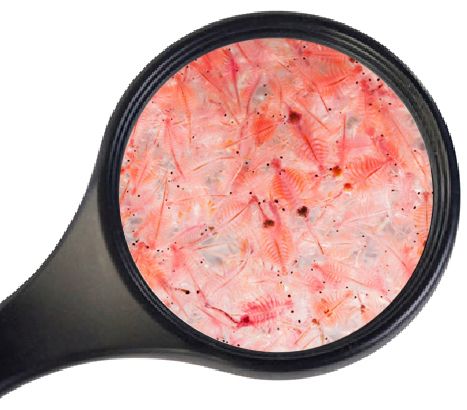
Levende Artemia 90ml
This species eats small crustaceans, and the species-specific care profile lists brine shrimp among accepted foods. This live Artemia is therefore a supplement only, not a complete staple. Offer it at the surface in small portions.
Check retailer for price0 retailers
View retailersPrices from the latest retailer update, excluding shipping. Check stock and delivery with the retailer.
Sources & review
This care guide draws on several specialist sources and was last checked on .
View the sources
- Seriously Fish — Seriously Fish — Dermogenys pusilla aquarium profile
- FishBase — FishBase — Dermogenys pusilla summary
- FishBase / IUCN Red List data — FishBase field guide — Dermogenys pusilla and conservation assessment
- California Academy of Sciences — Catalog of Fishes — Dermogenys pusilla
- Journal of Morphology / National Library of Medicine — Viviparity in the halfbeak genera Dermogenys and Nomorhamphus — PubMed record
- Goodeid Working Group — Goodeid Working Group — livebearer and halfbeak husbandry notes
- OpenCage / Wikimedia Commons — Dermogenys pusilla by OpenCage — Wikimedia Commons