Sparkling gourami
Trichopsis pumila

The sparkling gourami (Trichopsis pumila) is a small labyrinth fish from still and slow-moving waters in Southeast Asia. It takes air at the surface as well as breathing through its gills, and it can make audible croaking sounds. A specialist profile recommends a 45 by 30 centimetre tank base for a pair or small group, with dense planting, gentle flow and a safe air space above the water. Its small size does not make it a good match for busy or much larger tankmates. This guide covers checked water values, appropriately small foods, jumping, compatibility and bubble-nest breeding.
Plan your aquarium →At a glance
- Temperature
- 25–28 °C
- pH
- 6.0–7.0
- GH
- 5–12 °dGH
- Aquarium length
- At least 45 cm
- Minimum aquarium volume
- At least 41 L
- Adult size
- Up to 4 cm
- Group size
- At least 2 individuals
- Swimming zone
- Middle, Surface
- Temperament
- Peaceful, Territorial
About this species
Trichopsis pumila (Arnold, 1936) is commonly called the sparkling gourami, pygmy gourami or dwarf croaking gourami. It reaches about 4 cm standard length, measured without the tail fin. A dark central stripe topped by dark blotches helps distinguish it from larger relatives. Like other labyrinth fish, it can take air at the surface and is known for audible croaking during social interactions.
Natural habitat
The species occurs in the lower Mekong basin and parts of central and southern Thailand. Habitats include swamp forest, peat water, floodplains, ditches, rice fields and other shallow, still or sluggish waters with dense vegetation.
FishBase reports Least Concern (LC), based on a 2011 assessment. That is not a current population count. Never release aquarium fish into natural waters.
Aquarium and layout
Seriously Fish recommends a 45 × 30 cm base, about 41 litres, for a pair or small group. Consider floor area as well as volume. Furnish the aquarium with shade, dense plants, floating cover, shelters and little current. Leave part of the surface accessible for air breathing.
This species jumps well, so use a tight-fitting lid. Keep a warm, humid air space above the water; do not fill the aquarium to the brim. A gentle sponge filter may suit it, provided water quality remains good.
Water conditions
Seriously Fish gives 22–28°C, pH 5.0–7.5 and GH 1–12 dGH. FishBase ecological records list 25–28°C, pH 6–7 and hardness 5–19. Wild ecology records and aquarium recommendations are not identical measures, so we show the conservative overlap: 25–28°C, pH 6–7 and GH 5–12 dGH.
Keep values stable and avoid abrupt corrections. No verified species-specific KH target is available.
Behaviour and group size
Keep this small fish as a pair or small group. Larger or more vigorous fish can intimidate it or outcompete it for food. The specialist source gives possible tankmates only at genus level, so this guide does not claim an untested named pairing is guaranteed to work.
Both sexes can croak. Some aquarists report predation on small Caridina and Neocaridina shrimp. Do not assume the gourami is safe with shrimplets or very small shrimp.
Feeding
In the wild, Trichopsis pumila eats insects and other small invertebrates. Offer small portions of live or frozen foods such as Daphnia, brine shrimp or chironomid larvae, and also accustom it to suitable dry food.
Hikari Micro Pellets are manufacturer-described as daily food for small tropical fish with small mouths. They are a suitable dry-food option, but should not replace live or frozen foods in a varied diet. Feed small portions and remove leftovers.
Breeding
Trichopsis pumila is a bubble-nester, and the male guards the eggs. Seriously Fish reports hatching after about 24–48 hours, followed by roughly 2–3 days in the nest before the fry swim freely.
Free-swimming fry first need infusoria-sized food, then foods such as microworms or Artemia nauplii. Maintain warm humid air above the water and make small, regular water changes.
Suitable products
Supplementary foods
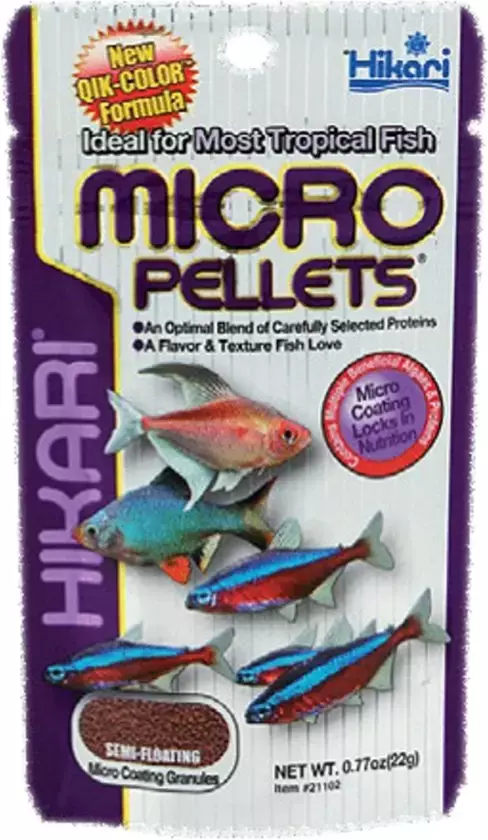
Hikari Micro pellets 22gr - Vissenvoer
Hikari describes Micro Pellets as a daily food for small tropical fish with small mouths. The micro pellet suits the gourami’s size; rotate it with small live or frozen prey.
Check retailer for price0 retailers
View retailersPrices from the latest retailer update, excluding shipping. Check stock and delivery with the retailer.
Sources & review
This care guide draws on several specialist sources and was last checked on .
View the sources
- Creative Commons — Creative Commons Attribution-ShareAlike 4.0 International
- Hikari Sales USA — Hikari Micro Pellets — manufacturer product information
- California Academy of Sciences — Eschmeyer’s Catalog of Fishes — Trichopsis pumila
- FishBase Consortium — Trichopsis pumila — FishBase summary
- Seriously Fish — Trichopsis pumila — specialist aquarium profile, revised 2026
- My-Fish — Knurrender Zwerggurami — My-Fish species profile
- Wikimedia Commons / Dezinformator15 — Sparkling gourami.jpg