Green fire tetra
Aphyocharax rathbuni

The green fire tetra (Aphyocharax rathbuni) is a small, active South American shoaler. Its iridescent green flanks and red side and tail colour show best as the fish move together. Keep at least six in an aquarium with a base around 60 × 30 cm (about 54 litres), with open swimming room beside planting. Although a quick profile tag calls it peaceful, the species-specific compatibility text warns about fin-nipping. Avoid long-finned and slow tankmates and observe the combination carefully.A secure lid, stable water and a full shoal matter more than extra decoration. Do not treat the stated volume as spare capacity for additional species.
Plan your aquarium →At a glance
- Temperature
- 20–26 °C
- pH
- 6.5–7.5
- GH
- 2–20 °dGH
- Aquarium length
- At least 60 cm
- Minimum aquarium volume
- At least 54 L
- Adult size
- Approximately 4.5–7.1 cm
- Group size
- At least 6 individuals
- Temperament
- May nip fins
About this species
Eigenmann described the species in 1907. It belongs to Aphyocharacinae within Characidae. An older name found in references is Aphyocharax stramineus; it is a synonym, not a separate aquarium species. It can also be confused with the bloodfin tetra A. anisitsi, which is distinct.
Adult size differs markedly between sources: Seriously Fish gives 45 mm standard length, while FishBase reports a maximum of 7.1 cm SL. The discrepancy is unresolved, so do not plan space or tankmates as if 4.5 cm were a dependable upper limit.
Natural habitat
Seriously Fish records the species in the Paraguay, Paraná and Uruguay drainages across Brazil, Paraguay, Argentina and Uruguay. It inhabits streams, rivers and tributaries, especially where floating or overhanging vegetation creates shade.
In an aquarium, provide planting and cover along parts of the margins with an open swimming lane. The source describes moderate flow. There is no need to imitate one exact locality, and basin-level distribution does not prove that every watercourse has identical conditions.
Aquarium and layout
A base of 60 × 30 cm and approximately 54 litres is explicitly described by the specialist profile as suitable for a small group. Keep at least six fish. Use sand, roots or bogwood and stones, with plants mainly around the margins; moderate flow is appreciated. Fit a secure lid and keep the shoal at a proper size.
The 54 litres is not a universal stocking formula and does not automatically leave room for other species. Assess additional tankmates by adult size, fin shape, activity, swimming zone and food competition. Keep filtration and water changes stable for the final stocking level.
Water conditions
Published care values are 20–26 °C, pH 6.5–7.5 and GH 2–20 °dGH; FishBase broadly supports the same range. No separate KH value has been established here. A range is not an instruction to target its extremes: stability within a suitable band matters more than frequent corrections.
Check temperature and water quality if behaviour changes, and avoid altering several parameters at once. Acclimate new fish gradually. A fish appearing calm on its first day also does not prove that tankmates will remain safe over time.
Behaviour and group size
The specialist profile says the green fire tetra can suit a community aquarium but also clearly warns of fin-nipping. Select robust, fast-moving tankmates and avoid long-finned species, including many labyrinth fish and cichlids. This behaviour risk remains even when temperature and pH overlap.
After introduction, look for frayed fins, chasing, withdrawal and unequal access to food. Observation helps but is not a controlled guarantee. Separate fish if nipping persists. The minimum group of six applies to the green fire tetras themselves and says nothing about safe group sizes for other species.
Feeding
Green fire tetras accept aquarium foods and are omnivorous. Offer a varied menu of complete dry food supplemented regularly with small live or frozen foods, as the specialist profile recommends. The linked complete tropical flakes can be a staple if the fish actually eat them.
No exact pellet size has been verified. Offer small, accessible portions, check that less dominant fish feed too, and remove leftovers. Flakes do not replace the recommended live or frozen variety. Do not increase the ration simply because the shoal rushes toward food.
Breeding
The species is a group spawner and egg scatterer. Eggs are adhesive; adults may eat them and provide no parental care. Fine-leaved spawning cover or a mop and removal of adults protect the eggs. The source describes soft water and low light for a breeding setup, but these are not daily requirements for a normal maintenance aquarium.
Seriously Fish reports spawning often begins within 24 hours, eggs hatch in about 2–3 days and fry become free-swimming roughly 4–5 days later. These are source-specific estimates, not guarantees. Start free-swimming fry on infusoria and increase food size gradually.
Suitable products
Recommended staple foods
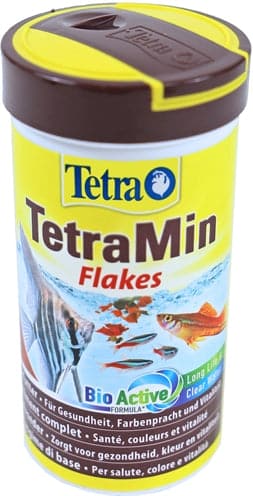
Tetramin Bio Active Vlokken Fish food 100 ml
Complete tropical flakes for omnivores. A suitable staple when green fire tetras readily eat them; continue to offer small live or frozen foods regularly.
Check retailer for price0 retailers
View retailersPrices from the latest retailer update, excluding shipping. Check stock and delivery with the retailer.
Sources & review
This care guide draws on several specialist sources and was last checked on .