Forktail blue-eye
Pseudomugil furcatus

The forktail blue-eye (Pseudomugil furcatus) is a small, striking blue-eye endemic to eastern Papua New Guinea. Mature males show elongated yellow-edged fins and a deeply forked tail. The species is peaceful, yet it needs a mature aquarium, stable water and a group of at least eight. Its small mouth makes appropriately fine food important. Provide dense planting around open swimming space, well-oxygenated water and gentle to moderate flow. Natural co-occurrence with other fishes does not by itself prove that every aquarium pairing is safe. It can suit a carefully planned community aquarium, but is not a fish for an unprepared start. Plan the adult group and appropriate food first, then check whether behaviour and actual water conditions fit the proposed tankmates.
Plan your aquarium →At a glance
- Temperature
- 24–28 °C
- pH
- 7.0–8.0
- GH
- 15–30 °dGH
- Aquarium length
- At least 60 cm
- Minimum aquarium volume
- At least 54 L
- Adult size
- Approximately 6 cm
- Group size
- At least 8 individuals
- Temperament
- Peaceful
About this species
The forktail blue-eye belongs to the family Pseudomugilidae. Its accepted scientific name is Pseudomugil furcatus Nichols, 1955. Older literature and the trade have also used Popondetta furcata and Popondichthys furcatus; these names refer to the same species, not additional fishes. The epithet furcatus refers to the forked tail.
The body is yellow-green to silvery. Adult males are usually more colourful and develop longer dorsal, anal and pelvic fins. The yellowish tail lobes have dark edges, and the blue eye is especially conspicuous under good light. Females have shorter, less showy fins. ANGFA gives a length of about 5–6 cm. Seriously Fish reports up to 60 mm standard length, measured to the caudal peduncle and excluding the tail fin, so total length looks greater. Do not confuse this species with the related Pseudomugil connieae; their colour and fin markings differ.
Natural habitat
The species is endemic to a small area of eastern Papua New Guinea, including the Musa and Kwagira river basins between Dyke Ackland and Collingwood Bays. It inhabits clear forest streams with abundant marginal and aquatic vegetation. Descriptions range from slow to relatively swift flow, reflecting local habitat and season; there is no single aquarium flow rate that represents all sites.
A 1981 field record gives 24–28.5 °C, pH 7–8 and hardness of 90–180 ppm. These are measurements from natural localities, not proof that every aquarium fish needs exactly those values. Seriously Fish gives an aquarium care range of 24–28 °C, pH 7–8 and GH 15–30 dGH. Treat the aquarium guidance as a starting range and avoid abrupt changes. The habitat is best translated into clear, oxygenated water, vegetation, some flow and a mature biological system.
Aquarium and layout
Seriously Fish lists a 60 × 30 cm base and about 54 litres as the smallest size to consider. Treat this as a lower bound for a suitable group, not a guarantee for every setup; tankmates need additional space. A longer aquarium gives the school room to swim and helps shy fish display natural behaviour. Keep at least eight, preferably eight to ten or more when the aquarium can support the group.
Use a mature filter with good gas exchange and an outlet that does not create relentless high flow. The species occurs across different currents, but aquarium fish must be able to rest and feed without fighting a strong stream. Plant the sides and back, optionally use floating plants to soften light, and leave some open midwater. Fine-leaved plants or moss offer cover and a possible spawning surface. A lid is a sensible general precaution for small active fish. Add the group only after biological filtration is stable and ammonia and nitrite are undetectable.
Water conditions
Seriously Fish gives 24–28 °C, pH 7.0–8.0 and GH 15–30 dGH for aquarium care. ANGFA reports 24–28.5 °C, pH 7–8 and hardness 90–180 ppm from natural habitat. Hardness in ppm is not a direct aquarium GH measurement, so do not treat the field data as an exactly convertible target. Based on the available aquarium guidance, this guide uses 24–28 °C, pH 7–8 and GH 15–30 dGH as a care band.
Stability matters as much as choosing a number. The species is described as vulnerable to fluctuations in an immature aquarium. Measure with suitable tests, maintain the tank regularly and correct deviations gradually. Avoid quick chemical pH adjustments to force a target reading. The sources reviewed do not establish a species-specific KH target, so none is supplied. Suitable filtration, gas exchange and regular appropriate water changes help maintain conditions.
Behaviour and group size
This is a peaceful shoaling fish. A group of at least eight to ten helps prevent an individual from remaining constantly alert or withdrawn. Males display their colour and fins during courtship and may hold brief displays against one another. Allow room and visual breaks while retaining open swimming areas. There is no reason to present one male-to-female ratio as a universal requirement; focus on an adequate group and whether any fish is persistently chased.
Seriously Fish lists similar small rainbowfishes and some gobies as possible companions when size and needs match. However, overlap in temperature or pH alone does not prove compatibility. The hardness ranges in the available care guidance for Gertrude’s spotted blue-eye (Pseudomugil gertrudae), for example, do not convincingly align, so this guide does not recommend the pairing without specialist review of provenance and actual water. A wild collection alongside Tateurndina ocellicauda is not an aquarium trial either. Avoid large predators, fast food competitors and fin nippers. In a mixed aquarium, check daily that every fish eats.
Feeding
In nature this fish feeds chiefly on tiny floating or suspended organisms such as zooplankton, phytoplankton and small invertebrates. Its mouth is small and it often feeds near the surface. Offer small portions in an appropriate particle size. Suitable live options may include Daphnia, Moina, newly hatched brine shrimp and microworms, provided the food is small enough for the fish. Finely crushed floating dry food may also be accepted.
Several small meals are preferable to one large feed. Watch whether less dominant fish also take food; seeing food in the aquarium does not mean every fish has eaten enough. Sera Micron Powder is an existing product with very fine suspended particles. Its manufacturer describes it primarily for fish fry and larvae, so it is linked only as a cautious supplementary trial, not as a proven complete staple for adult P. furcatus. Use a small amount, confirm ingestion and remove leftovers before they affect water quality. A varied diet remains necessary.
Breeding
Pseudomugil furcatus is an egg scatterer with no parental care. During courtship, the male displays his extended fins. Females may attach small numbers of adhesive eggs to fine plants, moss or another suitable medium. Adults may eat eggs and larvae. Dense vegetation gives the eggs a surface and provides cover, but does not guarantee fry in a community aquarium.
For a dedicated attempt, use a separate mature tank with a sponge filter and fine spawning medium. Move only eggs that have actually been located and keep the rearing tank clean; tiny larvae are vulnerable to accumulated food and waste. The species profile describes incubation at around 21 days depending on temperature, not a fixed schedule for every clutch. First foods must be very small, such as microworms or suitable nauplii once fry can take them. Seriously Fish also reports that aquarium stock may descend from a small historical collection and mentions fertility and deformity concerns. This is a reported risk, not a claim about every captive group; ask about provenance where possible and select healthy broodstock.
Keeping with other species

Spotted blue-eye
Not recommendedNot recommended as a default pairing with Gertrude’s spotted blue-eye (Pseudomugil gertrudae). The available aquarium care guidance does not convincingly overlap in hardness: Seriously Fish lists 15–30 dGH for P. furcatus, while the existing guide for P. gertrudae describes much softer water. Shared genus, size or habitat is not proof that cohabitation is appropriate. Only consider a shared aquarium after checking provenance and measured conditions; otherwise keep separate, species-appropriate groups.
View species profile →Suitable products
Supplementary foods
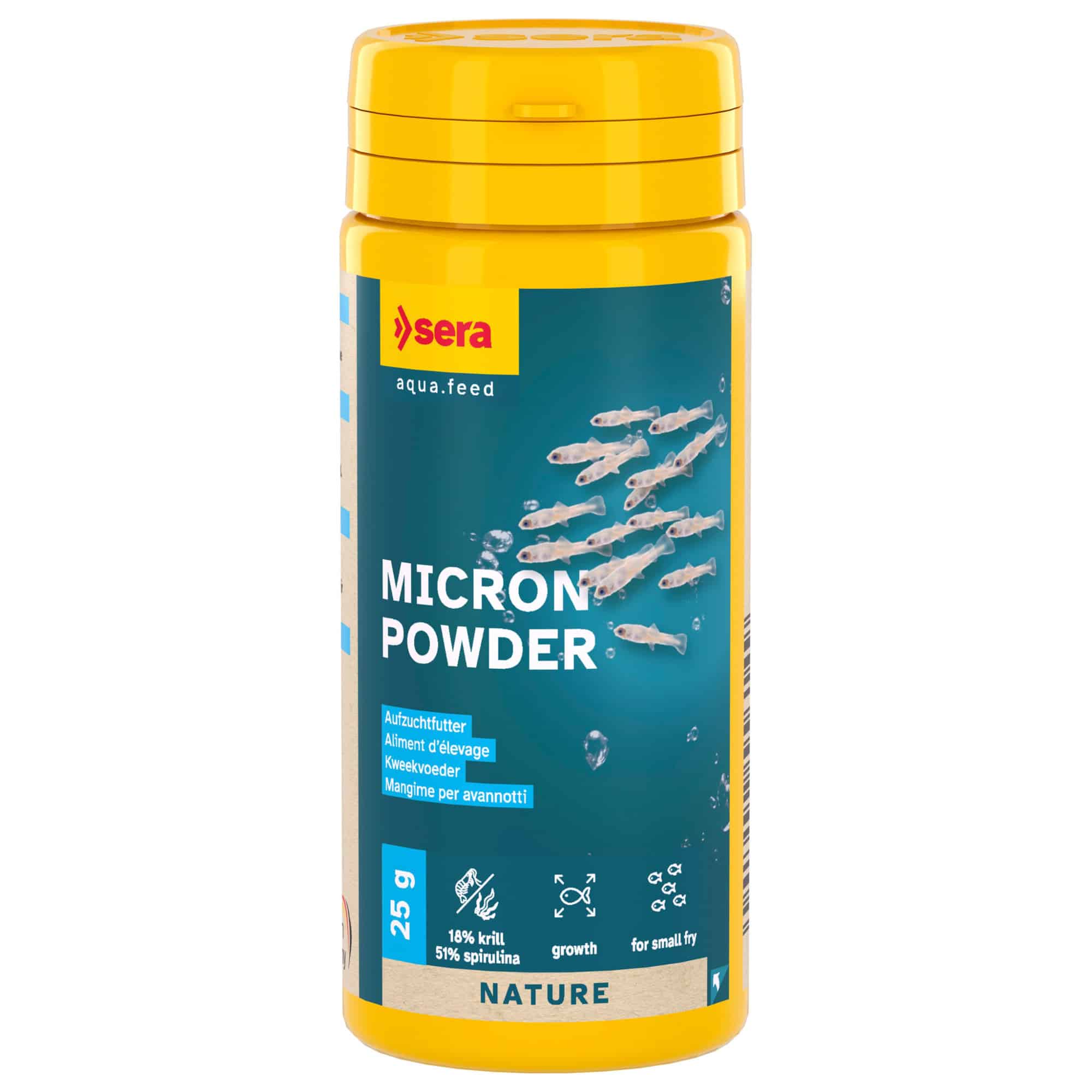
Sera Micron Nature - 50 ml
Very fine floating powder that can be trialled for its small particle size. The manufacturer positions it mainly for fish fry and larvae; use only as a cautious supplement, feed sparingly and confirm ingestion. Not proven as a staple for adults.
Check retailer for price0 retailers
View retailersPrices from the latest retailer update, excluding shipping. Check stock and delivery with the retailer.
Sources & review
This care guide draws on several specialist sources and was last checked on .
View the sources
- sera — sera Micron Powder — manufacturer product information
- Seriously Fish — Pseudomugil furcatus — specialist aquarium profile
- ANGFA — Pseudomugil furcatus — Home of the Rainbowfish
- FishBase — Pseudomugil furcatus — FishBase
- California Academy of Sciences — Pseudomugil furcatus — Catalog of Fishes
- GBIF — Pseudomugil furcatus Nichols, 1955 — GBIF Backbone Taxonomy
- Wikimedia Commons / Dirk Godlinski — Pseudomugil furcatus m Aquarium DG.jpg
- Creative Commons — Creative Commons Attribution-ShareAlike 3.0 Unported