Florida flagfish
Jordanella floridae
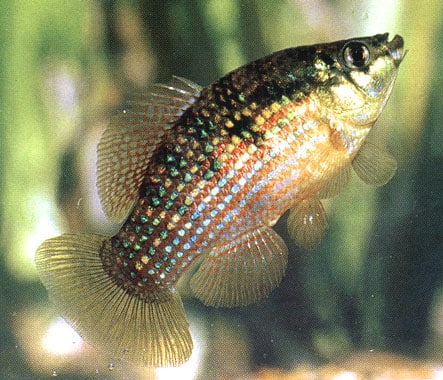
The Florida flagfish (Jordanella floridae) is a compact pupfish from the Florida peninsula. Males often show a striking blue-green body with red markings, while females are usually less vivid and have a dark mark toward the rear of the dorsal fin. The species grazes on small aquatic animals as well as algae and other plant material, so a varied diet matters; an exclusively animal-based diet is not appropriate. Males may establish temporary territories, especially around spawning. Cover and broken sight lines help, but do not automatically make this fish suitable for every community aquarium. It needs a well-planted layout with room to observe social behaviour. Sources disagree about parental care, so do not rely on a male to protect eggs or fry consistently.
Plan your aquarium →At a glance
- Temperature
- 18–30 °C
- pH
- 6.5–8.5
- GH
- 2–20 °dGH
- Aquarium length
- At least 60 cm
- Minimum aquarium volume
- At least 54 L
- Adult size
- Up to 5.5 cm
- Group size
- At least 2 individuals
- Temperament
- Territorial
About this species
The accepted name is Jordanella floridae Goode & Bean, 1879. GBIF places it in Cyprinodontidae within Cyprinodontiformes; Cyprinodon floridae is a former combination. Seriously Fish reports a maximum of about 55 mm standard length, measured without the tail fin. Males are usually more colourful and have longer dorsal and anal fins. Females may become rounder when carrying eggs and show a dark spot on the rear part of the dorsal fin. Colour varies with condition and captive line and should not be used alone for identification. This is not an annual killifish: females can deposit eggs repeatedly on algae and other surfaces.Natural habitat
The Florida flagfish is endemic to peninsular Florida in the United States. Seriously Fish describes shallow, vegetated freshwater habitats such as marshes, canals, ditches and quiet backwaters. It has occasionally been recorded in lightly brackish water, but that does not justify adding salt to a freshwater aquarium. Vegetated margins provide food and refuge, usually in still or gently moving water. In captivity, translate this into a mature planted aquarium with open swimming areas, cover and some filamentous algae if practical. There is no need to recreate a precise biotope. Treat older claims of a range beyond Florida cautiously; the current specialist profile describes the peninsula as the native range.Aquarium and layout
Seriously Fish gives a 60 × 30 cm footprint, about 54 litres, as just acceptable for a single pair. This is not a comfortable group recommendation: a larger aquarium is needed for several fish to establish space. Use aquatic plants, wood and, if breeding, suitable spawning mops, while leaving swimming room. Break long sight lines. Allow some filamentous algae to grow where possible. A sponge filter can be useful, particularly for breeding, because strong intakes may harm eggs or fry. Fit a secure lid and maintain mature biological filtration. Do not add salt routinely. Watch behaviour and feeding daily, especially with multiple males.Water conditions
The specialist aquarium profile lists 18–30°C, pH 6.5–8.5 and GH 2–20 °dGH. These are broad tolerance ranges, not targets to fluctuate between. Choose stable conditions appropriate to the fish’s history and acclimate gradually. Test source water and keep ammonia and nitrite at zero; avoid abrupt temperature or pH changes. The species is sometimes found in lightly brackish water, but no routine salt dose is established for normal care. Do not add marine salt without a separate, reliable reason. Stable quality and sensible water changes matter more than chasing one exact number.Behaviour and group size
The specialist profile describes this as a group fish, but tankmates still need careful selection. Males establish temporary territories and may chase each other or other fish, with stronger behaviour around spawning. Dense cover, interrupted sight lines and adequate floor space can reduce conflict, but cannot guarantee it will stop. A species-only aquarium is the safer choice when breeding is the goal. Small shrimp and vulnerable fry may be taken while foraging. No controlled list of proven tankmates is linked to this guide, so it does not label other species as safe. After stocking changes, check fins, hiding behaviour and access to food.Feeding
Jordanella floridae takes small crustaceans, worms, insect larvae and other zooplankton, as well as algae and plant material. Offer a varied omnivorous diet: a suitable complete dry food can form the staple if the fish accept it, supplemented with small live or frozen foods such as Artemia, Daphnia or mosquito larvae. Include meaningful plant or algal matter and allow natural algae where practical. Feed small portions and remove leftovers. The British Killifish Association stresses greens and algae, while Seriously Fish describes both animal and plant foods. A specific central-catalogue product has not yet been verified for this guide, so no arbitrary product recommendation is shown.Breeding
This species does not require a dry egg phase. Females deposit eggs singly or in small batches on algae and other surfaces; Seriously Fish describes repeated spawning when conditions suit. Males may defend temporary territories during courtship. Sources differ after spawning: Seriously Fish reports no extended parental care, whereas an older British Killifish Association account describes occasional male fanning or tending in particular setups. Assume eggs are unattended and protect them separately if needed. Seriously Fish gives a typical incubation of 7–14 days depending on temperature. Free-swimming fry can take Artemia nauplii or microworms. Prepare fine first foods and grow-out space, and avoid sharp substrate that could injure young fish.Suitable products
Supplementary foods
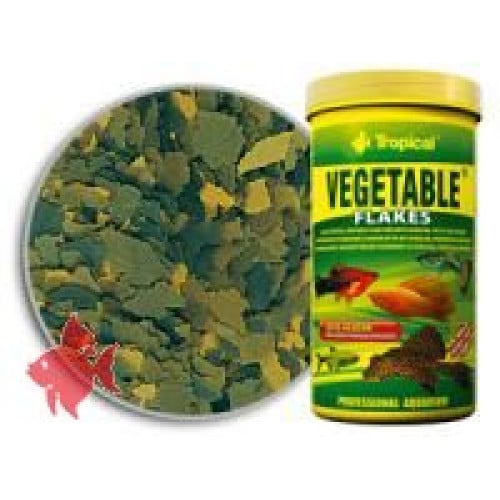
Tropical Vegetable 300ml
Supplementary vegetable-rich flakes suit its omnivorous diet; combine them with an appropriate complete staple and small animal foods.
Check retailer for price0 retailers
View retailersPrices from the latest retailer update, excluding shipping. Check stock and delivery with the retailer.
Sources & review
This care guide draws on several specialist sources and was last checked on .
View the sources
- GBIF — GBIF Backbone — Jordanella floridae
- Seriously Fish — Seriously Fish — Jordanella floridae
- FishBase — FishBase — Jordanella floridae
- British Killifish Association — British Killifish Association — Jordanella floridae
- Tropical — Tropical — Freshwater Aquarium Foods catalogue
- Aqua-rium.nl — Tropical Vegetable 300 ml — product identity and ingredients
- U.S. Geological Survey — USGS Nonindigenous Aquatic Species — Jordanella floridae
- USGS / Wikimedia Commons — Jordanella floridae — Wikimedia Commons