Electric Yellow Cichlid
Labidochromis caeruleus

The Electric Yellow Cichlid (Labidochromis caeruleus), also sold as the Yellow Lab, is a striking mbuna from Lake Malawi. Its popular yellow aquarium form does not remove the rocky, territorial needs of an African cichlid. It requires hard, alkaline and stable water, a generous footprint, rockwork with shelters, and a diet in which vegetable matter is prominent. A cited minimum of about 154 litres is only a starting boundary for a suitable setup, not an automatic allowance for a mixed Malawi community. Males can pursue females vigorously while spawning. Choose tank mates only when water chemistry, adult size, space and behaviour all fit. Avoid soft-water dwarf cichlids and mixed colour forms or other Labidochromis species because their requirements differ and hybridisation may occur.
Plan your aquarium →At a glance
- Temperature
- 24–28 °C
- pH
- 7.7–8.6
- GH
- 10–25 °dGH
- Aquarium length
- At least 90 cm
- Minimum aquarium volume
- At least 154 L
- Adult size
- Up to 10 cm
- Group size
- At least 4 individuals
- Temperament
- Peaceful, Territorial
About this species
The accepted name is Labidochromis caeruleus Fryer, 1956, in the family Cichlidae. It is endemic to Lake Malawi in East Africa, with records along the north-western shore. “Electric Yellow” refers to a bright yellow colour form in the trade; it is not a separate species or subspecies. The species also occurs in other natural colour forms, including blue and white. Seriously Fish reports that most fish offered in the trade are captive-bred. Ask about provenance when possible and avoid groups of uncertain mixed origin.
Seriously Fish gives 10 cm standard length, while FishBase lists a maximum of 8.1 cm standard length. Because the sources differ and standard length excludes the tail fin, we use a reported range of about 8–10 cm rather than a single exact maximum. The fish may look larger because of its deep body and fins. FishBase displays “Least Concern” based on a 2018 assessment; this is not a current guarantee for every local population.
Natural habitat
L. caeruleus occurs only in Lake Malawi. It has been recorded in rocky areas and dense Vallisneria beds. A mixture of stone, crevices and some vegetation is therefore more representative than a bare aquarium. The yellow form is reported from a more restricted part of the lake than some blue and white forms. This geographic detail helps describe provenance, but does not by itself predict the behaviour of an aquarium fish.
Lake water is mineral-rich and alkaline. For care, use the species-specific aquarium ranges from Seriously Fish; measurements at a wild locality are not separate aquarium targets. Prioritise stable chemistry, good gas exchange and clean water. The consulted species profile does not establish a controlled KH target, so none is presented as a fact.
Aquarium and layout
Seriously Fish gives a minimum footprint of 90 × 45 cm and a volume of about 154 litres. Treat this as a lower boundary for a carefully arranged aquarium, not a recommended capacity for a mixed Malawi community. Larger fish or several territorial species need more space. Build rock piles securely, with caves and crevices, and leave open swimming areas between structures. Place heavy rocks safely before adding sand so digging fish cannot undermine them.
A sandy substrate suits the habitat. Vallisneria may be tried in protected areas, but the layout and individual fish can affect whether plants remain intact; there is no guarantee. Use effective biological filtration and arrange the outlet for good oxygen exchange without making every shelter turbulent. Maintain regular water changes and test basic parameters. The stated minimum size is not automatically suitable for long-term cohabitation with other species.
Water conditions
The specialist aquarium profile gives 24–28 °C, pH 7.7–8.6 and GH 10–25 dGH. These are ranges, not values to fluctuate between each day. Choose a stable point within them that suits the measured source water and the rest of the Malawi aquarium. GH is general hardness; it is not KH or alkalinity. The consulted source does not provide a species-specific KH range, so one is not invented.
Do not add rapid pH adjusters to force a number. Measure source water first and make changes gradually, considering the whole community. Mature the aquarium biologically before introducing fish. Ammonia and nitrite should not be detectable. Good aeration, appropriate filter care and controlled portions help keep conditions stable.
Behaviour and group size
This species is described as relatively peaceful for an mbuna, but “more peaceful” does not mean non-territorial. During spawning, a male may defend a site and pursue females vigorously. Provide visual barriers, several routes between shelters and enough space. The source recommends one male with several females for targeted breeding; treat this as a breeding arrangement, not a universal stocking rule for every community tank. Watch the fish after introduction and intervene if pursuit is constant, injuries appear or fish cannot feed.
A Lake Malawi biotope with fish that tolerate similar hardness, alkalinity, adult size and behaviour is the safest starting point. Do not casually mix it with soft-water dwarf cichlids: published values for Apistogramma agassizii barely overlap and the species have different lifestyles, so this pairing is discouraged. Also avoid mixing colour forms or other Labidochromis species when maintaining breeding lines, as hybridisation may occur. Shared temperature alone does not prove compatibility.
Feeding
The care source recommends that vegetable matter, such as spirulina flakes or blanched greens, form a large part of the diet. Add variety with suitable small portions of animal-based foods; an exclusively protein-rich diet does not reflect the described needs. Check that all fish feed and that leftovers do not collect among the rocks.
Tropical Spirulina Flakes 100 ml is linked as an existing product because its manufacturer describes it as a daily flake food with 6% spirulina for herbivorous and omnivorous aquarium fish. It therefore fits as a plant-based component, but a single product is not a complete varied ration. Offer several small portions and monitor intake. The comparison shows current sellers and prices when available; those can change.
Breeding
This species is a maternal mouthbrooder. During courtship the male cleans and defends a spawning site; the female then picks up the eggs and incubates them in her mouth. Seriously Fish reports broods of roughly 5–30 eggs and a holding period of up to three or four weeks. These are published observations, not guaranteed counts or a fixed timetable for every aquarium. A swollen mouth may indicate a brooding female, which may eat less or stop feeding temporarily.
Do not move a female automatically: stress can cause premature release or loss of the brood. A separate breeding tank is useful only with a clear plan, mature filtration and suitable water. The source identifies newly hatched brine shrimp as suitable first food for free-swimming fry. Keep young away from fish that may eat them and feed small portions appropriate to their size. Sexing by black fin markings alone is unreliable and varies between individuals.
Keeping with other species

Agassiz's dwarf cichlid
Not recommendedNot recommended with the Agassiz’s dwarf cichlid (Apistogramma agassizii). Published pH ranges do not overlap and GH meets at most at the edge; size and lifestyle also differ. A shared temperature is not evidence of a suitable pairing. Keep this South American species separate from the Malawi cichlid.
View species profile →Suitable products
Supplementary foods
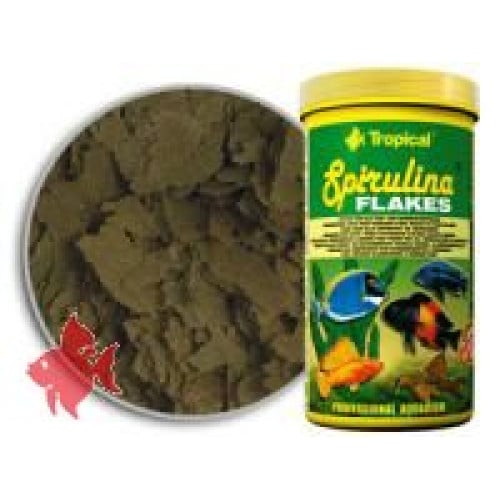
Tropical Spirulina Flakes 100ml
Tropical describes these spirulina flakes as a daily food with 6% spirulina for herbivorous and omnivorous aquarium fish. This fits as a plant-based component of the recommended Labidochromis caeruleus diet. Feed as part of a varied ration, not as the only food.
Check retailer for price0 retailers
View retailersPrices from the latest retailer update, excluding shipping. Check stock and delivery with the retailer.
Sources & review
This care guide draws on several specialist sources and was last checked on .
View the sources
- Tropical — Tropical Spirulina Flakes 100ml — manufacturer
- Creative Commons — Creative Commons Attribution-ShareAlike 3.0 Unported
- Seriously Fish — Labidochromis caeruleus — aquarium profile
- FishBase — Labidochromis caeruleus Fryer, 1956 — FishBase
- California Academy of Sciences — Eschmeyer’s Catalog of Fishes — Labidochromis caeruleus
- Integrated Taxonomic Information System — ITIS report — Labidochromis caeruleus, TSN 649132
- GBIF — Labidochromis caeruleus Fryer, 1956 — GBIF Backbone
- Wikimedia Commons / Julian Matz — Labidochromis caeruleus (male).jpg