Croaking gourami
Trichopsis vittata

The croaking gourami (Trichopsis vittata) is the largest member of its genus and inhabits shallow, plant-rich waters in Southeast Asia. This labyrinth fish takes air at the surface and can produce audible croaking sounds. A specialist profile recommends a 60 × 30 × 30 centimetre aquarium for a single pair; groups need more room. The species is generally peaceful, but territorial behaviour and social dynamics can change during breeding. This guide explains source-checked water values, aquarium setup, small live or frozen foods, breeding precautions and the uncertainty around some distribution records.
Plan your aquarium →At a glance
- Temperature
- 22–28 °C
- pH
- 6.0–7.5
- GH
- 5–15 °dGH
- Aquarium length
- At least 60 cm
- Minimum aquarium volume
- At least 54 L
- Adult size
- Up to 7 cm
- Group size
- At least 2 individuals
- Temperament
- Peaceful, Territorial
About this species
Trichopsis vittata (Cuvier, 1831) is known as the croaking gourami. It may reach about 7 cm standard length, measured without the tail fin. FishBase also reports 8 cm total length, a different measurement basis. The fish has several dark lateral stripes, and males develop extended fin rays. Like other labyrinth fish, it can breathe air at the surface and is known for audible sounds.
Natural habitat
The accepted range includes parts of Indochina, the lower Mekong, southern Thailand, the lower Salween, Peninsular Malaysia and Singapore. It inhabits lowland waters such as swamps, peatlands, ditches, rice fields and floodplains, generally with little current and dense vegetation.
Seriously Fish notes that records from Borneo, Sumatra and Java may represent another species. Origin labels for fish from those areas should therefore not be treated as certain. FishBase reports Least Concern (LC) based on a 2019 assessment; never release aquarium animals.
Aquarium and layout
Seriously Fish lists 60 × 30 × 30 cm, about 54 litres, as suitable for one pair. A group requires more room, so do not apply the pair minimum to a group. Provide dense, shady planting, floating cover, shelters and gentle flow. Keep access to the surface clear for air breathing.
Use a close-fitting lid because the species jumps. Leave a warm, humid air layer above the water. Use a mature filter and maintain water quality; a calm setup does not remove the need for maintenance.
Water conditions
Seriously Fish gives 22–28°C, pH 5.0–7.5 and GH 1–15 dGH. FishBase ecological records list 22–28°C, pH 6–8 and hardness 5–19. Wild ecology records and aquarium recommendations are not identical measures, so we show their cautious overlap: 22–28°C, pH 6–7.5 and GH 5–15 dGH.
Stable conditions matter more than chasing an exact number. Acclimate fish gradually. No supported species-specific KH target is available.
Behaviour and group size
Seriously Fish describes the species as peaceful outside breeding and suitable as a pair or group. My-Fish emphasises territorial behaviour and gives different group guidance. Because sources differ and behaviour can change between aquariums, use a cautious setup with visual barriers, enough floor space and a plan to separate fish if aggression increases.
Do not select tankmates based on water values alone. The gourami may prey on small invertebrates. This guide does not label unverified fish pairings as guaranteed suitable.
Feeding
The species eats small invertebrates. FishBase lists zooplankton, crustaceans and insect larvae; Seriously Fish reports aquatic and terrestrial prey. Offer small portions of live or frozen foods such as Daphnia, brine shrimp and chironomid larvae. Dried food can be introduced.
Hikari describes Micro Pellets as a food for small-mouthed tropical fish. It is a suitable dry-food option, but continue to offer a varied range of small foods and check that all fish are eating.
Breeding
Trichopsis vittata builds a bubble nest among floating plants, and the male guards it. Eggs usually hatch in about 48 hours; fry remain in the nest another 3–4 days before swimming freely. Watch both parents’ behaviour.
Free-swimming fry first need infusoria-sized food, then foods such as microworms or Artemia nauplii. Use a close-fitting cover to keep the air above the water warm and humid. Small, regular water changes are preferable to large, irregular changes.
Suitable products
Supplementary foods
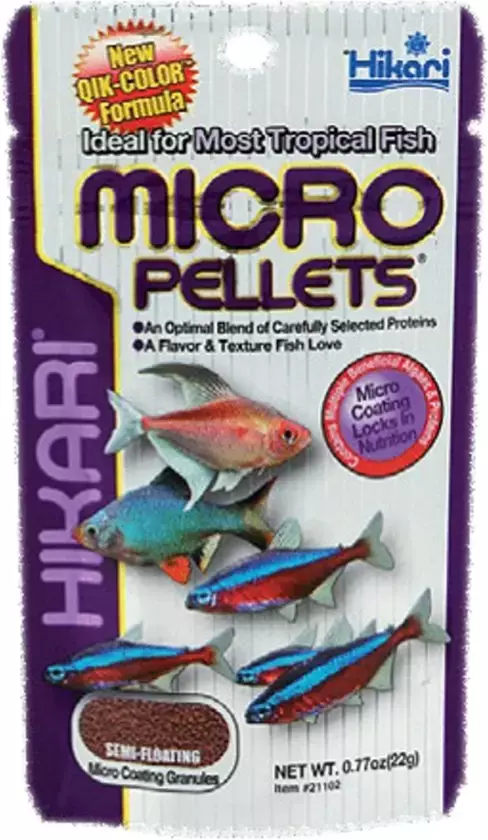
Hikari Micro pellets 22gr - Vissenvoer
Hikari describes Micro Pellets as dry food for small-mouthed tropical fish. This suits the croaking gourami; rotate with small live or frozen prey.
Check retailer for price0 retailers
View retailersPrices from the latest retailer update, excluding shipping. Check stock and delivery with the retailer.
Sources & review
This care guide draws on several specialist sources and was last checked on .
View the sources
- Creative Commons — Creative Commons Attribution 4.0 International
- Hikari Sales USA — Hikari Micro Pellets — manufacturer product information
- California Academy of Sciences — Eschmeyer’s Catalog of Fishes — Trichopsis vittata
- FishBase Consortium — Trichopsis vittata — FishBase summary
- Seriously Fish — Trichopsis vittata — specialist aquarium profile
- My-Fish — Knurrender Gurami — My-Fish species profile
- Wikimedia Commons / Aqmal-Naser et al. — Trichopsis vittata — Figure 27