Cambodian logsucker care
Ceratogarra cambodgiensis

Ceratogarra cambodgiensis, still widely called Garra cambodgiensis, is a medium-sized bottom fish from flowing Southeast Asian rivers. The trade name ‘false Siamese algae eater’ can mislead: this is not a Crossocheilus, and shipments labelled Siamese algae eater may contain more than one species. It needs a spacious aquarium with strong current, high oxygen, stable water and mature grazing surfaces. This guide uses the current species name, retains the older name for recognition and separates useful identification traits from uncertain trade labels.
Plan your aquarium →At a glance
- Temperature
- 20–27 °C
- pH
- 6.0–7.5
- GH
- 1–12 °dGH
- Aquarium length
- At least 120 cm
- Minimum aquarium volume
- At least 243 L
- Adult size
- Up to 15 cm
- Group size
- At least 3 individuals
- Temperament
- Peaceful
About this species
The current name in Eschmeyer’s Catalog of Fishes is Ceratogarra cambodgiensis (Tirant, 1884); aquarium books and shops often still use Garra cambodgiensis. It is a cyprinid with a modified lower lip that forms an adhesive disc. ‘False SAE’, ‘false flying fox’ and ‘stone-lapping minnow’ are trade names, not proof of identification. Confusion with striped Crossocheilus is common. Do not buy solely from a sales label; check the body stripe, mouth structure and, where available, provenance.
Natural habitat
The species occurs in parts of the Mekong, Chao Phraya and Mae Klong systems and northern Peninsular Malaysia. It is often found in clear, fast-flowing headwaters and tributaries. Sunlight and oxygen-rich water support biofilm on rocks and other submerged surfaces. During heavy rain, streams may become temporarily turbid while flow rises. An aquarium therefore needs more than clean water: high oxygen, movement and stable grazing areas also matter. Habitat observations help shape the setup, but they do not justify inventing precise local water readings.
Aquarium and layout
Seriously Fish gives a minimum footprint of 120 × 45 cm and about 243 litres. Treat this as a space baseline, not a guarantee that every tank with that volume is suitable. Use rounded stones, sand or fine gravel and a few larger rocks; wood can add grazing surfaces and cover. Keep open swimming routes and secure heavy stones. Mature biofilm is useful, so do not add the fish to a newly started aquarium. The specialist source recommends strong current, preferably filter turnover above ten times the tank volume per hour, with good aeration. Fit a secure lid: the fish jumps and can climb glass.
Water conditions
The published aquarium range is 20–27 °C, pH 6.0–7.5 and GH 1–12 dGH. The selected species source gives no reliable KH range, so none is shown. Maintain oxygen-rich water and good current while leaving quieter resting areas. Conditions should remain stable; high flow does not replace mature biological filtration or water changes. Monitor temperature and water quality, especially after setup work. The fish is often sold as an algae eater, but the trade name should not lead to an algae-only diet.
Behaviour and group size
Ceratogarra cambodgiensis is relatively peaceful with suitable companions, while conspecifics establish a hierarchy. The species occurs in loose aggregations; Seriously Fish recommends three or four or more when the aquarium has enough space. Tolerance falls in small tanks, where charging, fin displays and paling can occur. Assess each pairing by adult size, bottom use, current needs, food competition and room as well as water values. The ‘Siamese algae eater’ label may be used for different fish, making advice based on that label alone unsafe. This guide does not mark any individual species pairing as proven suitable.
Feeding
This grazer takes algae and biofilm when available but is not a strict herbivore. The specialist profile recommends a varied menu including animal foods such as chironomid larvae, Tubifex, Artemia or finely chopped prawn, plus sinking dry food, some with a substantial vegetable component. The linked Hikari Mini Algae Wafers are supplementary grazing food, not a complete diet. Offer small portions in several places so subordinate fish can feed too. Remove leftovers promptly and maintain natural grazing surfaces. A fish grazing aquarium glass is not necessarily receiving enough food.
Breeding
A 2004 study abstract describes hormone-induced spawning. As summarised by the specialist profile, eggs hatched after about 15–16 hours at 25–29 °C in that trial; rotifers and Moina were listed as early fry foods. This is a reported research setup, not a proven home-breeding standard or a method confirmed for every commercial fish. The source is unsure whether the approach is used in the ornamental trade. Breeding needs a separate stable setup and suitably fine starter food. Do not raise temperature beyond the normal care range simply to copy the trial.
Suitable products
Supplementary foods
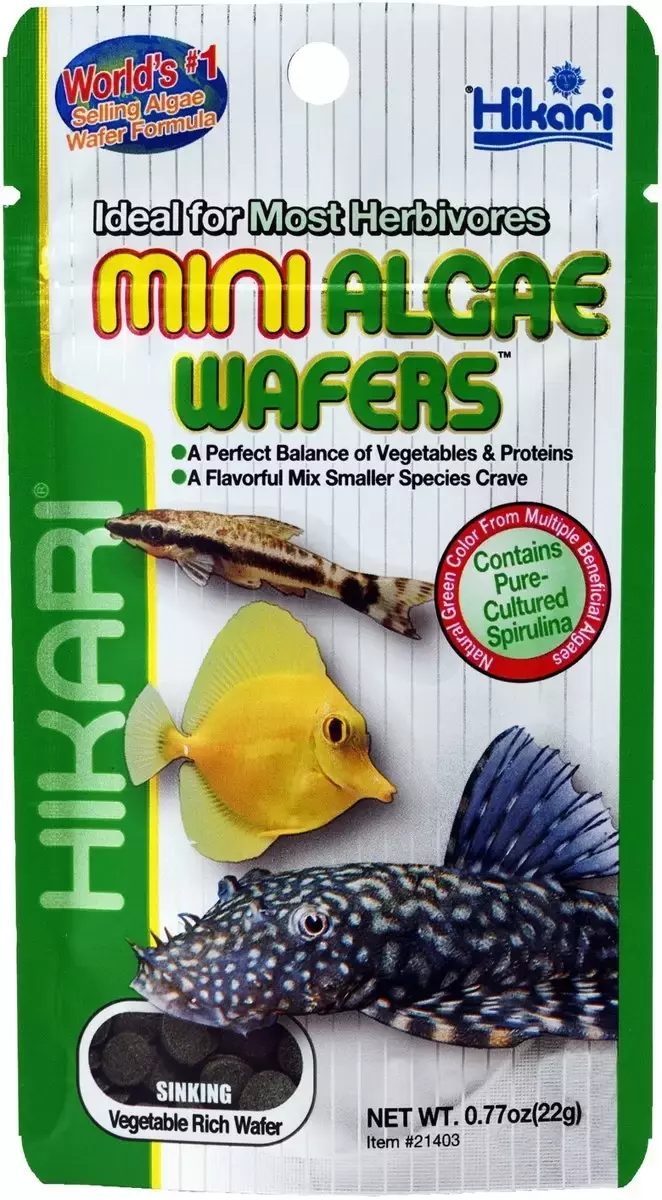
Hikari Mini algae wafers 22gr - Vissenvoer
Supplementary sinking algae wafer for the vegetable/grazing part of an omnivorous diet; combine with animal foods.
Check retailer for price0 retailers
View retailersPrices from the latest retailer update, excluding shipping. Check stock and delivery with the retailer.
Sources & review
This care guide draws on several specialist sources and was last checked on .
View the sources
- Hikari Sales USA — Hikari Mini Algae Wafers — manufacturer specifications and feeding guidance
- Seriously Fish — Garra cambodgiensis (False SAE) — aquarium and species profile
- California Academy of Sciences — Eschmeyer’s Catalog of Fishes — Ceratogarra cambodgiensis (current combination)
- Raffles Bulletin of Zoology / National University of Singapore — Kottelat (2020) — redefinition and description of Ceratogarra
- Integrated Taxonomic Information System — ITIS — Garra cambodgiensis legacy taxon record
- Wikimedia Commons — File:Flying fox.jpg — corrected species identification and reuse license
- Deutscher Tropentag 2004 / University of Kassel — Pornsopin et al. (2004) — induced spawning and early development of stonelapping minnow