Bala shark
Balantiocheilos melanopterus

The Bala shark (Balantiocheilos melanopterus), also called the silver shark, is a large, fast-swimming cyprinid from Southeast Asia. Its trade name is misleading: it is not a true shark. It can reach about 35 cm standard length and swims in open midwater. Plan for a base footprint around 240 × 60 cm and a group of at least five adults. The specialist aquarium reference gives about 864 litres for that footprint, making this a specialist display fish rather than a normal community-tank purchase. It is active, easily startled, jumps powerfully and may eat small fish. Wild populations are also classed as Vulnerable in the dated IUCN assessment. Buy only if you can house the adult group for the long term, and ask about captive-bred origin. A small shop juvenile does not indicate its eventual space requirement.
Plan your aquarium →At a glance
- Temperature
- 22–28 °C
- pH
- 6.0–8.0
- GH
- 5–12 °dGH
- Aquarium length
- At least 240 cm
- Minimum aquarium volume
- At least 864 L
- Adult size
- Up to 35 cm
- Group size
- At least 5 individuals
- Swimming zone
- Middle
- Temperament
- Predator, May jump
About this species
The Bala shark is a streamlined, silver cyprinid with a deeply forked tail and dark margins on several fins. Its shape suits sustained swimming in open water. “Shark” describes its outline only; it is not closely related to sharks. Eschmeyer’s Catalog of Fishes accepts Balantiocheilos melanopterus (Bleeker, 1850) in Cyprinidae. Do not confuse it with the smaller B. ambusticauda, described from Indochina; older literature sometimes included those populations under B. melanopterus. It can reach about 35 cm standard length, measured without the caudal fin. Adult body size and swimming power make juvenile shop size misleading. Young fish are difficult to sex; mature females are fuller-bodied according to the specialist source.Natural habitat
The accepted species is recorded from Borneo and Sumatra and possibly the Malay Peninsula. Older range accounts may include Indochina, but taxonomic work separated B. ambusticauda there. The Bala shark lives in open or midwater areas of medium and large rivers and lakes. This points to open swimming space, oxygen-rich water and flow, not a densely planted small aquarium. Wild populations have declined or disappeared in several areas. The IUCN assessment made in 2019 and published in 2020 lists it as Vulnerable (VU), citing restricted occupancy and declines linked to habitat degradation and fishing. That is a dated assessment, not a 2026 population survey. Specialist sources report that many trade fish are commercially bred, but origin varies by seller; ask rather than assuming wild-caught or captive-bred provenance.Aquarium and layout
Plan for an adult group in a tank with a base footprint around 240 × 60 cm. The specialist reference gives about 864 litres at a 60 cm water depth. Length and width are core requirements: a taller tank of the same volume does not provide the same swimming route. This species exceeds most home aquaria and needs a very large, mature system with substantial filtration, high oxygen availability and stable water quality. Keep a long central swimming lane open. Secure rocks or wood around the edges and avoid loose décor that could topple if the fish bolts. A heavy, tight-fitting lid is essential because Bala sharks can leap forcefully. Before purchase, decide where five adult fish could stay if the current aquarium becomes unsuitable.Water conditions
The sources support an overlapping temperature range of 22–28 °C: Seriously Fish gives 20–28 °C and FishBase 22–28 °C. Both give pH around 6–8. For hardness, this guide uses the cautious overlap of 5–12 dH; one source gives 2–15 dGH. Broad tolerance does not make rapid changes safe. Keep temperature and chemistry stable, prevent organic waste accumulation and provide strong aeration. The species occurs in flowing and still fresh water, so extreme values are unnecessary. Test reliably and base water changes on water quality. Do not adjust pH abruptly with chemicals. Arrange flow and filtration to provide oxygen-rich current while retaining calmer areas.Behaviour and group size
The Bala shark is social and forms a loose shoal. Keep at least five; groups of two or three can expose subordinate fish to persistent bullying. A solitary fish may instead become aggressive toward similar-looking species. This advice applies only when the adult group has enough room; do not use a standard community aquarium as temporary housing for five juveniles. Small fish may be eaten. Constant activity and vigorous feeding can also overwhelm slow or timid tankmates. In exceptionally large systems, assess any tankmate individually for adult size, swimming zone and behaviour. No specific positive pairing is marked safe here. Matching water values alone do not prove compatibility.Feeding
This is an omnivore. Natural food records include small crustaceans, insects and larvae, algae and other plant matter. Offer varied quality dry foods, small frozen or live foods and plant-based additions. Match food size to the mouth; larger fish can take larger pieces. Hikari Algae Wafers are linked only as supplementary plant food, not as a complete staple. Feed small portions and check that subordinate fish also get food. Remove leftovers to limit the waste load in a large aquarium. Do not rely on algae alone or overfeed to make a shoal grow.Breeding
Successful breeding in an ordinary home aquarium is not well documented in the specialist source reviewed. Hormone-assisted commercial production is reported, but that is not a practical hobbyist method. Avoid claims of easy breeding or predictable home-bred supply. Adults are difficult to house and young fish are hard to sex. Even if spawning occurs, the adult group still needs substantial space. Discuss provenance with the seller and do not buy fish for an aquarium they will soon outgrow.Suitable products
Supplementary foods
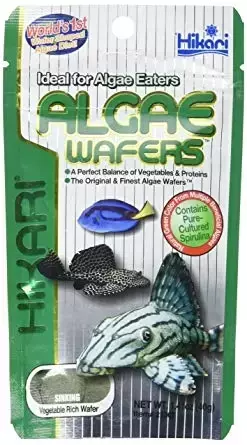
Hikari Algae wafers 40gr - Vissenvoer
Supplementary plant-based food for an omnivorous diet; combine it with animal and other suitable foods. Not a complete staple.
Check retailer for price0 retailers
View retailersPrices from the latest retailer update, excluding shipping. Check stock and delivery with the retailer.
Sources & review
This care guide draws on several specialist sources and was last checked on .
View the sources
- Hikari — Hikari Tropical Algae Wafers — manufacturer feeding information
- California Academy of Sciences — Eschmeyer’s Catalog of Fishes — Balantiocheilos melanopterus
- Seriously Fish — Balantiocheilos melanopterus — species and aquarium profile
- FishBase — Balantiocheilos melanopterus — FishBase species summary
- IUCN — IUCN Red List assessment — Balantiocheilos melanopterus (2020; assessed 2019)
- Lerdsuwa / Wikimedia Commons — Balantiocheilos melanopterus.JPG — Wikimedia Commons