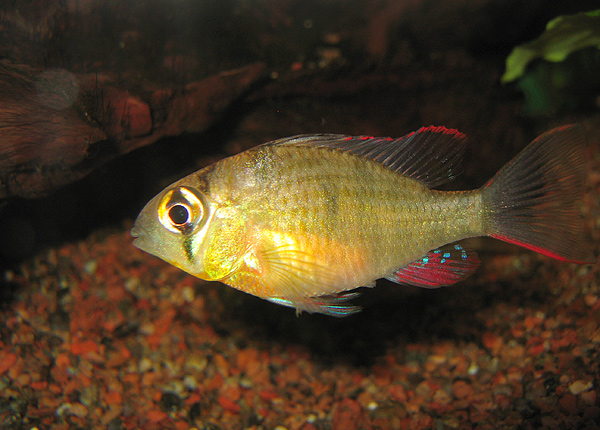
Bolivian ram
Mikrogeophagus altispinosus
Calm bottom-oriented foraging; do not confuse with the warmer-water ram cichlid. A small cichlid that establishes a territory. Sand, shelters and broken sight lines help limit conflict.
At a glance
- Scientific name
- Mikrogeophagus altispinosus
- Dutch name
- Boliviaanse ramirezi
- Water temperature
- 24–28 °C
- pH
- 6–7.5
- Adult length, up to approximately
- 8 cm SL
- Experience
- Some experience
- General hardness (GH)
- 1–10 °dGH
- Starting footprint
- 90 × 45 cm
- Swimming or living zone
- Bottom
- Flow
- Gentle, with adequate oxygen
This is a documented adult size, not a measured average. SL means body length excluding the tail fin. Sex, origin and cultivated form can affect size.
Care guidance; origin and captive breeding can change requirements. Some ranges are deliberately narrower than natural extremes in the source. Adjust water gradually and keep ammonia and nitrite at zero.
Tank sizes are editorial starting points for adults, not guarantees for a complete stocking plan. Group size, tank height, swimming length and territories may require a larger aquarium.
Origin
South America — Madeira / Mamoré / Guaporé
Habitat & setup
Tropical rivers and tributary waters; provide cover and open swimming space.
Diet
Small animal prey and suitable protein-rich complete food. Vary frozen food and safely cultured live food.
Behaviour & grouping
Plan separate territories; an arbitrary pair may still fight.
Living with other animals
Calm fish outside the bottom territory with matching water needs. Even usual companions may be chased during brood care.
Possible combinations to investigate further
- Lemon tetra
24–28 °C · pH 6–7.5
Reproduction
Eggs on a substrate; parents may become highly territorial while guarding.
A suitable cover helps prevent escape and jumping. Protect intakes for small animals. Do not use copper-based fish medication with invertebrates.
Sources & image credits
Data compiled on: 2026-09-27. Species sources support identity and care; group sources give general starting points. Practical recommendations are an editorial synthesis.
Photo: Mikrogeophagus_altispinosus_PiaH.jpg — Pia Helminen. CC BY 2.5.